Health note: Humor can support well-being, but it is not a replacement for medical treatment, psychotherapy or urgent care. Persistent pain, depression, anxiety, sleep disruption or other symptoms deserve professional assessment.
😂 Benefits of Humor for Physical and Mental Health
❔ Why the benefits of humor deserve a closer look
Humor is easy to underestimate. A shared joke can last only a few seconds, yet it may change the emotional temperature of an entire room. A comic perspective can make a difficult conversation more approachable, help a person tolerate uncertainty, or create a moment of connection during an exhausting day. Even a private smile can interrupt an automatic cycle of tension.
But the popular phrase “laughter is the best medicine” needs refinement. Laughter is not a universal cure, and the research on humor and health is more nuanced than many viral claims suggest. Some studies examine spontaneous laughter, others study humor-based interventions, and others measure a person’s habitual style of coping with stress. These are related, but they are not identical.
The most defensible conclusion is that humor can be a valuable adjunctive health behaviour. It may support stress regulation, positive emotion, pain tolerance, social connection and cognitive flexibility. Its effects depend on timing, context, personality, culture and the type of humor involved.
This article explores eight potential benefits of humor for physical and mental health, explains the mechanisms researchers are investigating and offers practical ways to bring more intelligent, kind and restorative humor into daily life. 🙂
😄 Humor, laughter and health: an important distinction
Humor is the ability to perceive, create or appreciate amusement, incongruity or playfulness. Laughter is one possible physiological and social response to humor, but people can experience humor without laughing loudly. A person may smile internally at a clever observation, feel amused by a memory, or enjoy irony without any dramatic physical response.
This distinction matters because much of the evidence measures laughter rather than humor itself. A laughter-based intervention may include comedy, playful interaction, breathing, movement, or group connection. When participants report feeling better, it may be impossible to attribute the result to one ingredient alone.
The strongest practical approach is therefore not to chase a target number of laughs. It is to create regular opportunities for safe amusement, play, perspective and connection while keeping realistic expectations.

Muse Headband: A Game-Changer for Meditation
1. Humor may help regulate stress
Stress is not simply a feeling. It is a coordinated response involving the autonomic nervous system, hormones, attention, muscle tension, breathing and behaviour. When a stressful event is interpreted as threatening, the body prepares for action. This response is useful in short bursts but costly when it remains activated without recovery.
Laughter can briefly alter breathing, muscle activity, heart rate and arousal. After an intense laugh, many people experience a sense of release. Humorous reframing can also create psychological distance: the problem remains real, but it is no longer the only possible way to see the situation.
This is one reason humor can complement established stress-management practices. It does not remove the stressor; it may help the nervous system move from constant vigilance toward recovery.
A review in the Journal of Lifestyle Medicine described laughter as a potentially useful lifestyle intervention while also emphasising that the evidence base has limitations. The U.S. Department of Veterans Affairs similarly presents humor and laughter as tools that may support stress relief within a broader whole-health approach.
Advanced application: use humor after validation
Humor works poorly when it is used to deny a person’s experience. If a colleague says they are overwhelmed, and you immediately tell a joke, the result may feel dismissive. A better sequence is:
- Validate the reality: “That sounds like a demanding situation.”
- Ask what is needed: listening, problem-solving, or a break.
- Use gentle humor only if the person is receptive.
Humor should open breathing space, not close down emotional truth.
2. Laughter may support cardiovascular responses
Laughter involves changes in respiration and muscle activity. Some experimental studies have found that humorous stimuli can influence vascular function, including temporary changes in blood flow and vessel dilation. Researchers at the University of Maryland famously investigated differences in vascular response after people watched humorous and distressing films, helping stimulate wider interest in the cardiovascular effects of laughter.
This does not mean that watching comedy replaces exercise, blood-pressure treatment, sleep or a heart-healthy diet. The cardiovascular effects of a laugh are brief and variable. A humorous film cannot be prescribed as a substitute for clinical care.
The more useful insight is behavioural: enjoyable social activities may make healthy routines more sustainable. A walk with a funny friend, a playful dance session or a comedy podcast during meal preparation can combine movement, connection and positive emotion.
For a broader look at the relationship between movement and stress, explore Stress Relief Techniques: The Neuroscience of Calm and How to Build It Daily. Humor may make a demanding healthy habit easier to repeat – not because it transforms the habit into entertainment, but because pleasure improves adherence.
3. Humor may increase pain tolerance
Pain is a complex experience involving sensory input, attention, emotion, expectation, and meaning. Humor cannot erase tissue damage or diagnose the cause of pain, but it may influence how strongly pain is perceived in a particular moment.
Research associated with Robin Dunbar and colleagues has explored whether laughter can increase pain tolerance through social laughter and endogenous opioid mechanisms. Some experimental findings suggest that genuine laughter may be followed by a temporary rise in pain tolerance, possibly because intense laughter triggers physiological processes related to endogenous opioids.
The key word is tolerance, not elimination. Humor may change the experience of discomfort without changing the underlying medical problem. This distinction is essential for people with chronic pain, who may be harmed by advice that implies they should simply “laugh it off.”
A safe pain-management application
For someone receiving appropriate medical care, humor might support coping during a waiting period, rehabilitation exercise, or difficult procedure. Choose humor that gives the person agency. Invite rather than impose it, and never use jokes to minimise pain or pressure someone to appear positive.
Clinical pain remains clinical pain. Humor can be a companion to treatment, not a diagnostic tool.
4. Humor may support immune and inflammatory regulation – but claims should remain modest
One of the most repeated claims about laughter is that it “boosts the immune system.” Some small studies have observed short-term changes in immune markers after laughter or pleasant stimulation, including aspects of immune-cell activity or stress-related hormones. These findings are interesting, but they do not prove that humor prevents infection or substitutes for vaccination, nutrition, sleep or medical care.
The immune system is highly complex. A temporary change in a biomarker does not automatically translate into fewer illnesses or a longer life. Many early studies were small, used different interventions and did not establish long-term clinical outcomes.
A more scientifically responsible statement is that positive emotion, stress recovery and social connection may influence pathways relevant to health, while the direct immune effects of humor remain an active area of research.
For practical foundations, see Ways to Strengthen Your Immune System and focus on the fundamentals that have stronger support: adequate sleep, balanced nutrition, physical activity, appropriate vaccination, hygiene and professional medical advice when needed.
5. Humor can improve mood and create emotional distance from difficult thoughts
Humor does not treat depression or anxiety by itself, but it can influence mood in the short term. A funny interaction may produce positive emotion, interrupt rumination, and make the next action feel more manageable. It may also help people see that a distressing thought is an interpretation rather than an absolute fact.
This is a form of cognitive reappraisal: changing the meaning assigned to an event without pretending that the event is harmless. Someone may think, “This mistake proves I am incapable,” and later reframe it as, “This was an expensive lesson, but it is still a lesson.” That second perspective is not a joke, yet it contains psychological flexibility – the same quality that healthy humor often supports.
Research reviews of laughter and humor interventions have reported potential improvements in anxiety, depression, and stress measures. However, study quality and intervention design vary. People with significant symptoms should not be told to consume more comedy instead of seeking care.
Humor and depression: an important edge case
Humor can become defensive. Some people joke continuously to avoid grief, anger, or vulnerability. Others use dark humor to create solidarity during trauma, while privately needing support they are not receiving. A person can be funny and deeply distressed at the same time.
Look for flexibility rather than constant cheerfulness. Healthy humor allows serious conversation when serious conversation is needed.
For related strategies involving sleep, nutrition, movement and emotional well-being, read Overcome Anxiety With Exercise, a Good Diet, and Sleep.
6. Shared humor strengthens relationships and social connection
Laughter is often social. People laugh to signal friendliness, synchronise emotion, reduce tension and communicate that an interaction feels safe. Shared amusement creates a small sense of “we understand the same thing,” which can strengthen belonging.
In romantic relationships, humor can support attraction, friendship and conflict recovery. In families and teams, playful moments may reduce hierarchy and make communication easier. The effect depends on whether the humor is inclusive.
Inclusive humor versus aggressive humor
Not all laughter is beneficial. Sarcasm, ridicule, humiliation, and prejudice can produce laughter while damaging trust. Humor based on a power imbalance may be experienced as coercion rather than play.
A useful test is to ask:
- Who is the audience of the joke?
- Who carries the cost?
- Can the target disagree safely?
- Would the humor still work without humiliation?
- Does it create connection or merely establish dominance?
The healthiest humor tends to be affiliative: it brings people into a shared moment rather than pushing one person outside the group.
The World Health Organization has emphasised the importance of social connection for health and well-being. Humor is not a substitute for reliable relationships, but it can become a low-cost bridge toward them: send a funny voice note, share a memory, play a game or invite someone to experience something delightfully absurd.
7. Humor may strengthen resilience during adversity
Resilience is not permanent positivity. It is the ability to adapt, recover, seek support, learn, and continue functioning amid difficulty. Humor may help because it offers perspective without requiring denial.
A person coping with uncertainty may use humor to preserve a sense of identity: “This week has been chaos, but at least my coffee has achieved emotional stability.” The joke does not solve the problem. It reminds the person that the problem has not consumed every dimension of life.
Humor can also support meaning-making, the process of integrating difficult events into a broader personal story. Survivors, healthcare workers, and communities have often used humor to maintain solidarity under pressure. Yet humor must remain voluntary. Imposing positivity on someone in grief is not resilience; it is emotional silencing.
A resilience practice: the dual-awareness sentence
Try holding two truths at once:
“This is painful, and I can still notice something gently funny.”
This practice is more psychologically useful than forcing yourself to choose between despair and optimism. Mature coping can contain grief, anger, hope, fatigue, and amusement in the same day.
For more on compassion and social resilience, explore How Kindness Can Transform Our World.
8. Humor can support creativity, learning, and cognitive flexibility
Humor often depends on detecting incongruity – seeing a pattern and then noticing an unexpected connection. This mental movement can encourage cognitive flexibility, which is important for creativity and problem-solving.
Positive mood has been associated in several lines of research with broader attention and more flexible thinking, although the effect is not unlimited. A mildly amused person may generate more unusual associations than someone trapped in a narrow threat response. Too much stimulation, distraction, or pressure to be funny can have the opposite effect.
Humor is particularly useful in learning when it clarifies an abstract concept, creates a memorable example, or reduces fear of making mistakes. A teacher who uses a well-timed metaphor can make difficult material less intimidating without reducing its complexity.
Advanced application: comic reframing for problem-solving
When stuck, describe the problem in three ways:
- The literal description: what is happening?
- The exaggerated description: if this were a ridiculous film, what would it look like?
- The useful description: what pattern does the exaggeration reveal?
The goal is not to laugh at the people affected. It is to loosen rigid thinking so that new options become visible.
Muse Headband: A Game-Changer for Meditation
How to bring more healthy humor into daily life
The benefits of humor are most useful when they become part of a realistic routine rather than another task to optimise.
Curate humor that restores rather than exhausts you
Choose comedy, creators, books, podcasts or conversations that leave you lighter, more connected or more curious. If a humor account repeatedly increases anger, comparison or contempt, it is not supporting your well-being simply because it makes you laugh.
Use a “humor menu”📋
Create a list of accessible options for different energy levels:
- a short stand-up clip;
- a favourite comic essay;
- a playful friend;
- a funny family memory;
- an improv exercise;
- a light game;
- an amusing walk with a change of route;
- a private journal written in an exaggerated voice.
This reduces the friction of choosing a restorative activity when you are already tired.
Practise kind self-directed humor
Self-deprecating humor can reduce defensiveness, but it becomes unhealthy when it reinforces shame or invites others to agree with a cruel self-image. Aim for situational humor rather than identity attacks.
Helpful: “My planning system has entered its experimental phase.”
Harmful: “I ruin everything, as usual.”
The first creates distance from a situation. The second rehearses a damaging belief.
Add play to movement
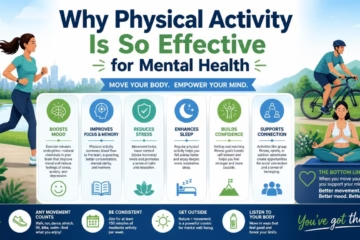
Walk with someone who makes you laugh, dance to a deliberately ridiculous song, or try an activity where beginners are expected to be awkward. Play can make movement more emotionally accessible.
For a complementary reflective approach to time and enjoyment, consider Happier Hour by Cassie Holmes, which explores how the quality and design of daily experiences influence well-being.

Happier Hour by Cassie Holmes
Ever wondered how to squeeze more joy from each day? Enter the Happier Hour book by Cassie Holmes! With a witty flair, Holmes teaches us that the secret to happiness is not in the quantity of time, but in the quality of our experiences. Who knew optimizing our hours could be this fun?
Use humor in difficult conversations carefully
Humor can soften a transition, but it should not replace accountability. If an apology contains a joke that asks the injured person to comfort you, it is probably too soon.
A mature sequence is:
- Name what happened.
- Acknowledge the impact.
- Take responsibility without qualification.
- Ask what repair would help.
- Use humor later, if trust has been restored and the other person welcomes it.
Try laughter-based practices with realistic expectations
Laughter yoga, comedy groups, improvisation and playful social activities can be enjoyable and may support mood or connection. The active ingredients may include breathing, movement, group synchrony, anticipation, novelty and belonging – not laughter alone.
Treat these practices as well-being activities, not medical cures. If you have a cardiovascular, respiratory, neurological or musculoskeletal condition, adapt activities with appropriate guidance.
When humor can become unhelpful
Humor is not automatically healthy. It may become problematic when it is used to:
- avoid every serious conversation;
- conceal symptoms that need attention;
- mock vulnerable people;
- normalise unsafe behaviour;
- manipulate someone into accepting a boundary violation;
- intensify online outrage;
- make grief or trauma appear insignificant;
- replace sleep, treatment, nutrition or professional support.
If humor leaves you feeling ashamed, isolated, more activated, or pressured to perform happiness, change the type and context of humor rather than assuming you need more of it.
People also differ in humor preference. Neurodivergent people, trauma survivors, and individuals from different cultural backgrounds may experience timing, sarcasm, sensory stimulation, and social laughter differently. Inclusive well-being does not require everyone to find the same things funny.
📅 A seven-day humor and well-being experiment
Try this gentle experiment without tracking laughs as a performance metric.
Day 1 – Notice: Record when humor appears naturally and how your body feels afterwards.
Day 2 – Connect: Share something amusing with one person without turning the exchange into a popularity test.
Day 3 – Reframe: Use gentle exaggeration to describe a manageable frustration, then identify the real problem underneath.
Day 4 – Move: Pair a walk or light exercise with a humorous audio experience.
Day 5 – Create: Write, draw, improvise, or tell a story designed to amuse one trusted person.
Day 6 – Repair: Notice whether you used humor to avoid a conversation and address the conversation directly.
Day 7 – Integrate: Ask which forms of humor increased energy, connection, or perspective – and which did not.
The result is more valuable than a vague instruction to “laugh more.” You learn your own humor ecology: what restores you, what drains you, what connects you, and what conceals something important.
🪷 Humor within a holistic lifestyle
A holistic approach recognises that physical health, mental health, relationships, purpose and daily environment interact. Humor fits naturally into this picture because it can touch the body through breathing and arousal, the mind through reappraisal, relationships through shared attention and purpose through meaning-making.
It works best alongside foundational care: sleep, nourishing food, movement, social connection, time in nature, emotional literacy and professional help when needed. The Dream Oak’s Holistic Living guide offers a broader framework for connecting these dimensions.
If you want a structured way to bring these ideas into ordinary routines, explore the Expert-Crafted Holistic Routine to Nourish Your Daily Life. The aim is not to turn joy into another productivity assignment. It is to create conditions in which lightness, reflection, and genuine connection have somewhere to appear.
The Holistic Living Routine
📧 Receive Our Free Expert-Crafted Holistic Routine to Nourish Your Daily Life.
Readers interested in developing mindfulness alongside humor may also explore New Skills Academy Mindfulness Courses. Mindful awareness helps you recognise whether a laugh is relieving tension, building connection or covering an emotion that deserves attention.
❓ Frequently asked questions about the benefits of humor
What are the main benefits of humor?
Potential benefits include short-term stress relief, improved mood, greater pain tolerance, social bonding, cognitive flexibility, and support for resilience. Physical effects such as changes in breathing, muscle activity, and cardiovascular responses have also been studied.
Can laughter improve mental health?
Humor can support mood and coping, but it is not a standalone treatment for depression, anxiety, or trauma. It should complement – not replace – evidence-based care when symptoms are persistent or severe.
Does laughter strengthen the immune system?
Some small studies have reported short-term changes in immune-related markers after laughter or positive emotional experiences. This does not prove that laughter prevents illness. Sleep, nutrition, vaccination, hygiene, and medical care remain essential.
Can humor reduce pain?
Humor and laughter may temporarily increase pain tolerance or change the emotional experience of discomfort. They do not necessarily treat the underlying cause of pain, so persistent or severe pain requires medical assessment.
Is laughing alone as beneficial as laughing with others?
Both private amusement and shared laughter may be enjoyable, but social laughter adds connection and synchrony. The most helpful format depends on the person, context, and quality of the interaction.
Is dark humor healthy?
Dark humor can help some people process difficult experiences and create solidarity, especially within trusted communities. It can also become harmful when it targets vulnerable people, prevents emotional processing, or is imposed on someone who does not welcome it.
How much should I laugh each day?
There is no scientifically established daily laughter target that guarantees better health. Focus on regular opportunities for enjoyment, play, perspective, and connection instead of counting laughs.
Can humor help with stress at work?
Appropriate, inclusive humor may reduce tension and improve connection. It should never be used to excuse bullying, harassment, discrimination, or unsafe practices. In professional settings, read the power dynamics carefully.
Muse Headband: A Game-Changer for Meditation
📚 References and further reading
- Akimbekov, N. S., and A. Razzaque. “Laughter Therapy: A Humor-Induced Hormonal Intervention to Reduce Stress and Anxiety.” Journal of Taibah University Medical Sciences, 2021.
- Bennett, M. P., and C. Lengacher. “Humor and Laughter May Influence Health: III. Laughter and Health Outcomes.” Evidence-Based Complementary and Alternative Medicine, 2008.
- Dunbar, R. I. M., et al. “Social Laughter Is Correlated with an Elevated Pain Threshold.” Proceedings of the Royal Society B, 2012. DOI: 10.1098/rspb.2011.1373.
- Gelkopf, M. “The Use of Humor in Serious Mental Illness: A Review.” Evidence-Based Complementary and Alternative Medicine, 2011.
- Kramer, C. K., et al. “Laughter as Medicine: A Systematic Review and Meta-Analysis of Interventional Studies Evaluating the Impact of Laughter on Health.” Complementary Therapies in Medicine, 2023.
- Louie, D., et al. “The Laughter Prescription: A Tool for Lifestyle Medicine.” American Journal of Lifestyle Medicine, 2016.
- Martin, R. A. The Psychology of Humor: An Integrative Approach. Elsevier Academic Press, 2007.
- U.S. Department of Veterans Affairs, Whole Health Library. “The Healing Benefits of Humor and Laughter.”
- World Health Organization. “Social Connection Linked to Improved Health and Reduced Risk of Early Death.” 2025.
😂 A laugh is not a cure – but it may be a doorway
The benefits of humor are not found in pretending that everything is fine. They are found in the small expansion that happens when a person can hold difficulty and possibility at the same time.
A laugh may loosen the body after stress. A playful exchange may remind someone that they are not alone. A comic perspective may interrupt a rigid thought. A shared absurdity may restore belonging. None of these moments solves every problem, but each can make the next wise action more available.
As health care increasingly recognises the relationship between physical, psychological and social well-being, humor may be understood less as an optional luxury and more as one modest resource within a broader lifestyle. The future of well-being will probably not be built on forced positivity or permanent entertainment. It may depend on something subtler: learning when lightness supports healing, when seriousness deserves our full attention, and how to move between the two without losing compassion.
So the question is not simply, “How can I laugh more?” It may be: What kind of humor helps me become more present, more connected, and more capable of facing reality?
What role has humor played in your health, relationships, or recovery from a difficult period? Share your experience in the comments – and tell us which kind of humor genuinely restores you. 🙂
Disclosure: Some links in this article may be affiliate links. If you make a purchase through them, The Dream Oak may receive a commission at no additional cost to you. Recommendations are selected for their relevance to holistic living and personal development.
Learn, Help Family And Friends, And Help The Planet!