❔ What brings more happiness: being myself or being important?
The question looks like a choice between two identities.
Should I focus on being myself – living according to my values, preferences, limits, and convictions? Or should I aim to be important – respected, influential, successful, admired, and difficult to ignore?
The honest answer is more nuanced than “authenticity good, status bad.” Human beings need autonomy, belonging, competence, recognition, safety, and purpose. Being seen can feel deeply nourishing. Influence can help us protect others, fund meaningful work, and create change. Authenticity can bring coherence and self-respect. Yet status pursued without inner alignment can become an endless demand for proof.
A more useful question is:
Can I become more visible and influential without becoming a stranger to myself? 🌱
That question allows ambition and authenticity to coexist. It also recognises an important distinction: being important is not the same as being superior. A person can be important because they contribute, care, teach, create, organise, protect, or serve – not only because they attract attention.
🦚 What Brings More Happiness?

Unparalleled online learning experiences, New Skills Academy!
Authenticity is alignment, not unrestricted self-expression
Authenticity is often misunderstood as “saying whatever I feel” or refusing all adaptation. In psychological terms, a more useful definition involves congruence: the degree to which actions, values, emotions, and self-understanding fit together honestly.
An authentic person can still be diplomatic, private, strategic, professional, and considerate. They do not reveal every thought to prove that they are real. They choose disclosure according to context, safety, responsibility, and relationship.
Authenticity includes:
- Knowing what matters to you.
- Recognising where your preferences are inherited or chosen.
- Accepting strengths and limitations.
- Acting in ways that are broadly consistent with your values.
- Taking responsibility when your behaviour causes harm.
- Updating your identity when you learn something new.
- Maintaining boundaries without turning them into weapons.
Authenticity is therefore not a fixed personality. It is an ongoing practice of honest self-correction.
Explore: The Importance of Authenticity: How Being Genuine Enhances Your Life and Relationships for a deeper examination of genuine living.
What does it mean to be important?
“Importance” can describe several different goals:
- Status: social rank, prestige, wealth, authority, or visibility.
- Influence: the ability to change decisions, behaviours, or systems.
- Significance: feeling that one’s life matters to other people.
- Contribution: creating value through work, care, knowledge, art, or service.
- Recognition: receiving feedback that effort has been noticed.
These goals should not be collapsed into one category. A nurse may seek significance through care. A researcher may seek influence through evidence. A parent may want to matter deeply to a child. An entrepreneur may seek recognition for building something useful. A public figure may pursue visibility primarily for admiration.
The psychological consequences depend on the motive, the method, and the cost.
Unparalleled online learning experiences, New Skills Academy!
Why recognition can feel so rewarding
Dopamine is relevant here, but not as a simple “happiness chemical.” It is involved in motivation, learning, salience, reward prediction, effort allocation, and the brain’s response to meaningful outcomes.
Social approval can become a powerful learning signal. Praise, likes, invitations, promotions, and public recognition may teach the brain that a particular behaviour is valuable or socially safe. This can energise effort and help people persist through difficulty.
The problem appears when recognition becomes the only reliable evidence of worth. Variable approval – sometimes receiving attention, sometimes not – can encourage repeated checking and escalation. A person may begin to optimise their life for visibility rather than value.
A dopamine-aware question is not “How do I increase dopamine?” It is:
What rewards are training me to repeat this behaviour, and are they connected to the life I actually want?
There is nothing morally wrong with enjoying achievement or praise. The risk is confusing the emotional lift of being noticed with the deeper stability of belonging, meaning, competence, and self-respect.
Authenticity and the basic needs of well-being
Self-determination theory identifies autonomy, competence, and relatedness as basic psychological needs associated with motivation and well-being. These needs clarify why neither pure self-expression nor pure status-seeking is enough.
- Autonomy: I experience my actions as chosen rather than controlled by external pressure.
- Competence: I can develop capability and see that my efforts produce learning or useful results.
- Relatedness: I feel connected, respected, and significant to others.
Authenticity supports autonomy when it helps a person choose according to values. Achievement supports competence when it reflects real mastery. Recognition supports relatedness when it communicates contribution and belonging.
But each need can be frustrated. A person may become externally successful while feeling controlled by expectations. Another may defend “being authentic” while avoiding skill development, responsibility, or mutuality. A third may collect admiration while remaining emotionally isolated.
The goal is not to select one need. It is to build a life where all three are supported.
Unparalleled online learning experiences, New Skills Academy!
The psychological benefits of being yourself
Greater internal coherence
When values and behaviour are reasonably aligned, fewer psychological resources are spent maintaining a false image. This does not eliminate anxiety or conflict, but it can reduce the exhaustion associated with constant impression management.
More trustworthy relationships
Authenticity can attract relationships based on accurate information rather than performance. People can respond to the real person, not a carefully edited character.
This comes with a caveat: authenticity does not guarantee acceptance. Being genuine may reveal incompatibility. That can be painful, but it may also prevent a relationship from being built on concealment.
More stable self-worth
If self-worth depends entirely on applause, it rises and falls with the audience. A values-based identity offers another source of evaluation: Did I act with integrity? Did I learn? Did I contribute? Did I repair what I damaged?
Better long-term decision-making
Authenticity can help people reject opportunities that look impressive but conflict with health, relationships, ethics, or purpose. Saying no to a prestigious path is not automatically brave; sometimes it is avoidance. The relevant question is whether the decision reflects values and considered consequences.
The psychological benefits of being important
Recognition and importance can also contribute to well-being when they are grounded in contribution.
- Achievement can create evidence of competence.
- Influence can allow a person to improve systems.
- Visibility can provide access to resources and opportunities.
- Status can offer security in some environments.
- Recognition can validate work that is otherwise invisible.
- Leadership can create meaning through responsibility.
For marginalised people, visibility and representation may be especially significant. Advising everyone to “ignore recognition” can overlook the real consequences of exclusion, discrimination, financial insecurity, or lack of institutional power.
The issue is not wanting to matter. The issue is allowing external importance to become the sole measure of human value.
When the pursuit of importance becomes costly
A status-oriented life becomes fragile when the target keeps moving. The promotion leads to a new title; the title leads to a larger audience; the audience leads to comparison with people who have even more reach.
Common warning signs include:
- Feeling anxious when not visible.
- Choosing projects mainly for prestige.
- Comparing ordinary life with other people’s highlights.
- Treating relationships as networking opportunities.
- Hiding mistakes to preserve an image.
- Neglecting sleep, health, or family for recognition.
- Becoming resentful when others succeed.
- Needing constant confirmation that you matter.
- Experiencing emptiness immediately after achievement.
These signs do not prove that ambition is unhealthy. They suggest that the cost–value relationship deserves inspection.
When “being myself” becomes an excuse
Authenticity can also be misused. “That’s just who I am” may conceal cruelty, inflexibility, prejudice, avoidance, or a refusal to grow.
Being yourself does not exempt you from:
- Learning how your behaviour affects others.
- Apologising and repairing harm.
- Developing professional competence.
- Respecting agreements and boundaries.
- Changing beliefs when evidence changes.
- Asking for feedback.
- Tolerating discomfort during growth.
A better definition of authenticity includes accountability. The authentic self is not only the person you feel like being in the moment; it is also the person you choose to become through repeated action.
The difference between healthy ambition and status addiction
Healthy ambition is directed toward a meaningful standard: mastery, contribution, service, protection, creativity, freedom, or excellence. Status may follow, but it is not the only purpose.
Status addiction is more dependent on external measurement. The target is often vague – more attention, more followers, more authority, more admiration – and satisfaction disappears quickly after each gain.
Use the substitution test:
If nobody could see this achievement for five years, would I still want to pursue it?
A “no” is not automatically a reason to stop. Public recognition may be part of the work’s function. But the answer reveals how much intrinsic value the goal contains.
A practical integration: become important through authenticity
1. Define your contribution
Complete this sentence: “I want to matter by…” Choose a concrete contribution rather than a vague identity. Examples include making complex information understandable, creating safe spaces, supporting a family, improving a product, mentoring others, or protecting nature.
2. Separate private values from public metrics
Write two lists:
- Values I want to embody when nobody is watching.
- Metrics other people can see.
The distance between the lists shows where external recognition may be distorting your priorities.
3. Build a recognition budget
Decide how much time you will spend checking analytics, messages, rankings, praise, and comparisons. A budget is not punishment; it prevents feedback from occupying the entire day.
4. Create a private practice
Do something meaningful that produces no public evidence: read, practise, exercise, pray, learn, repair, or help someone anonymously. Private effort strengthens identity beyond performance.
5. Seek high-quality feedback
Do not ask everyone whether you are impressive. Ask trusted people specific questions: Was the work useful? Did I communicate clearly? What should I improve? Did my behaviour match my values?
6. Review the emotional aftertaste
After an achievement, note what remains six hours and seven days later: satisfaction, relief, anxiety, pride, emptiness, connection, or renewed purpose. The aftertaste often reveals whether the reward was meaningful or merely stimulating.
Authenticity in the age of personal branding
Personal branding can help people communicate expertise, find opportunities, and build communities. It can also turn identity into a product that must be constantly updated.
The challenge is not visibility itself. It is maintaining a distinction between:
- Communication: showing relevant aspects of yourself so people understand your work.
- Performance: shaping every aspect of life to maximise approval.
Protect off-camera relationships, unmonetised interests, private beliefs, rest, and activities that do not need to become content. A life that cannot exist without an audience may gradually lose the ability to feel real.
The role of belonging and social importance
People need to feel that they matter, but significance is not the same as fame. Belonging often grows through repeated small acts: showing up, remembering, helping, listening, sharing responsibility, and allowing others to depend on you appropriately.
A person may be globally visible and privately lonely. Another may be unknown outside a neighbourhood yet deeply important to family, friends, students, patients, or colleagues.
Research on well-being consistently points toward social connection, meaning, autonomy, and supportive participation as important dimensions of a good life. This suggests that the most sustainable importance may be relational rather than performative.
🌿 Your free holistic routine for authentic fulfilment
The Free Expert-Crafted Holistic Routine to Nourish Your Daily Life can help you connect authenticity and ambition through reflection, movement, rest, meaningful work, relationships, and purposeful action.
The Holistic Living Routine
Get our Free Expert-Crafted Holistic Routine to Nourish Your Daily Life.
For readers interested in meditation and contemplative research, explore Altered Traits by Daniel Goleman and Richard J. Davidson. The Silva Mind Control Method may also interest readers exploring popular approaches to mental training; it should be read as a historical self-development resource rather than as a substitute for scientific or clinical guidance.
Try this weekly structure:
- One value check: What did my choices communicate?
- One private practice: What did I do without an audience?
- One contribution: Whom or what did my effort genuinely help?
- One relationship investment: Where did I show up with attention?
- One recognition boundary: When will I stop checking for approval?
For structured personal development, explore Personal Development Courses – academy+. For a broader framework on wealth beyond money and status, read The 5 Types of Wealth by Sahil Bloom.
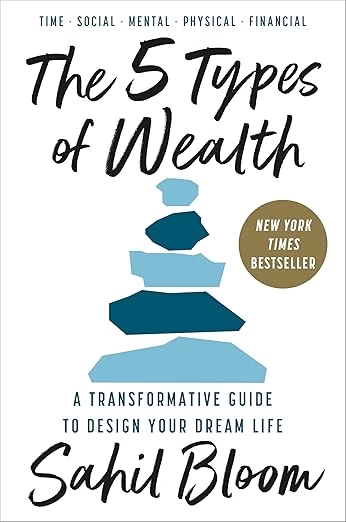
The 5 Types of Wealth: A Broader Approach to a Richer Life
Discover Sahil Bloom’s holistic approach to wealth in ‘The 5 Types of Wealth,’ offering practical insights to help you live a richer, more intentional life. Don’t wait to start designing your dream life! This book is your starting point!
❓ Frequently asked questions
Is authenticity more important than success?
Authenticity and success answer different questions. Authenticity concerns alignment and integrity; success concerns outcomes. The healthiest form of success is built without permanently sacrificing values, health, or relationships.
Can recognition make people happy?
Recognition can create pleasure, confidence, motivation, belonging, and opportunities. Its benefits are usually more sustainable when recognition reflects meaningful contribution rather than being the only source of self-worth.
Does dopamine cause the desire to be important?
Dopamine contributes to motivation, reward learning, salience, and responses to social feedback. The desire for importance also involves attachment, identity, culture, insecurity, values, and material conditions. It cannot be reduced to one neurotransmitter.
Is wanting attention unhealthy?
No. Humans need to be seen and acknowledged. It becomes concerning when attention is pursued compulsively, when self-worth depends on it, or when the pursuit causes significant harm.
Can I be authentic in a professional environment?
Yes, with boundaries. Professional authenticity means communicating honestly and behaving consistently with core values; it does not require revealing every private feeling or rejecting appropriate role expectations.
How do I know whether a goal is mine or socially imposed?
Ask whether you would still value it without public recognition, whether the process interests you, what sacrifices it requires, and whether it supports or conflicts with your chosen values.
Can people change and still be authentic?
Yes. Authenticity is not a frozen identity. Growth, therapy, education, relationships, and evidence can legitimately change what a person believes and values.
💬 Questions for reflection and discussion
- When do you feel most like yourself?
- What kind of importance would still matter if it were not publicly visible?
- Which achievement brought lasting meaning, and which brought only temporary relief?
- Where has “being authentic” helped you – and where might it be protecting you from growth?
- How can you become more influential without becoming more performative?
Share your perspective. The tension between belonging, ambition, authenticity, and recognition is not solved by one slogan; it changes across work, family, culture, age, and life circumstances.
Perhaps the answer is not to choose between being yourself and being important. It is to decide what kind of importance is compatible with being yourself.
In the coming years, artificial intelligence may make it easier to produce polished content, build a public profile, and optimise social engagement. Visibility may become cheaper, faster, and more abundant. If attention becomes easier to manufacture, trust, depth, and lived contribution may become more valuable than reach alone.
The future question may therefore be less “How important can I become?” and more “What remains valuable when visibility is no longer rare?” The people who thrive may be those who can use recognition as a tool without needing it as proof of existence – people whose public influence grows from private integrity, meaningful relationships, and work that would still matter even if nobody applauded. ✨
References:
- American Psychological Association. “Self-Determination Theory: A Quarter Century of Human Motivation Research.”
- Ryan, R. M., & Deci, E. L. (2020). Self-Determination Theory: Basic Psychological Needs in Motivation, Development, and Wellness. Guilford Press.
- Haim-Litevsky, D., Komemi, R., & Lipskaya-Velikovsky, L. (2023). “Sense of Belonging, Meaningful Daily Life Participation, and Well-Being.” International Journal of Environmental Research and Public Health, 20(5), 4121.
- Wood, A. M., Linley, P. A., Maltby, J., Baliousis, M., & Joseph, S. (2008). “The Authentic Personality.” Journal of Counseling Psychology, 55(3), 385–399.
- Kernis, M. H., & Goldman, B. M. (2006). “A Multicomponent Conceptualization of Authenticity.” Advances in Experimental Social Psychology, 38, 283–357.
- Bromberg-Martin, E. S., Matsumoto, M., & Hikosaka, O. (2010). “Dopamine in Motivational Control.” Neuron, 68(5), 815–834.
- McKnight Brain Institute. “How Dopamine Guides Our Social World.”
- World Happiness Report (2025). “Connecting with Others.”
- National Institute of Mental Health. “Mental Health Information.”
- World Health Organization. “Mental Health.”
- American Psychological Association. “Building Your Resilience.”
- Deci, E. L., & Ryan, R. M. (2000). “The ‘What’ and ‘Why’ of Goal Pursuits.” Psychological Inquiry, 11(4), 227–268.
Learn, Help Family And Friends, And Help The Planet!