If you want to learn more about holistic living, an online course can give you a structured starting point – but the right choice depends on your goal. Some courses focus on mindfulness and stress management; others explore nutrition, aromatherapy, spiritual practices, coaching, or broader wellness principles.
In this guide, we compare selected holistic health and wellness courses from Centre of Excellence and New Skills Academy. We look at subject coverage, learner level, course format, assessment, certificates, practical value and professional scope. We also explain what an online certificate can – and cannot – qualify you to do.
Quick answer: choose a mindfulness course if you want practical tools for everyday stress; choose a nutrition or wellness course if you want to understand lifestyle foundations; and choose a diploma-style programme only after checking its assessment, tutor support, recognition and suitability for your intended use.
Important: An online course certificate is not automatically a regulated healthcare qualification or a licence to diagnose and treat people. Use course material for education and personal development, and seek appropriate professional advice for medical concerns.
💻 Online Holistic Health and Wellness Courses
Quick comparison: which holistic course may suit you?
| Your goal | Best course direction | What to check before enrolling |
|---|---|---|
| Learn mindfulness as a beginner | Mindfulness and meditation | Practice guidance, lesson structure and assessment |
| Explore spiritual practices | Spirituality, Reiki or related subjects | Clear boundaries between personal exploration and healthcare claims |
| Understand nutrition and lifestyle | Nutrition and wellness | Scientific scope, safety guidance and whether the course is introductory |
| Develop coaching skills | Life coaching or holistic coaching | Coaching boundaries, supervision and professional recognition |
| Study natural therapies | Aromatherapy, herbalism or Ayurveda | Contraindications, safe-use guidance and local regulations |
| Build broad personal knowledge | Holistic health or wellness foundation | Curriculum breadth, practical exercises and certificate wording |
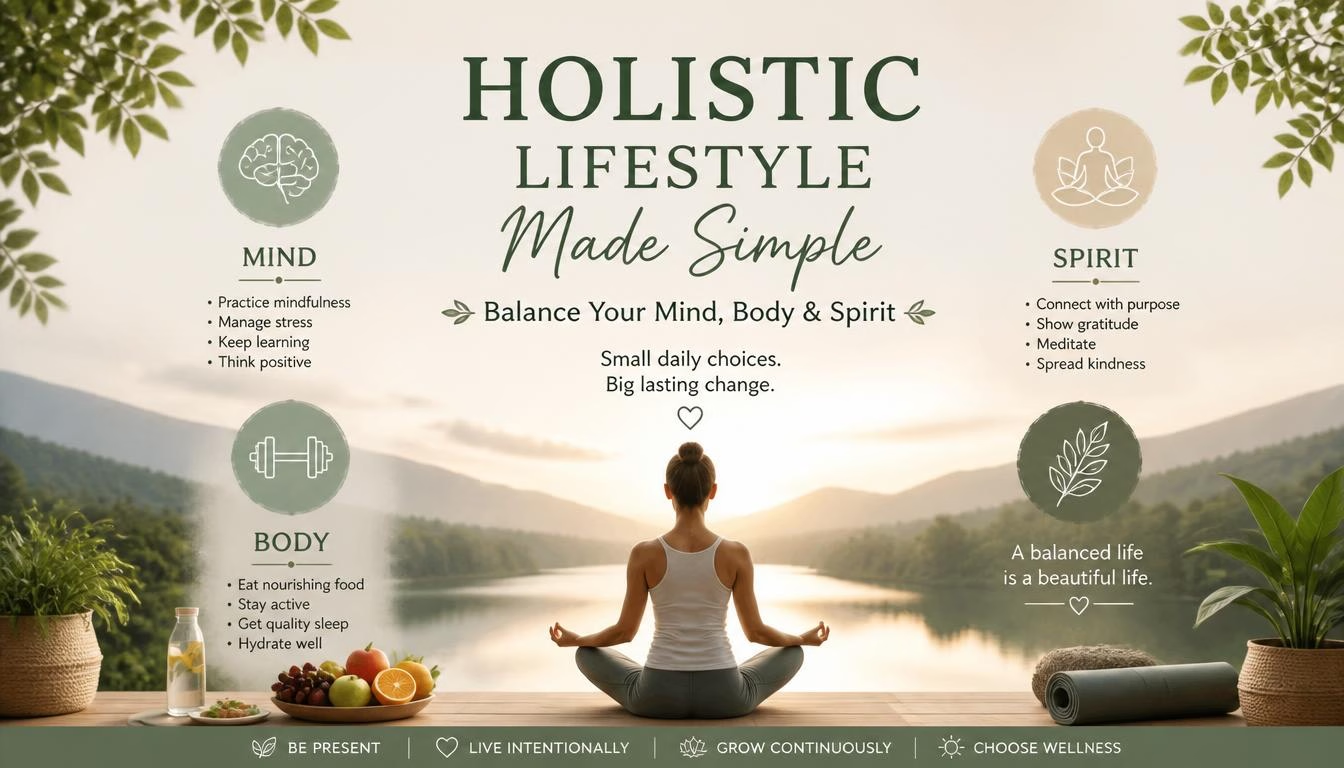
What does holistic living mean?
Holistic living is a way of thinking about well-being as an interconnected process. It considers how physical health, emotional regulation, mental habits, relationships, environment, purpose and spiritual life can influence one another.
That does not mean every holistic claim is scientifically established, or that one practice can solve every health problem. It means that a person may benefit from considering the wider context of their life alongside appropriate medical or mental-health care.
For a deeper explanation of the concept, read The Dream Oak’s guide to What Is Holistic Living? Definition, Benefits, the 6 Pillars and How to Start. This article has a different purpose: helping you choose an online course that matches your goals and expectations.
How we compared these holistic health courses
We used the following criteria when assessing the options discussed in this guide:
- Curriculum: Does the course explain a coherent subject rather than simply listing attractive topics?
- Learner level: Is it suitable for a complete beginner, or does it assume previous knowledge?
- Format: Is the learning self-paced, tutor-supported, video-based, text-based, or a mixture?
- Assessment: Are there quizzes, assignments, case studies or practical exercises?
- Certificate wording: What exactly is issued after completion, and what does it not prove?
- Practical usefulness: Can the learner apply the knowledge safely in everyday life?
- Professional scope: Does the course clearly distinguish personal education from regulated clinical training?
- Transparency: Are pricing, access, discounts and course details explained clearly?
- Safety: Does the material acknowledge risks, contraindications and the limits of non-clinical practice?
Provider information and prices can change. Check the current course page before purchasing, particularly if a discount is displayed.

Best Online Courses to Transform Your Life: The Complete 2026 Guide (Centre of Excellence + New Skills Academy)
Best online holistic health and wellness courses
The courses below are organised by learner goal rather than by a single claim that one programme is best for everyone.
1. Best for a broad introduction: Holistic Health Practitioner Certificate
A holistic health practitioner foundation course can be useful for learners who want an overview of the relationship between lifestyle, mind-body practices and general well-being. It may introduce subjects such as nutrition, mindfulness, natural therapies and the principles of holistic health.
Best for: beginners who want broad exposure before choosing a specialism.
What to look for: a clear curriculum, responsible health language, explanations of professional boundaries and a certificate that is described accurately.
Potential strength: broad courses can help you discover whether your real interest is nutrition, mindfulness, coaching, spiritual practice or another area.
Potential limitation: breadth can come at the expense of depth. A foundation course should not be treated as equivalent to clinical training or specialist professional education.
A course of this type is a sensible starting point if you are still exploring. If your goal is simply to build healthier routines, you may not need a practitioner-oriented title at all; a focused mindfulness, nutrition or lifestyle course may be more practical.
2. Best for mindfulness and stress-management skills: Mindfulness Courses
Mindfulness courses are among the most accessible holistic living courses because the learner can usually practise the techniques without buying specialist equipment. A good beginner programme should explain attention, present-moment awareness, breathing, meditation practice and realistic ways to develop consistency.
Best for: people who want a structured introduction to mindfulness, meditation and everyday stress-management habits.
What to look for: practical exercises, guidance for beginners, a realistic discussion of expected benefits and language that avoids promising to cure anxiety, depression or other conditions.
Potential strength: mindfulness can be integrated into ordinary routines, including short periods of breathing, walking or focused attention.
Potential limitation: completing a course does not make someone a therapist, psychologist or medical professional. People with significant or persistent symptoms should seek qualified help rather than relying on a self-paced course alone.
Explore the New Skills Academy Mindfulness Courses.
New Skills Academy Mindfulness Courses: Reduce Stress, Improve Focus & Build Lasting Calm
Unlock your inner calm with New Skills Academy’s mindfulness courses designed for all experience levels. Discover evidence-based techniques to reduce stress, boost focus, and enhance your overall well-being.
3. Best for spiritual exploration: Spirituality Courses
Some learners are drawn to holistic living through questions about meaning, intuition, ritual, energy, symbolism, or personal spirituality. A spirituality course can provide a structured way to explore these subjects, particularly for someone who does not know where to begin.
Best for: adults exploring spirituality as a personal, reflective or cultural practice.
What to look for: a respectful presentation of different traditions, clear distinction between belief and evidence, and no promises that a practice can replace medical treatment.
Potential strength: a structured course may help learners reflect on values, purpose and personal practices instead of consuming disconnected content from social media.
Potential limitation: spiritual and energy-based subjects vary considerably in evidence and professional recognition. Treat certificates as evidence of course completion unless the relevant regulator or professional body states otherwise.
Explore the Spirituality Courses at New Skills Academy

Spirituality Courses At New Skills Academy
Embrace a deeper understanding of spirituality with the comprehensive Spirituality Courses offered at New Skills Academy. These courses are designed for anyone looking to explore various spiritual practices and enhance their personal and professional growth.
4. Best for nutrition and lifestyle learning: Vegan Health, Nutrition and Lifestyle Course
Nutrition is often a central part of holistic living, but it is also an area where online content can become misleading. A nutrition course should distinguish established nutrition principles from personal preference, ideology and claims that require professional assessment.
Best for: learners interested in plant-based eating, conscious food choices and the relationship between diet and lifestyle.
What to look for: coverage of nutritional adequacy, practical meal planning, individual differences and the importance of professional advice for medical conditions.
Potential strength: a well-structured introductory course can help someone ask better questions about food, habits and sustainability.
Potential limitation: a short online course cannot assess an individual’s health, diagnose deficiencies or replace a registered dietitian or other appropriately qualified practitioner.
Explore the Vegan Health, Nutrition and Lifestyle Course.
Vegan Health, Nutrition and Lifestyle Course: Build a Balanced Plant-Based Approach
Are you ready to revolutionize your approach to health and nutrition? The New Skills Academy’s Vegan Health, Nutrition, and Lifestyle Course is designed just for you! Dive into the world of plant-based living and learn to make conscious food choices that benefit your body and the planet.
5. Best for coaching and personal-development skills: Life Coaching or Holistic Coaching Diploma
Coaching courses appeal to learners who want to support goal-setting, reflection, motivation and behaviour change. Some programmes use the word “holistic” to describe a broad approach that considers a person’s goals, values, habits and life context.
Best for: learners interested in communication, goal-setting and non-clinical coaching conversations.
What to look for: coaching ethics, boundaries, informed consent, referral guidance, practical exercises and an accurate description of recognition.
Potential strength: coaching education can provide useful frameworks for listening, asking questions and helping someone clarify their own goals.
Potential limitation: coaching is not psychotherapy, medical treatment or crisis intervention. A responsible course should make this boundary explicit.

Life Coaching Diploma Course: Develop Practical Skills for Guiding Personal Growth
Discover the transformative journey of the Life Coaching Diploma Course offered by the Centre of Excellence. This comprehensive program is designed for individuals eager to enhance their coaching skills and make a significant impact on others.
6. Best for aromatherapy and natural-therapy interest: Aromatherapy Diploma
Aromatherapy courses usually introduce essential oils, blending, application methods and the relationship between scent and subjective well-being. They can be interesting for personal education, but they require particularly careful safety language.
Best for: learners who want to understand essential oils and their traditional or practical uses.
What to look for: dilution guidance, contraindications, pregnancy and child-safety information, interactions, allergies and instructions against ingestion unless advised by a suitably qualified professional.
Potential strength: the subject can be practical and engaging when taught with careful attention to safe use.
Potential limitation: essential oils are concentrated substances. Natural does not automatically mean harmless, and an online certificate does not authorise medical claims.
The Centre of Excellence Aromatherapy Diploma Course.
Aromatherapy Diploma Course: Master Essential Oil Chemistry & Professional Practice
Master the science of aromatherapy benefits with the Centre of Excellence’s comprehensive Aromatherapy Diploma Course. This fully accredited online course transforms your passion for essential oils into professional expertise-whether you’re a complete beginner or an experienced wellness practitioner.
You’ll learn the exact chemistry behind why aromatherapy benefits work: how linalool in lavender reduces cortisol by 23%, how menthol activates pain-relief receptors, how frankincense affects neurochemistry. No vague claims. Pure science.
By the end, you’ll be certified, insurable, and ready to build a profitable aromatherapy practice-or simply deepen your personal wellness. This is the course that bridges self-care into professional mastery.
7. Best for crystal healing and energy practices: Crystal Healing Diploma
Crystal healing courses are generally chosen for spiritual, symbolic, or personal practices. Readers may enjoy learning about traditions, intention-setting, meditation and ritual, but the page must not imply that crystals have been established as treatments for disease.
Best for: adults interested in spiritual practice, symbolism and reflective rituals.
What to look for: transparent language about the nature of the subject, respectful treatment of belief and a clear statement that the course is not medical training.
Potential strength: learners may use the subject as a framework for reflection or meditation.
Potential limitation: scientific evidence for crystal healing as a treatment is not equivalent to evidence for established medical interventions.
Explore the Crystal Healing Diploma Course.
Crystal Healing Diploma Course: Explore the History and Practices of Crystal-Based Wellness
Embark on a journey of self-discovery and healing with the Crystal Healing Diploma Course by the Centre of Excellence. This comprehensive program not only enhances your knowledge of crystal healing but also empowers you to apply these techniques in everyday life.
8. Best for a deeper professional direction: Diploma or certificate in holistic health practice
Some readers are not looking for a hobby or introductory course. They want a substantial programme that may support a future career in wellness education, coaching or a particular non-clinical modality.
In that case, compare the course with greater care. Look for the total learning time, tutor involvement, assessed work, practical requirements, insurance implications, local laws, professional-body recognition and the exact activities permitted after completion.
A course marketed as “accredited”, “certified” or “recognised” should be investigated carefully. Ask:
- Who provides the accreditation?
- Is it institutional, professional, continuing-education or marketing recognition?
- Does it apply to the course, the provider or the certificate?
- Is it recognised in the country where you intend to work?
- Does it permit professional practice, or does it simply confirm course completion?
Centre of Excellence vs New Skills Academy
Both platforms may suit different learners, but the right choice depends on the individual course rather than the brand name alone.
| Comparison point | Centre of Excellence | New Skills Academy |
|---|---|---|
| Course direction | Broad catalogue with diploma-style and specialist subjects | Practical, accessible courses across wellness and personal development |
| Suitable for | Learners who want a structured specialist subject | Learners who prefer flexible, self-paced introductory learning |
| What to compare | Course modules, tutor support, assessment and certificate wording | Module depth, access terms, assessment and certificate wording |
| Possible advantage | Specialist subjects and longer-form course options | Straightforward entry point and broad practical catalogue |
| Possible limitation | A diploma label does not automatically equal regulated professional status | A self-paced certificate may not provide supervised practical experience |
| Best next step | Check the exact course page and recognition claims | Check the exact course page, access terms, and assessment |
The platform-level comparison is only a starting point. A mindfulness course from one provider may be a better fit than a general holistic health course from the same provider, while a learner interested in nutrition may need a completely different curriculum.

How to choose the right holistic living course
Start with the outcome, not the discount
Ask what you want to be able to do after completing the course. Do you want to practise meditation more consistently, understand food and lifestyle choices, explore spirituality or develop non-clinical coaching skills?
A discount can make an interesting course affordable, but it should not determine whether the curriculum is suitable.
Check the level and workload
A course labelled “beginner” should explain basic terms without assuming previous training. A diploma-level programme may require more reading, assignments and independent study. Compare the estimated study time with your actual schedule.
Separate learning from professional qualification
If you want to work with clients, investigate the legal and professional requirements in your location before enrolling. Check whether you need a regulated qualification, supervision, insurance, safeguarding training or membership of a professional body.
Look for safety and referral guidance
A responsible wellness course should explain when a learner must refer someone to a doctor, psychologist, dietitian or other qualified professional. This is especially important for nutrition, herbalism, aromatherapy, mental health, pregnancy and chronic illness.
Compare the assessment
Watching videos is different from completing assignments or demonstrating practical understanding. Find out whether the course uses quizzes, written work, tutor feedback or practical assessments.
Read the certificate wording carefully
A certificate can confirm that you completed a course. It does not necessarily confirm that you are licensed, clinically qualified, insured or recognised by every employer or professional body.
Certificates, accreditation and professional scope
The words “certificate”, “diploma” and “accredited” are not interchangeable. Their meaning depends on the issuing organisation, the relevant regulator and the country in which the learner intends to use the qualification.
Before enrolling, save a copy of the provider’s current description and check:
- the name of the issuing organisation;
- the assessment requirements;
- whether tutor support is included;
- whether practical experience is required;
- the exact professional limitations;
- whether recognition applies in your country;
- the provider’s refund and access terms.
For personal development, a well-designed introductory course may be entirely appropriate. For professional practice, the research should go much further.
Safety and evidence considerations
Holistic living includes practices with very different levels of evidence. Mindfulness, physical activity, sleep and balanced nutrition have substantial research bases for aspects of general well-being, although no practice should be presented as a universal treatment.
Other subjects, including crystal healing and some energy-based practices, may be meaningful to individuals as spiritual or reflective activities while lacking comparable evidence as medical treatments.
Be especially cautious with content about:
- anxiety, depression and trauma;
- chronic illness;
- eating disorders and restrictive diets;
- herbs and supplements;
- essential oils;
- pregnancy and children;
- detoxification or disease-treatment claims.
If symptoms are severe, persistent or worsening, a course is not a substitute for appropriate healthcare.
❓ Frequently asked questions
What credentials do you need to be a holistic doctor?
To become a holistic doctor, you typically need the following credentials:
Bachelor’s degree (often in a related field such as biology or health sciences).
Medical degree (MD or DO) or a degree in naturopathy (ND).
Completion of a residency program (if pursuing traditional medicine).
Licensure to practice medicine in your state.
Additional training or certification in holistic or integrative medicine (such as through organisations like the Academy of Integrative Health & Medicine).
Continuing education in holistic practices and therapies.
How long does it take to become a holistic therapist?
Becoming a holistic therapist typically takes between six months and two years, depending on the modality and level of training. Short certificate courses in areas like crystal healing, aromatherapy, or mindfulness can be completed in weeks through online platforms. Diploma-level programmes that qualify you to practise professionally usually require one to two years of structured study. No single timeline applies; it depends on the therapy you choose and the depth of qualification you’re aiming for.
What holistic job makes the most money?
Holistic health practitioners, particularly those specialising in integrative medicine or functional medicine, can earn substantial incomes, often ranging from $75,000 to over $200,000 annually, depending on their expertise, location, and clientele.
Do you need a degree to be a holistic therapist?
No, a formal university degree is not required to become a holistic therapist. Most practising holistic therapists qualify through accredited diploma or certificate programmes offered by specialist training providers. What matters most is completing recognised training in your chosen modality, such as aromatherapy, nutrition, or energy healing, and obtaining professional indemnity insurance if you plan to work with clients. Relevant certification from a reputable provider carries more weight in this field than a general academic degree.
What is the best online holistic health course for beginners?
The best option depends on your goal. A mindfulness course is a practical entry point for stress-management habits, while a broad holistic health course may suit someone who wants to explore several subjects. Choose a programme with a clear beginner-level curriculum, realistic claims and transparent certificate information.
Are online holistic health certificates recognised?
Recognition varies by provider, course and location. A certificate may confirm completion without being a regulated professional qualification. Before enrolling, check the issuing body, assessment method, professional-body recognition and legal requirements where you intend to use the training.
Can an online course qualify me to practise as a holistic therapist?
Not automatically. Professional practice may require specific training, supervised experience, insurance, registration or compliance with local law. Treat an online certificate as education unless a relevant professional or regulatory body clearly confirms its scope.
What is the difference between holistic health, holistic wellness and holistic living?
The terms overlap but are often used differently. Holistic living usually describes a lifestyle approach that considers several dimensions of well-being. Holistic wellness often refers to practices supporting that lifestyle. Holistic health may be used more broadly or in a practitioner context, so the provider’s definition should be checked carefully.
Which course is best for mindfulness and stress management?
A dedicated mindfulness course is usually a more focused choice than a broad holistic health programme. Look for practical exercises, realistic explanations of benefits, guidance for beginners and clear advice that the course does not replace mental-health care.
How should I compare course quality before enrolling?
Compare the curriculum, learning hours, assessment, tutor support, practical work, certificate wording, safety guidance, price, refund terms and professional scope. Do not rely on the discount percentage or the word “accredited” without checking what it specifically means.
Is a holistic living course suitable for personal development?
Yes. Many people take these courses to build knowledge, reflect on their habits or explore mindfulness, nutrition, spirituality and wellness. For personal learning, focus on clarity, practical usefulness and responsible claims rather than assuming that a certificate has professional status.
⭐ Final recommendation
For most beginners, a structured mindfulness or general wellness course is the safest starting point because it offers practical learning without implying that the learner can diagnose or treat others.
Choose a specialist diploma when you have a clear subject, enough time for the workload, and a realistic understanding of what the certificate represents. If your goal is professional practice, investigate local requirements before paying for any course.
Centre of Excellence may appeal to learners who prefer specialist, diploma-style subjects. New Skills Academy may appeal to learners who want accessible, self-paced courses across wellness and personal development. In both cases, compare the exact course – not only the platform, promotional language or discount.
The most holistic choice is the one that fits your goal, respects the evidence, acknowledges its limits and gives you knowledge you can use responsibly.
Ready to explore further? Start with the course that matches your immediate goal, then build your understanding gradually. A calmer routine, more thoughtful food choices or a clearer sense of purpose can begin with one well-chosen learning step.
At The Dream Oak, we write about the connection between mind, body, and soul – because a fulfilled life grows from all three. Browse more articles on mindfulness, personal growth, and health & wellness.
🗓️ The Holistic Living Routine
🆓 Receive Our Free Expert-Crafted Holistic Routine to Nourish Your Daily Life. Unlock clarity. Take action.
📚 Further Reading
- 10 Reticular Activating System Exercises: Train Your Brain to Notice Opportunities
- What Brings More Happiness? Being Myself or Being Important?
- The Brain Needs To Stop! Being Inactive (not bored) Is Part Of Life
- The Power of Your Mind: Transform Your Life Today With 5 Science-Backed Strategies
📚 Research Sources
- Harvard Gazette (2017) – 80-year study;
- Harvard Gazette (2018) – Meditation & brain;
- Stanford University (2019) – Nature & cortisol;
- PMC5679245 – Mindfulness;
- PLOS Medicine (2010) – Social connection;
📝 Affiliate Disclaimer
This post contains affiliate links. If you make a purchase through them, we may earn a small commission at no extra cost to you. We only recommend courses and products we genuinely believe in.
Learn, Help Family And Friends, And Help The Planet!