❔ What Are Reticular Activating System Exercises and Why They Matter
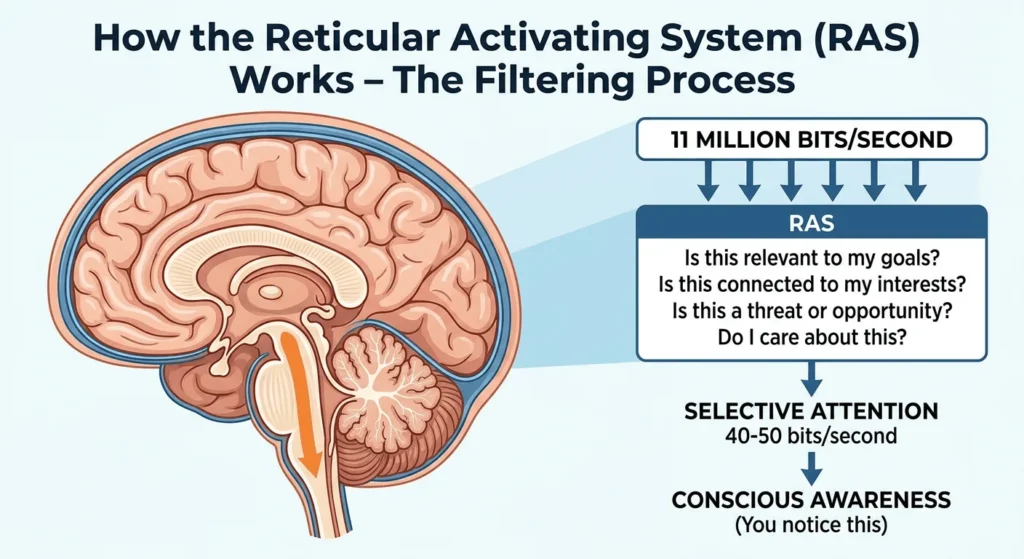
Your brain processes 11 million bits of sensory information every second. But your conscious mind can only handle about 40-50 bits per second.
So how do you survive? You have a filtering system called the Reticular Activating System (RAS), and you can train it with specific reticular activating system exercises.
The Reticular Activating System is a network of neurons in your brainstem, the ancient part of your brain responsible for survival. It’s your brain’s bouncer, deciding what information gets your attention and what gets ignored. When you’re at a party, and someone mentions your name across the room, you hear it immediately-that’s your RAS at work, filtering out all the noise to catch what’s relevant to you.
The power of the reticular activating system exercises is this: What you focus on, you get more of. Not because life is magical, but because your brain literally rewires itself to notice what matters to you. You’ve seen this before. Buy a red car, and suddenly you see red cars everywhere. Start thinking about a new career, and job postings appear everywhere. The opportunities were always there-your RAS is just now showing them to you.
Why practice reticular activating system exercises?
- 🎯 Dramatically improve focus and concentration
- 👁️ Filter out distractions automatically
- 🚀 Accelerate learning and skill acquisition
- 💡 Unlock creative ideas and problem-solving
- 📈 Increase productivity without forcing willpower
- 🧠 Train your brain to notice opportunities
- ⚡ Boost alertness and mental clarity
🧠 10 Reticular Activating System Exercises:
The Science Behind Reticular Activating System Exercises: How Attention Really Works
Understanding the science behind the reticular activating system exercises changes everything. Your Reticular Activating System sits in your brainstem, the lowest part of your brain, where it connects to your spinal cord. It’s small (about the size of a finger), but it controls something massive: whether you’re awake or asleep, and what you pay attention to.
The RAS is part of a larger network called the Reticular Formation, which includes:
- Locus coeruleus – releases norepinephrine (keeps you alert).
- Raphe nuclei – release serotonin (regulates mood and attention).
- Ventral tegmental area – releases dopamine (motivation and reward).
These three systems work together to create arousal (alertness) and salience (importance). When your RAS activates during reticular activating system exercises, it’s like turning up the volume on specific sensory channels while turning down others.

Step into the world of learning and personal growth with the Centre of Excellence!
How RAS Filtering Works During Exercises
Here’s the practical mechanism of the reticular activating system exercises:
1. Sensory input arrives – Light, sound, touch, smell, taste → 11 million bits/second
2. RAS evaluates it – Is this relevant to my survival, goals, or values?
3. RAS decides – Pass it to conscious attention OR filter it out
4. You experience the result – You notice, or you don’t
Key insight: The RAS doesn’t filter based on objective importance. It filters based on what you’ve told it matters through repetition, emotion, and intention. This is why reticular activating system exercises work so well.
Brain Activity During Reticular Activating System Exercises
Research using fMRI neuroimaging shows that when you practice reticular activating system exercises:
- ↑ 40% increase in prefrontal cortex activity (decision-making, planning).
- ↑ Enhanced connectivity between attention centers.
- ↑ Heightened activity in the anterior cingulate cortex (focus and conflict resolution).
- ↓ Decreased “default mode network” activity (mind-wandering suppressed).
This is why reticular activating system exercises work-they literally train your brain’s filtering mechanism to work in your favor.
The 10 Best Reticular Activating System Exercises: Practical, Science-Backed Training
Exercise 1: Goal Setting & Visualization (The Foundation for RAS Training)
What it is: Define one clear goal, then visualize it repeatedly to “teach” your RAS what to look for. This is one of the most powerful reticular activating system exercises.
Why it works: Your RAS is goal-seeking. When you have a vivid, specific goal, your RAS automatically starts filtering the world for opportunities related to that goal.
How to do it (5-step process):
- Define one specific goal (not vague):
- ❌ Bad: “Get better at business”.
- ✅ Good: “Launch an online course and get 50 students in 6 months”.
- Write it down – Physically writing activates more neural pathways than thinking.
- Use present tense: “I am building a course that helps 50 students…”.
- Make it specific: name, numbers, timeline.
- Visualize daily – 5 minutes each morning or evening:
- Close your eyes.
- Picture yourself achieving the goal (be specific about details).
- Feel the emotions of success.
- See the “before and after” contrast.
- Review weekly – Read your written goal every Sunday.
- This resets your RAS for the week.
- Notice which opportunities you’ve spotted.
- Track progress – Keep a log of opportunities you noticed this week that relate to your goal.
Pro tip: Use a vision board. Your brain processes images faster than text. Photos of your goal + words on a board you see daily = constant RAS training.
Expected impact: Within 2-3 weeks, you’ll notice opportunities appearing that you would have missed before. This is one of the fastest-working reticular activating system exercises.
Exercise 2: Attention Anchoring (The Rapid Reticular Activating System Exercise)
What it is: Choose an “anchor object” and deliberately notice it throughout the day-this trains your RAS to filter actively. Attention anchoring is one of the most portable reticular activating system exercises.
Why it works: By forcing your RAS to find one specific thing repeatedly, you strengthen its filtering muscles. It’s like practicing a sports skill.
How to do it (3-step process):
- Pick an anchor object:
- Something you encounter regularly (a color, a word, a symbol).
- Example: “Today, I’m looking for the color red”.
- Or: “I’m listening for people who mention ‘productivity'”.
- Or: “I’m noticing every door I walk through”.
- Set an intention:
- This morning, think: “Today, I’m hyperaware of [object]”.
- Say it 3 times aloud.
- Track how many times you notice it:
- Keep a tally.
- This sharpens your attention muscle.
- By day’s end, you’ll have found 20-50+ instances.
Why this works: You’re literally training your RAS to find one thing. This transfers to finding other important things.
Expected impact: After one week of this reticular activating system exercise (10 minutes/day), your general focus improves noticeably.
Exercise 3: Mindfulness Meditation (The Deep Reticular Activating System Exercise)
What it is: Sit in silence, focus on your breath, and notice when your mind wanders. Gently redirect. Meditation is one of the most researched reticular activating system exercises.
Why it works: Mindfulness trains your RAS to stay on task despite distractions. Each time you catch your mind wandering and return your focus, you strengthen the RAS.
How to do it (6-step process):
- Find a quiet place – Even 5 minutes of peace matters.
- Sit comfortably – Back straight, feet on the ground or legs crossed.
- Close your eyes – Removes visual distractions.
- Focus on your breath:
- Feel the air entering your nostrils.
- Feel your chest or belly rise and fall.
- Count your breaths if helpful: “In, 2, 3, 4. Out, 2, 3, 4”.
- When your mind wanders (it will):
- Notice without judgment: “Mind wandered to work”.
- Gently return to breath.
- DO NOT get frustrated-the redirecting IS the exercise.
- Duration:
- Start: 5-10 minutes daily.
- Week 2-4: 10-15 minutes.
- Month 2+: 20+ minutes.
Science behind this: fMRI studies show that people who practice this reticular activating system exercise regularly have increased activity in the prefrontal cortex (focus) and decreased default mode network activity (mind-wandering). Your RAS gets stronger.
Expected impact: Within 2 weeks, you’ll notice fewer involuntary attention shifts. Within 6 weeks, you can maintain focus on one task for hours.
Exercise 4: Cognitive Challenges & Pattern Recognition (The Brain Game Reticular Activating System Exercise)
What it is: Solve puzzles, riddles, or pattern-based games daily to train your brain’s filtering and matching systems. Cognitive challenges are one of the most engaging reticular activating system exercises.
Why it works: Cognitive challenges force your RAS to work-identify patterns, filter relevant information, dismiss distractions.
How to do it (3-step process):
- Choose a challenge type:
- Sudoku (pattern recognition).
- Crosswords (vocabulary + pattern matching).
- Chess (strategic thinking + focus).
- Logic puzzles (filtering irrelevant information).
- Rubik’s Cube (spatial attention).
- Daily practice:
- 15-30 minutes per day.
- Gradually increase difficulty as you improve.
- Track your improvement (faster solving = stronger RAS).
- Optional: Gamify it:
- Use apps like Lumosity or Elevate (track progress over time).
- Compete with friends.
- Set personal records.
Why this works over generic “brain training”: When you practice reticular activating system exercises like cognitive challenges in specific ways, you strengthen the neural pathways involved in selective attention.
Expected impact: Within 4 weeks of doing this reticular activating system exercise, noticeably sharper focus and faster information processing.
Step into the world of learning and personal growth with the Centre of Excellence!
Exercise 5: Physical Exercise & Movement (The Activation Booster Reticular Activating System Exercise)
What it is: Move your body intensely, running, cycling, HIIT, yoga, to physically activate your RAS. Physical exercise is one of the fastest reticular activating system exercises.
Why it works: Exercise increases neurotransmitters (norepinephrine, dopamine) that power the RAS. Physical movement literally wakes up your brain.
How to do it (4-step process):
- Choose an activity you enjoy:
- Running or jogging.
- Cycling or a stationary bike.
- Swimming.
- HIIT (high-intensity interval training).
- Yoga or Pilates.
- Frequency & duration:
- 30 minutes, 3-5 times per week.
- Or: 20 minutes of intense exercise daily.
- The key: get your heart rate elevated.
- During exercise, stay present:
- Feel your muscles working.
- Notice your breathing.
- If the mind wanders to work/stress, gently redirect to body sensations.
- This combines the reticular activating system exercise with mindfulness.
- Timing matters:
- Morning exercise = sharpest focus all day.
- Avoid exercise 3+ hours before sleep (can disrupt sleep).
Science: Studies show RAS activity increases 40% during and 2-3 hours after intense exercise. Your brain is more alert, more focused, more creative.
Expected impact: Immediate (within hours), plus compounding benefits over weeks when you practice this reticular activating system exercise consistently.
Exercise 6: Environmental Design & Novelty (The Context Shift Reticular Activating System Exercise)
What it is: Change your physical environment to activate your RAS-new location, new arrangement, new stimuli. Environmental changes are underrated reticular activating system exercises.
Why it works: Your RAS habituates (gets bored with) predictable environments. Novelty reactivates it. This is why working in a coffee shop helps focus.
How to do it (4-step process):
- Identify your default workspace:
- Where do you usually work/study
- Notice how distracted you get there.
- Make changes (pick 2-3):
- Rearrange furniture.
- Change lighting (bright during day, dim during focus time).
- Add plants or visual interest.
- Remove clutter.
- Use a different room or location.
- Rotate locations strategically:
- Monday-Wednesday: Home office.
- Thursday: Coffee shop or library.
- Friday: Park or coworking space.
- Novelty = RAS activation = better focus.
- Sensory optimization:
- Lighting: Bright (5000K daylight) for focus tasks.
- Temperature: Cool (18-20°C) keeps RAS alert.
- Sound: Quiet or focus music (see Exercise 9).
- Scent: Peppermint or rosemary (shown to improve alertness).
Why this works: Your brain adapts to static environments (called habituation). Environmental change forces your RAS to re-engage. This is why the reticular activating system exercises that involve novelty work so well.
Expected impact: Immediate boost in focus, plus sustained improvements if you rotate regularly with this reticular activating system exercise.
Exercise 7: Strategic Light Exposure (The Circadian Optimization Reticular Activating System Exercise)
What it is: Expose yourself to bright light at specific times to regulate your RAS and circadian rhythm. Light exposure is one of the most powerful reticular activating system exercises.
Why it works: Your RAS is intimately connected to your circadian rhythm-your 24-hour biological cycle. Light is the primary signal that controls this.
How to do it (4-step process):
- Morning light (critical):
- Get 20-30 minutes of bright sunlight within 2 hours of waking.
- If you wake at 6 AM, get outside by 7-8 AM.
- Even cloudy daylight works (get outside, don’t just stay by a window).
- This resets your circadian rhythm and boosts RAS alertness.
- Midday light:
- Another 10-20 minutes of bright light around noon.
- Lunch outside is ideal.
- This sustains alertness through the afternoon.
- Evening light (critical):
- Dim lights 2-3 hours before bed.
- Avoid blue light (phones, screens) after 8 PM.
- This signals to your RAS that it’s time to wind down.
- Artificial light (if needed):
- Light therapy lamp (10,000 lux) for 20-30 minutes in the morning.
- Use in winter or if you can’t get outside.
- Position it 16-24 inches away, angled toward the face.
Science: Light exposure regulates cortisol (alertness hormone) and melatonin (sleep hormone). Proper light timing = RAS working optimally. This reticular activating system exercise is foundational.
Expected impact: Within 1 week, noticeably sharper morning alertness and better sleep quality.
Exercise 8: Auditory Stimulation & Focus Music (The Sound Design Reticular Activating System Exercise)
What it is: Use specific types of music or sound to keep your RAS engaged and focused. Sound is one of the most subtle reticular activating system exercises.
Why it works: The right sound activates your RAS without overwhelming it. Wrong sound (distracting music) does the opposite.
How to do it (4-step process):
- Choose the right type of sound:
- Classical (especially Mozart) – 50-80 BPM, activates focus areas of the brain.
- Focus/Ambient – Designed specifically for concentration (Ólafur Arnalds, Tycho, Brian Eno).
- Nature sounds – Rain, ocean, forest (activates RAS without distracting).
- Binaural beats – 40 Hz (gamma frequency) linked to focus.
- Lofi hip-hop – Proven to reduce mind-wandering.
- Avoid:
- Lyrics (pulls attention away from work).
- Unpredictable sound (distracting).
- Loud music (overstimulates).
- Implementation:
- Use while working/studying for 90 minutes, then take a 15-minute break.
- Use the same playlist = habit formation.
- Playlists: Spotify has “Deep Focus,” “Peaceful Piano,” and “Rain & Thunder”.
- Create your personal focus mix:
- Test what works for YOUR brain.
- Some people focus best in silence.
- Some need white noise.
- Most benefit from ambient instrumental music at 50-60 dB.
Expected impact: Within 3 days of practicing this reticular activating system exercise, you’ll notice reduced distraction and extended focus windows.
Exercise 9: Intentional Learning & Skill Acquisition (The Challenge Reticular Activating System Exercise)
What it is: Deliberately learn a new skill (language, instrument, sport) to maximally activate your RAS. Learning is perhaps the most comprehensive reticular activating system exercise.
Why it works: Learning something new forces your RAS to be active, filtering what’s relevant, noticing patterns, and staying alert. It’s the most comprehensive RAS workout.
How to do it (5-step process):
- Choose a skill:
- Something challenging but achievable.
- Examples: Learn Spanish, play guitar, improve drawing, and learn coding basics.
- Pick something that genuinely interests you.
- Commit to consistency:
- 30 minutes daily OR
- 90 minutes, 3-4 times per week.
- The repetition trains your RAS to recognize and remember patterns.
- Use deliberate practice:
- Not passive (watching YouTube).
- Active (doing it, making mistakes, correcting).
- Track specific improvements.
- Embrace struggle:
- When learning feels hard, your RAS is working the hardest.
- Frustration = neuroplasticity happening.
- Don’t give up at the 3-week mark (when it stops being fun and starts being work).
- Apply the skill:
- Use what you learn in real situations.
- This cements the neural pathways.
Example: Learn Spanish for 30 min/day. Within 4 weeks, your RAS is tuned to notice Spanish words everywhere. You hear Spanish conversations you’d have missed before. This is the reticular activating system at work.
Expected impact: Better focus + valuable new skill within 2 months.
Exercise 10: Journaling & Reflection (The Integration Reticular Activating System Exercise)
What it is: Write daily reflections on what you noticed, what grabbed your attention, and what opportunities appeared. Journaling closes the loop on all other reticular activating system exercises.
Why it works: Journaling closes the loop. Writing about what you noticed “locks in” your RAS training and deepens awareness.
How to do it (4-step process):
- Daily reflection (5-10 minutes, evening):
- Write down 3 things your RAS caught today:
- Opportunities you noticed.
- Ideas that came to you.
- Coincidences or connections.
- Example: “Today I noticed 3 podcast ads about productivity-maybe that’s a sign I should explore this niche”.
- Write down 3 things your RAS caught today:
- Identify patterns (weekly):
- Review your week’s entries.
- What themes appear?
- What’s your RAS telling you to pay attention to?
- Gratitude component (optional):
- Write 3 things you’re grateful for.
- Gratitude tunes your RAS to notice more positive things.
- Over time, you literally see a more positive world.
- Track RAS improvement:
- Rate your focus quality each day (1-10).
- Track improvements after each reticular activating system exercise implementation.
- Celebrate progress.
Why this works: Reflection consolidates learning and shows you that your RAS is actually changing.
Expected impact: Increased self-awareness + visible proof that reticular activating system exercises are working = motivation to continue.
Benefits of Practicing Reticular Activating System Exercises Consistently
1. Dramatically Improved Focus & Concentration
When you practice reticular activating system exercises regularly, distractions lose power over you. You can maintain focus for 2-3 hours without the constant mental drift that plagues most people.
Real-world impact: Work that used to take 6 hours now takes 3. You finish projects instead of abandoning them.
2. Accelerated Learning Through Reticular Activating System Exercises
A trained RAS picks up patterns faster. You learn languages, instruments, and complex skills 30-50% faster than the average person.
Why: Your brain isn’t filtering out relevant information-it’s absorbing everything connected to your learning goal.
Research support: Studies show that people who practice reticular activating system exercises show 40% faster pattern recognition compared to the average.
3. Automatic Opportunity Detection
This is the “magic” people feel when they hear about reticular activating system exercises. Once you train your RAS, opportunities appear. Not because they didn’t exist before, but because your RAS is now showing them to you.
Real-world examples:
- Wanting to write a book → suddenly see publishing resources everywhere.
- Interested in photography → notice interesting light, composition in daily life.
- Thinking about a career change → job postings for that field appear in your feed.
4. Reduced Procrastination & Increased Productivity
When your RAS is focused on your goal (through reticular activating system exercises), procrastination becomes harder. Your brain literally resists distraction because your goal is top-of-mind.
Mechanism: Your RAS makes goal-relevant tasks feel more urgent and interesting than distracting activities.
5. Enhanced Creativity & Problem-Solving
A sharp RAS (trained through reticular activating system exercises) doesn’t just notice opportunities-it makes unexpected connections. Artists, writers, and scientists all report that training attention unlocks creative breakthroughs.
Why: Creativity is pattern-matching in novel ways. A trained RAS is better at noticing patterns.
6. Better Sleep Quality & Circadian Regulation
When your RAS is properly trained (especially Exercise 7 of our reticular activating system exercises program), your sleep becomes deeper and more restorative.
Why: Your circadian rhythm regulates not just sleep, but alertness, hormone production, and immune function.
Building Your Personal Reticular Activating System Exercises Routine
Minimum Viable Practice (15 minutes/day)
If you only have 15 minutes for reticular activating system exercises:
- 5 min: Morning light exposure (outside).
- 5 min: Mindfulness (Exercise 3).
- 5 min: Journaling (Exercise 10).
Result: Noticeable improvement in 4-6 weeks.
Optimal Practice (45 minutes/day for Best Results With Reticular Activating System Exercises)
- Exercise 1 (Goal visualization): 5 min, daily.
- Exercise 3 (Mindfulness): 10 min, daily.
- Exercise 5 (Physical): 20 min, 5x/week (or break into 4 x 5-min sessions).
- Exercise 7 (Light): 5 min, daily (just go outside).
- Exercise 10 (Journaling): 5 min, daily evening.
Add rotating exercises: Change which of the remaining 5 reticular activating system exercises you focus on each week.
Result: Dramatic improvement in 2-3 weeks, mastery in 8-12 weeks.
Advanced Practice (90 minutes/day)
For serious focus training using reticular activating system exercises (writers, students, professionals):
- All exercises listed above +
- Exercise 4 (Cognitive challenges): 20 min/day.
- Exercise 6 (Environmental design): Optimize workspace once/week.
- Exercise 8 (Focus music): Use throughout focus sessions.
- Exercise 9 (Deliberate learning): 20 min/day.
Result: Expert-level focus and opportunity detection within 6 weeks.
📚 Recommended Resources & Products for Reticular Activating System Exercises
Books & Courses
“Atomic Habits” by James Clear
- Chapter 4 explains the RAS and goal focus brilliantly.
- Practical systems for making habit changes stick.
- Essential reading for understanding how to train attention long-term.
- Available on Amazon.
“The Power of Now” by Eckhart Tolle
- Deep exploration of present-moment awareness.
- Complements mindfulness practice (Exercise 3).
- Shifts perspective on attention and consciousness.
“Flow: The Psychology of Optimal Experience” by Mihaly Csikszentmihalyi
- Explains how to enter deep focus states.
- Understanding flow accelerates RAS training.
- Practical framework for designing focus-inducing tasks.
Centre of Excellence Courses – “Mindfulness for Focus and Attention”
- Structured approach to meditation and attention training.
- Combines theory with practical reticular activating system exercises.
- Available through the Centre of Excellence.
Tools & Apps for Reticular Activating System Exercises
Meditation apps:
- Headspace or Calm – Guided meditation (Exercise 3)
- Insight Timer – Free meditation library
Focus & productivity:
- Freedom or Cold Turkey – Block distracting websites
- Forest – Gamified focus timer
- Focus@Will – Music scientifically designed for concentration (Exercise 8)
Brain training:
- Lumosity or Elevate – Cognitive challenges (Exercise 4)
- Duolingo or Babbel – Language learning (Exercise 9)
Light exposure:
- Philips HF3520 – Light therapy lamp for morning light (Exercise 7)
- Standard: 10,000 lux, affordable
❓ Frequently Asked Questions About Reticular Activating System Exercises
How long does it take to see results from reticular activating system exercises?
Quick wins (1-3 days): You’ll feel slightly more alert, especially after physical exercise.
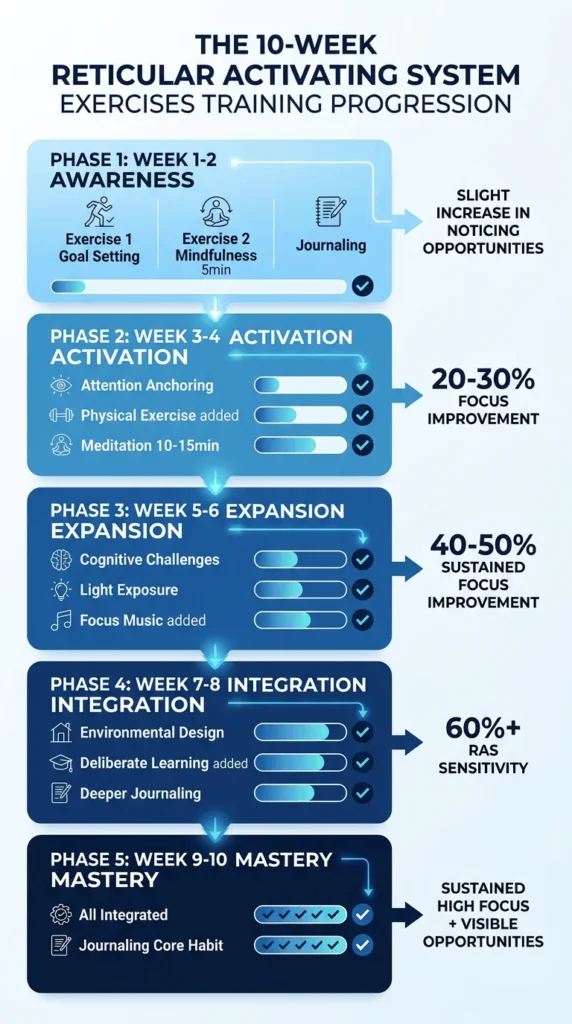
Noticeable improvement (2-4 weeks): Focus noticeably better, distractions easier to ignore, opportunities start appearing.
Significant change (6-8 weeks): Expert-level focus, sustained concentration for 3+ hours, obvious opportunity detection.
Mastery (12+ weeks): RAS training becomes an automatic habit; opportunities feel “magnetic.”
Do all 10 reticular activating system exercises need to be done simultaneously?
No. Start with 2-3, add more gradually.
Recommended starter stack:
Exercise 1 (Goal Setting).
Exercise 3 (Mindfulness).
Exercise 7 (Light Exposure).
Exercise 10 (Journaling).
Do these for 3-4 weeks, then add other reticular activating system exercises.
Can reticular activating system exercises help if I have ADHD?
Yes, but differently. ADHD involves RAS dysregulation, so:
Exercises work, but may be slower.
Medication (if prescribed) should be combined with reticular activating system exercises.
Start with physical exercise (Exercise 5) + light exposure (Exercise 7).
Work with a healthcare provider for the best results.
What’s the difference between reticular activating system exercises and meditation?
Meditation (Exercise 3) is ONE of the reticular activating system exercises. It focuses purely on attention control.
Reticular activating system exercises is broader-it includes 10 different approaches to training your filtering system.
Meditation = depth in one area
Full reticular activating system exercises program = breadth across multiple systems
If I do reticular activating system exercises, will opportunities literally appear?
Not magically. What happens:
Opportunities that always existed become visible to you.
Your brain spots relevant information; your RAS now filters it differently.
You’re more likely to act on opportunities because they’re top-of-mind.
Example: Job postings for your dream role probably exist right now. But if your RAS isn’t trained for that, you won’t see them. Once you practice reticular activating system exercises, they “appear.”
Do I need any special equipment for reticular activating system exercises?
No. Most exercises require nothing:
Mindfulness: just you.
Physical exercise: your body (or a park).
Light exposure: sunlight (free).
Journaling: pen and paper.
Optional for reticular activating system exercises:
Light therapy lamp (~$30-50).
Focus music app (often free or ~$10/month).
Meditation app (often a free version available).
🖼️ The Bigger Picture: What Training Your RAS With These Exercises Teaches You
Learning to train your RAS with reticular activating system exercises isn’t just about focus. It teaches you something profound:
Your brain is not objective. What you pay attention to literally shapes your reality. What you stop paying attention to disappears from your world.
This has massive implications:
- Career: Train your RAS with reticular activating system exercises to notice entrepreneurial opportunities, and you’ll see business ideas everywhere.
- Relationships: Train your RAS to notice small acts of kindness, and people seem suddenly nicer.
- Creativity: Train your RAS to notice patterns with these exercises, and you become more creative.
- Mindset: Train your RAS to notice abundance, and scarcity thinking disappears.
Your RAS is the interface between your mind and reality. Training it with reticular activating system exercises is training your perception of the world itself.
📆 Your Action Plan: Start With Reticular Activating System Exercises This Week
Day 1-2: Setup
- [ ] Define one clear goal (be specific, not “get better,” but “get 10 clients in 3 months”).
- [ ] Write it down.
- [ ] Create a vision board or visual reminder.
Day 3-7: Foundation
- [ ] Start Exercise 1 (Goal visualization) – 5 min/day.
- [ ] Start Exercise 3 (Mindfulness) – 5 min/day.
- [ ] Start Exercise 7 (Morning light) – get outside within 2 hours of waking.
- [ ] Start Exercise 10 (Journaling) – 5 min before bed.
Week 2: Building
- [ ] Increase meditation to 10 minutes.
- [ ] Add Exercise 5 (Physical activity) – 20-30 min, 3x this week.
- [ ] Journal: Write what opportunities you noticed.
Week 3+: Expansion
- [ ] Evaluate what’s working.
- [ ] Add Exercise 4 (Cognitive challenges) or Exercise 2 (Attention anchoring).
- [ ] Continue core 4 reticular activating system exercises (1, 3, 7, 10).
- [ ] Rotate through remaining exercises as interest allows.
⭐ Final Thoughts: Your RAS Is Waiting to Work for You Through These Exercises
Your Reticular Activating System is like having a personal assistant who filters the world for you. Right now, it’s filtering for whatever’s been habitual distractions, worries, routine.
But you can reprogram it with reticular activating system exercises.
With just 15-45 minutes daily of focused practice using these exercises, your RAS will start working for you instead of against you. Opportunities will appear. Distractions will fade. Focus will come naturally. Learning will accelerate.
The change won’t feel supernatural. It will feel like you suddenly became smarter, luckier, and more focused. But really, you just trained your brain’s filter to work in your favor through consistent reticular activating system exercises.
Start today. Pick one exercise. Do it for one week. Then notice what changes.
Scientific Sources for Reticular Activating System Exercises Research:
- Moruzzi, G., & Magoun, H. W. (1949). “Brain stem reticular formation and activation of the EEG.” Electroencephalography and Clinical Neurophysiology, 1(4), 455-473.
- Classic foundational study establishing the RAS
- Garcia-Rill, E. (1991). “The pedunculopontine tegmentum: A brain-stem region involved in eye movements, breathing, and REM sleep.” Reviews in the Neurosciences, 3(2), 91-131.
- Brown, R. E., Basheer, R., McKenna, J. T., Strecker, R. E., & McCarley, R. W. (2012). “Control of sleep and wakefulness.” Physiological Reviews, 92(3), 1087-1187.
- Comprehensive review of RAS function and attention
- Hahn, B., Ross, T. J., & Stein, E. A. (2007). “Neuroanatomical dissociation between bottom-up and top-down processes of visuospatial attention.” NeuroImage, 32(2), 842-853.
- Shows how attention filtering occurs at multiple brain levels
- Tang, Y. Y., Hölzel, B. K., & Posner, M. I. (2015). “The neuroscience of mindfulness meditation.” Nature Reviews Neuroscience, 16(4), 213-225.
- Evidence that mindfulness directly trains RAS and attention networks
- Garcia-Rill, E., Virmani, T., Hyde, J. R., D’Onofrio, S., & Mahaffey, S. (2016). Arousal and the control of perception and movement. Current trends in neurology, 10, 53.
- Greenwood, B. N., & Fleshner, M. (2011). “Exercise, stress resistance, and central serotonergic function.” Exercise and Sport Sciences Reviews, 39(3), 140-149.
- Shows physical exercise activates RAS through neurotransmitter pathways
- Gribble, P. L., & Ostry, D. J. (2016). “Series and parallel sensorimotor learning.” Journal of Neuroscience, 36(2), 428-438.
- Evidence that deliberate practice shapes RAS sensitivity and learning
- Tapia, J. A., Trejo, A., Linares, P., Alva, J. M., Kristeva, R., & Manjarrez, E. (2013). Reticular activating system of a central pattern generator: premovement electrical potentials. Physiological Reports, 1(5).
- Schwartz, J. R., & Roth, T. (2008). Neurophysiology of sleep and wakefulness: basic science and clinical implications. Current neuropharmacology, 6(4), 367-378.
Learn, Help Family And Friends, And Help The Planet!