🎯 A Bridge Between Worlds
Alan Watts (1915–1973) was far more than a philosopher. He was a translator of worlds – the brilliant mind who taught millions of Westerners that they weren’t separate from the universe, but expressions of it.
In a world obsessed with striving, accumulating, and controlling, Watts whispered a radical truth: You are already home. You’ve always been home. You just forgot.

Why Watts matters now more than ever:
🌍 In our fragmented, polarized world, his teaching of interconnection is medicine.
⏰ In our hyper-productive culture, his advocacy for presence and ease is revolutionary.
🧠 In our existentially anxious times, his perspective on death and impermanence brings peace.
💚 In our spiritually hungry age, his bridge between East and West is exactly what’s needed.
What you’ll discover:
- 🎓 His life: From Christian priest to Zen ambassador (his radical transformation).
- 🌏 His core philosophy: The illusion of the separate self, the nature of reality, the way forward.
- 🔄 How to practice it: Concrete exercises to dissolve ego and embrace the present.
- 7️⃣ Your 7-day Watts protocol: Integrating his teachings into daily life.
- ❓ FAQ: Addressing the deepest questions his philosophy raises.

Muse Headband: A Game-Changer for Meditation
Exploring the Life and Philosophy of Alan Watts
🎓 PART 1: THE LIFE OF A TRANSLATOR
From Christianity to Zen: A Radical Journey
1915: Alan Wilson Watts was born in Chislehurst, Kent, into an ordinary English family with extraordinary intellectual currents.
The turning point: As a teenager, Watts discovered a book on Asian culture. It was like someone handing him a key to a room he didn’t know existed. Suddenly, the narrow worldview of Western Christianity felt insufficient.
His early path:
- 📚 Self-educated himself in Zen Buddhism, Taoism, and Hinduism.
- ⛪ Became an ordained Anglican priest (playing the role society expected).
- 🤝 Met D.T. Suzuki (the master who brought Zen to the West) and everything shifted.
- 🔓 Realized he couldn’t authentically remain a Christian priest while believing differently.
The crisis: Watts faced a choice every awakened person faces: Live inauthentically for approval, or risk rejection for truth?
He chose truth. He left the priesthood.
What followed: A lifetime of translating the untranslatable – making Zen poetry accessible, explaining Taoism without losing its essence, helping Westerners see that Eastern and Western consciousness aren’t enemies but complements.
Why His Timing Was Perfect
The 1960s counterculture was hungry for exactly what Watts offered:
✨ Alternative to materialism ✨ Spiritual legitimacy ✨ Intellectual rigor ✨ Poetic beauty.
While others were experimenting with LSD, seeking what Watts taught (ego dissolution, unity consciousness), he remained clear: The drugs show you; the discipline keeps you there.
His lectures became cult classics. His books sold millions. His charismatic speaking style made philosophy feel like a conversation, not a lecture.
The irony: Watts taught non-attachment while becoming famous. He taught presence while giving hundreds of lectures. He taught simplicity while living a complex life. This paradox – living the tension between teaching and practice – is precisely what made him so real.
🌏 PART 2: THE CORE PHILOSOPHY
The Illusion of the Separate Self
Here’s Watts’ foundational insight: You are not a separate ego living in a body. You are the universe experiencing itself through a particular perspective.
What this means:
Most people experience themselves as:
- 🎪 A central “me” (subject) observing the world (object).
- 📍 An isolated entity trapped inside a body.
- ⚔️ An individual ego in competition with other egos.
- 🕰️ A continuous thread of identity persisting through time.
Watts says this is the illusion.
The reality:
- 🌊 You’re a process, not a thing (like a wave that thinks it’s separate from the ocean).
- 🌌 Your consciousness is inseparable from universal consciousness.
- 🎭 The “self” is a useful fiction, but not your ultimate nature.
- 🔄 Identity is constantly recreating itself (you’re not the same “you” from moment to moment).
The proof? Try to find the “you” that exists independent of:
- Your thoughts (but you’re not your thoughts – you’re aware of them).
- Your body (but you’re not just your body – you animate it).
- Your past (but you’re not bound by it – you’re free right now).
- Other people (but they shape and define you).
Where is this “self” you’re looking for? Nowhere. It’s a ghost.
And that’s liberation.
Because once you realize the separate self is an illusion, you’re free from:
- Fear of death (there’s no “me” to die – consciousness continues).
- Anxiety about the future (the only moment you can live in is now).
- Isolation (you’re never actually separated from the whole).
- The need to control everything (when you’re the entire dance, not a dancer).
The Nature of Reality: Process, Not Substance
Western philosophy asks: “What is reality made of?” (Atoms? Matter? Ideas?)
Watts flips the question: “Is reality made of things or is it a process?”
Western answer: Things. Reality is composed of static substances.
Eastern answer: Process. Reality is a verb, not a noun. It’s flowing, changing, dancing.
Why this matters:
When you see reality as things:
- 🏗️ You think you can build permanence (but everything changes).
- 🎯 You try to fix yourself into a better version (but self is already flow).
- ⚡ You experience resistance to change (because change seems like failure).
When you see reality as process:
- 🌊 You surrender to the dance of becoming.
- 🎨 You participate in creative change rather than resist it.
- 😌 You stop trying to make yourself permanent and enjoy the flow.
Example: You think your body is a thing you inhabit. But your body is a process – cells dying and being born, atoms cycling through the ecosystem. You’re not in your body; you’re a body-ing (a bodily process).
Similarly, you’re not a self; you’re a self-ing – an ongoing process of becoming.
The Nature of Consciousness: You’re Not in the World, The World is in You
Here’s where Watts gets truly radical.
Most people believe:
- 🧠 Consciousness is generated by the brain (inside your head).
- 👀 Your brain observes an external world.
- 📡 Information flows from the world → eyes → brain (then experience happens).
Watts suggests the opposite:
What if your brain is a receiving antenna for universal consciousness, not the source of it?
What if the world isn’t outside you – consciousness is the environment in which the world appears?
Think of it like dreaming:
- 🌙 When you dream, you create entire universes (people, places, physics).
- 🧠 You do this entirely with your brain.
- 🎬 You’re both the dreamer and the dream simultaneously.
- ✨ There’s no “external world” in the dream – just consciousness taking forms.
What if waking life is the same? What if the entire universe is consciousness dreaming itself into existence, and you’re a particular eddy in that flow – a local form of the whole thing?
This isn’t mysticism. It’s a different interpretation of the same facts:
- ✅ We don’t experience the “external world” directly – we experience our brain’s representation of it.
- ✅ All experience is internal (happening in consciousness).
- ✅ So logically, the world exists within consciousness, not the other way around.
The freedom this brings: If you’re not a separate consciousness trapped in an alien universe, then you’re not alone. You’re always intimately connected to everything.
🔄 PART 3: THE PRACTICAL PATH
Wu Wei: The Way of No-Way
This Taoist concept is Watts’ favorite teaching: Wu wei = effortless action, non-forcing, going with the grain.
What it’s not:
- Passivity or laziness.
- Giving up or resignation.
- Going along with everything.
What it is:
- ⛵ Sailing with the wind instead of rowing against it.
- 🎨 Creating with the flow instead of imposing your will.
- 🌊 Surfing the wave instead of fighting the water.
- 🎭 Dancing the dance instead of trying to choreograph it.
Example: A martial artist practicing wu wei doesn’t muscle their opponent. They use the opponent’s own force against them. They flow with the attack and redirect it.
In daily life:
Instead of:
- 💪 Forcing yourself to meditate (“I must sit still for 30 minutes!”).
- 🚀 Pushing toward success (hustle culture, always striving).
- 🎯 Controlling others (nagging, manipulating, demanding).
Practice wu wei by:
- 🧘 Meditating naturally (sit when you’re genuinely drawn to it).
- 🌱 Allowing success to emerge (work intelligently, then let go of outcome).
- 🤝 Influencing gently (suggest, model, allow others their freedom).
The secret: The more you relax and surrender, the more effective you become.
This is counterintuitive for Western minds trained in force, willpower, and control. But science backs it up – when you’re in a state of ease rather than strain, your nervous system is optimized for peak performance.
Presence: The Only Time You’re Alive
Watts constantly hammered on this: The present moment is the only time you ever actually live.
- 🕐 The past is memory (experience, not reality).
- 🕑 The future is imagination (possibility, not reality).
- 🕒 Only now is real.
Yet most people live:
- 😔 Haunted by the past (replaying mistakes, holding grudges).
- 😰 Anxious about the future (planning, worrying, anticipating).
- 🎬 Completely absent from now.
Watts’ antidote: Notice the present moment with all your senses.
See:
- The play of light on surfaces.
- The texture of objects.
- The colors and shapes around you.
Hear:
- Bird songs.
- Wind in trees.
- The ambient hum of existence.
Feel:
- Temperature on your skin.
- Texture in your hands.
- Your breath moving in and out.
Taste and smell:
- The flavor of your tea.
- The scent of flowers.
- The aroma of food.
By fully inhabiting sensory experience, you return to the present. And in the present, there’s no anxiety, no regret – only being.
This is precisely what mindfulness teaches. Watts’ philosophy is the poetry behind the practice.
Muse Headband: A Game-Changer for Meditation
🔀 PART 4: THE 7-DAY WATTS PROTOCOL
The Goal
Integrate Watts’ philosophy into lived experience. Not as belief, but as knowing.
Day 1: The Illusion of Self
Morning practice (20 minutes):
The simple exercise:
Sit comfortably. Close your eyes.
Now try to find the “I” that’s doing the observing.
- You can find thoughts, but they arise and pass – you’re aware of them, so you’re not them.
- You can feel sensations, but you’re aware of them, so you’re not them.
- You can observe emotions, but you’re the awareness, not the emotion.
Keep going deeper: What remains when you strip away all of this? What is aware of all phenomena?
Don’t answer intellectually. Just notice: awareness itself is what you are. And awareness has no shape, no boundary, no self.
Evening reflection (10 minutes):
Journal: “What shifted when I recognized that the ‘me’ I thought I was is a fiction?”
Day 2: The Flow of Reality
Morning practice (30 minutes):
Observe process:
Pick something in nature (a stream, wind in trees, clouds, fire, rain).
Watch it for 30 minutes without interpretation.
Notice:
- How it’s constantly changing.
- How there’s no “thing” being moved – there’s movement itself.
- How every particle is in process.
- How you, too, are part of this flow.
Evening reflection:
“Where in my life am I resisting change? Where could I flow with what’s happening instead of fighting it?”
Day 3: Wu Wei in Action
Throughout the day:
Choose one activity and do it with zero force.
Examples:
- 🧘 Meditation: Don’t “try hard.” Simply sit. Let attention rest naturally.
- 💼 Work: Don’t strain. Work calmly, intelligently, then release attachment to results.
- 👨👩👧👦 Relationships: Don’t manipulate or control. Express yourself authentically, then let others respond as they will.
- 🚶 Walking: Don’t march purposefully. Stroll. Notice your feet contacting earth.
The practice: Feel the difference between force and flow. Notice how effortless action is both more relaxed and more effective.
Day 4: Presence – The Sensory Immersion
Morning (15 minutes):
Take a single activity (drinking tea, eating breakfast, walking outside) and do it with complete sensory presence.
No thinking about past or future. Just:
- See: colors, light, texture.
- Hear: sounds, silence between sounds.
- Feel: temperature, texture on skin.
- Taste/smell: the actual flavors and aromas.
Notice: When you’re fully present in sensation, where is anxiety? Where is the sense of separate self?
Evening reflection:
“How often am I actually here? Where is my consciousness usually located (past, future, abstraction)? What would life be if I lived 30% more of it in the present?”
Day 5: The Universe Expressing Itself
Practice (20 minutes):
Contemplate your interconnectedness:
- The oxygen in your lungs came from trees.
- The water in your body cycles through oceans and clouds.
- The atoms in your cells were forged in stars.
- The consciousness animating you is the same in all beings.
You are not in the universe. You are the universe, locally expressed.
“How does my life change when I deeply know I’m not separate from everything? How do my relationships shift? My ambitions? My fears?”
Day 6: Ego Dissolution in Presence
Practice (30 minutes):
Sit with the paradox:
Notice how the “self” dissolves in genuine presence. When you’re fully absorbed in an activity you love, where is the ego that was anxious moments ago?
When you’re lost in conversation with someone you love, where is the self-consciousness?
When you’re in nature, fully present, where is the sense of being separate?
The insight: The self exists in abstraction (thought, memory, imagination). In direct sensory presence, it disappears.
Evening:
“What would it be like to live more from this place of dissolved ego? Who would I become? What would I stop doing? What would I start?”
Day 7: Integration and Commitment
Morning reflection (30 minutes):
Review the week:
- What shifted in how you see yourself?
- How did wu wei change your effectiveness?
- What did presence reveal?
- What practices felt most alive?
Create your Watts practice going forward:
Choose one practice to commit to:
- Daily sensory presence (15 minutes minimum).
- One activity daily with wu wei (no forcing).
- Weekly nature immersion (30+ minutes fully present).
- Monthly meditation retreat (deepening the dissolution of ego).
The commitment: For the next month, practice this one thing consistently. Let Watts’ philosophy move from intellectual understanding to lived knowing.
📒 Related reads you might enjoy:
- 🤫 Enjoy The Silence: The Healing Power of Silence for Mind, Body & Soul
- 📽️ Finding Joe Documentary: Joseph Campbell’s Hero’s Journey Explained (Documentary Review)
🎁 TOOLS THAT AMPLIFY WATTS’ TEACHINGS
📖 The Element by Ken Robinson
Robinson explores how finding your passion (your “element”) aligns with Watts’ teaching of wu wei – effortless action in the direction of your nature. When you’re in your element, you’re in flow, not forcing.

The Element by Ken Robinson
In The Element, renowned educator Ken Robinson explores the intersection of passion and talent, showcasing how finding one’s unique element can lead to greater fulfillment. This thought-provoking book provides insights into connecting personal passions with professional pursuits.
🚶 Walking by Henry David Thoreau
Thoreau’s meditation on walking is Watts’ presence practice in action. Walking deliberately, observing nature deeply – this is how you return to the present moment.
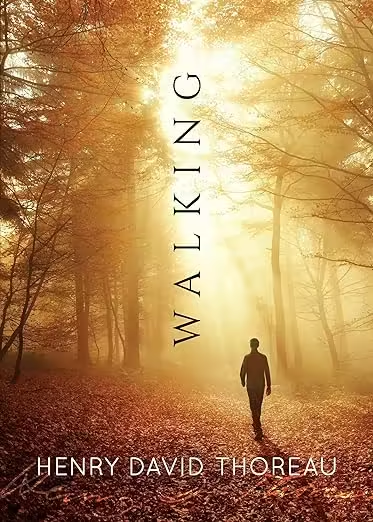
Walking by Henry David Thoreau
In Walking, Henry David Thoreau explores the intrinsic connection between nature and the human spirit. This seminal work emphasizes the importance of immersing oneself in the natural world through the simple act of walking.
⏰ Happier Hour by Cassie Holmes
Science-backed guide to aligning your time with your values. Perfectly complements Watts’ teaching that how you spend your days is how you spend your life. Make presence and meaning your priority.

Happier Hour by Cassie Holmes
Ever wondered how to squeeze more joy from each day? Enter the Happier Hour book by Cassie Holmes! With a witty flair, Holmes teaches us that the secret to happiness is not in the quantity of time, but in the quality of our experiences. Who knew optimizing our hours could be this fun?
❓ FAQ – ALAN WATTS & HIS PHILOSOPHY
Q: Isn’t Watts’ philosophy just “give up and accept everything”?
A: No. Wu wei isn’t passivity – it’s intelligent responsiveness. You work effectively, but without strain. You create, but in harmony with what wants to emerge. You accept what you can’t control while acting with full commitment in what you can influence.
Q: How does Watts’ philosophy connect to modern psychology?
A: Perfectly. Modern psychology (especially mindfulness-based therapies) is discovering what Watts taught: ego dissolution reduces anxiety, presence heals trauma, self-compassion emerges when you see your illusory nature.
Q: If the self is an illusion, why does it feel so real?
A: Because it is functionally real. The ego is useful for navigating daily life. But it’s not your ultimate nature. Like a character in a movie is “real” within the film but ultimately an illusion projected on a screen. You’re the screen, not the character.
Q: How does Watts’ teaching on interconnection relate to holistic living?
A: Holistic living is Watts’ philosophy in action. When you understand interconnection, you naturally care for your whole being (mind, body, spirit) and your relationships and the planet. It’s not fragmented wellness – it’s unified being.
Q: Can I practice Watts’ philosophy without meditation?
A: Yes, though meditation deepens it. You can live wu wei, practice presence, and contemplate interconnection in daily life. But meditation gives you direct experience of ego dissolution and presence that thinking about it never can.
🌟 THE BOTTOM LINE
Alan Watts didn’t teach philosophy – he taught freedom.
The freedom to stop trying to be someone and realize you’ve always been the whole.
The freedom to stop forcing and discover how effortless mastery is.
The freedom to stop living for a future and wake up to the eternal now.
In a world obsessed with productivity, accumulation, and becoming, Watts whispers: You are already complete. You are already home. You are already the whole thing. Stop seeking and start seeing.
🎯 Ready to Wake Up?
Download our Free Expert-Crafted Holistic Routine – a complete guide integrating mindfulness practice, daily presence, philosophical contemplation, and authentic living.🆓
This routine shows you how to live Watts’ philosophy in real time – not as belief, but as lived awakening.
Join 300+ subscribers living as if they’ve already woken up.
Learn, Help Family And Friends, And Help The Planet!




)