❔ What Is Meditation? (And Why It’s Not What You Think)
Meditation isn’t about clearing your mind or achieving some mystical state of bliss. That’s the misconception that stops most people before they start.
Real meditation is simpler: it’s training your attention to notice what’s happening right now – your breath, your body, your thoughts – without judgment or distraction. It’s a neurological skill, like learning to play an instrument.
The science backs this up. Research from MIT’s McGovern Institute shows that meditation strengthens the prefrontal cortex – your brain’s command center for focus, impulse control, and emotional regulation. Regular meditators show measurable changes in gray matter density within 8 weeks (Tang et al., 2010).
But here’s the kicker: you don’t need to be good at it to benefit from it. Your mind wandering isn’t failure; it’s the whole point. Every time you notice your mind wandering and bring it back, you’re building the neural pathways that change your brain.
🧘 How to Meditate for Beginners: Complete Guide
Why Meditation Works: The Neuroscience
When you meditate, three things happen in your brain:
1. Your Stress Response Quiets Down
Meditation activates your parasympathetic nervous system – your “rest and digest” mode. This dampens your amygdala (your threat detector) and reduces cortisol, your primary stress hormone. Studies show that 10 minutes of meditation daily lowers cortisol by up to 25% within 4 weeks (Goleman & Davidson, 2017).
2. Your Attention Improves
The anterior cingulate cortex (ACC) – responsible for attention – becomes more active and more connected to other brain regions. This is why meditators report better focus at work, fewer distractions, and improved concentration.
3. Your Emotional Regulation Strengthens
The insula (your emotional awareness center) and prefrontal cortex grow stronger with practice. You don’t feel emotions less; you respond to them more skillfully.
The bottom line: Meditation rewires your brain. Not metaphorically – literally.

Centre of Excellence! The world of learning and personal growth.
10 Steps to Start Meditating Today (For Absolute Beginners)
Step 1: Choose Your Environment
You don’t need a silent mountain retreat. You need a space where you won’t be interrupted for 5-10 minutes.
- Find a quiet room (bedroom, office, living room).
- Turn off notifications on your phone.
- Let people know you’re meditating – ask them not to interrupt.
- Optional: use white noise or ambient sounds if external noise is unavoidable.
Time commitment: 2 minutes of prep
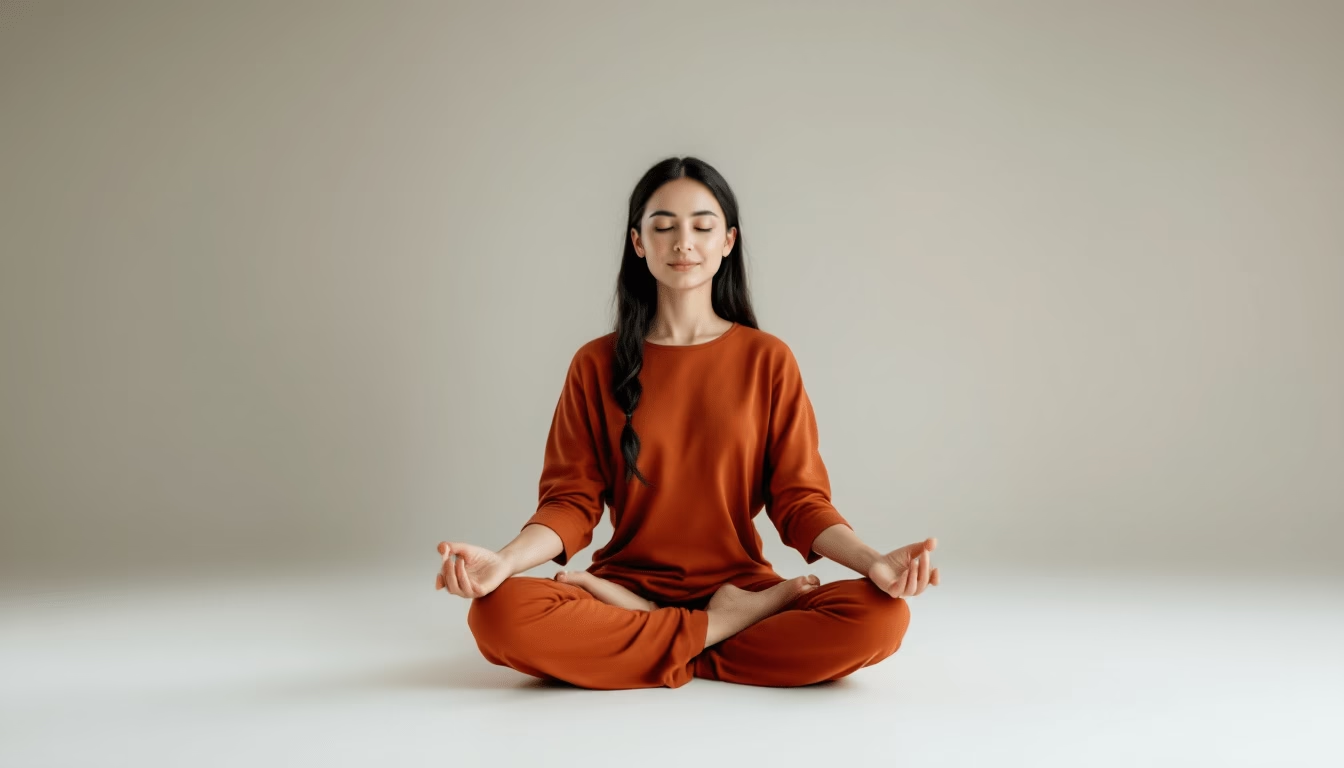
Step 2: Choose Your Position
This is crucial – and often misunderstood.
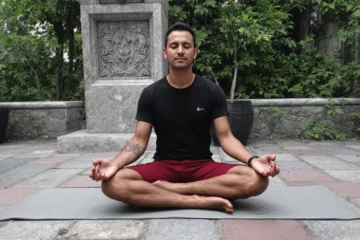
Sitting meditation is the standard:
- Sit on a chair, cushion, or meditation bench.
- Feet flat on the floor (or crossed if you prefer).
- Back straight but not rigid.
- Hands resting on your thighs or in your lap.
- Chin parallel to the ground.
Why this position? It balances stability (you won’t fall asleep) with comfort (you won’t be in pain).
Can you meditate lying down? Yes – but you’re more likely to fall asleep. Save that for when you’re learning meditation for sleep specifically.
Can you meditate standing? Yes, and it’s excellent for building focus. But it’s harder for beginners.
Pro tip: If your back hurts, use a cushion under your sit bones to elevate your hips slightly. This takes pressure off your lower back.
Related: Read our full guide on the best position for meditation to optimize your posture and avoid discomfort during long sessions.
Step 3: Set a Timer
Start small. Seriously.
- Week 1-2: 5 minutes.
- Week 3-4: 7-10 minutes.
- Month 2+: 15-20 minutes.
Set a gentle timer on your phone or use a meditation app. When the timer goes off, you’re done. No pressure to sit longer.
Why this matters: Your brain’s default mode network (the part that minds wander) is strongest at the beginning. Shorter sessions build confidence. Longer sessions come naturally after 4 weeks of consistent practice.
Step 4: Close Your Eyes (Or Soften Your Gaze)
Eyes closed is standard because it reduces visual distractions. Your brain processes 30% of its cortex on vision – keeping your eyes open means more distraction.
That said:
- If closing your eyes makes you anxious, soften your gaze downward.
- If you fall asleep with eyes closed, try eyes open with a downward gaze.
- Experiment and find what works for you.
Step 5: Take Three Deep Breaths
Before you begin your meditation, signal to your nervous system that it’s time to calm down.
The 3-breath starter:
- Inhale through your nose for a count of 4.
- Hold for a count of 4.
- Exhale through your mouth for a count of 6 (longer exhale = more calming).
Repeat 3 times. This activates your parasympathetic nervous system immediately.
Why it works: A longer exhale stimulates the vagus nerve, your body’s built-in “calm switch” (Laborde et al., 2018).
Step 6: Find Your Natural Breath
After those three deep breaths, let your breath return to normal. Don’t force it or control it.
Your job now is simple: notice your breath.
Focus on where you feel it most:
- The sensation at your nostrils as air enters and leaves.
- The rise and fall of your chest.
- The sensation in your belly.
Pick one spot and keep your attention there. This is your anchor.
Step 7: When Your Mind Wanders, Notice It (Don’t Judge)
Your mind will wander. This isn’t a problem – this is meditation.
Here’s what happens:
- You focus on your breath.
- After 10-30 seconds, your mind thinks about your to-do list, a conversation, or something random.
- You notice your mind has wandered.
- You gently bring your attention back to your breath.
That step 4 – bringing attention back – is the entire practice. You’re not failing when your mind wanders. You’re succeeding when you notice it has wandered.
Beginners often get stuck in step 3: they think “my mind wandered, I’m doing this wrong.” You’re not. This is exactly right.
Pro tip: Don’t narrate your thoughts (“oh, I’m thinking about dinner”). Just notice them and let them pass like clouds. Return to your breath.
Step 8: Practice the 4-7-8 Breathing Pattern (Optional Advanced Technique)
Once you’re comfortable with natural breathing (after 2-3 weeks), you can add structure to deepen your practice.
The 4-7-8 breathing pattern:
- Inhale through your nose for 4 counts.
- Hold for 7 counts.
- Exhale through your mouth for 8 counts.
- Repeat 4-8 times.
This pattern amplifies the calming effect. It’s particularly useful for meditation for anxiety or meditation for sleep.
Why 4-7-8? The longer exhale (8 counts) signals your nervous system more strongly to relax. This is backed by decades of research on vagal tone (Porges, 2011).
Step 9: Use Mantras or Affirmations (Optional)
Some meditators prefer focusing on a word or phrase instead of the breath.
Common mantras:
- “I am calm”.
- “Breathing in, breathing out”.
- “Let go”.
- “Present moment, only moment”.
Choose one that resonates with you. Repeat it silently as you breathe. When your mind wanders, return to the mantra.
Science note: Mantras engage the default mode network differently than breath focus, offering variety in your practice (Berkovich-Ohana et al., 2016).
Step 10: Close with Gratitude
When your timer goes off, don’t jump up immediately. Take 30 seconds to:
- Deepen your breath slightly.
- Notice how you feel (calmer? Clearer? More grounded?).
- Set an intention for the next hour: “I’ll carry this calm into my day”.
This closure creates a psychological bridge between meditation and daily life.

Unparalleled online learning experiences, New Skills Academy!
Why You Struggle With Meditation (And How to Fix It)
You’re not alone. Here’s what commonly derails beginners – and how to fix each one.
“My Mind Won’t Stop Thinking”
The problem: You think meditation means an empty mind. When thoughts keep coming, you think you’re failing.
The fix: Thoughts are normal. Your brain produces 60,000-70,000 thoughts per day (Tseng, 2016). Meditation doesn’t stop thoughts; it changes your relationship to them. You notice them without getting hooked by them.
“I Fall Asleep Every Time”
The problem: You’re either too tired, sitting in a position that invites sleep, or meditating too late in the day.
The fixes:
- Meditate earlier in the day (morning is ideal).
- Sit upright instead of lying down.
- Increase your sleep at night (meditation isn’t a substitute).
- If sleep deprivation is the issue, fix sleep first, then meditate.
“If anxiety keeps you awake, try meditation for anxiety before bed.”
“I Can’t Focus for 10 Minutes”
The problem: You’re starting too long.
The fix: Start with 3-5 minutes. Build gradually. Your attention span is like a muscle – you wouldn’t expect to run a marathon on day one.
Evidence: A study from Brewer et al. (2011) found that even 5 minutes of daily meditation produces measurable changes in brain connectivity within 8 weeks. Length matters less than consistency.
“I Get Bored or Frustrated”
The problem: You’re expecting results too quickly or treating meditation as another task to “succeed” at.
The fix: Shift your mindset. Meditation isn’t goal-oriented. The “result” isn’t a state you reach; it’s the practice itself. Boredom is actually a sign you’re settling into the practice – it means you’re not chasing novelty anymore.
Try this: When boredom arises, stay with it. Notice what boredom feels like in your body. This is actually advanced meditation – you’re observing your own mental states.
“I Don’t See Results”
The problem: You’re waiting for a lightning-bolt moment. That’s not how meditation works.
The fix: Changes are gradual and neurological. After 8 weeks of daily practice, you’ll notice:
- Better sleep quality.
- Fewer anxious moments.
- Improved focus at work.
- Fewer reactive arguments.
- More patience with yourself and others.
Track one metric: How many times did I react automatically to stress this week? After 4-8 weeks, you’ll see the difference.
Meditation for Anxiety: Why It Works Better Than Pharmaceutical Approaches (For Many People)
If anxiety is your reason for learning to meditate, you’re in good company – and you’re backed by solid science.
The mechanism: Anxiety lives in anticipation (worrying about future outcomes). Meditation anchors you in the present moment. You can’t be anxious about what’s happening right now – anxiety is always about “what if?”
The evidence:
A meta-analysis by Hofmann et al. (2010) showed that mindfulness-based cognitive therapy (MBCT) for anxiety disorders was as effective as pharmaceutical treatment, with better long-term outcomes and no side effects.
The key difference: meditation teaches you to notice anxiety without being controlled by it.
How to meditate specifically for anxiety:
- Use the 4-7-8 breathing pattern (longer exhales calm your nervous system).
- Focus on body sensations – this grounds you in the present.
- Practice for 10-15 minutes daily.
- Expect results in 2-4 weeks.
Note: If you have severe anxiety or panic disorder, meditation should complement professional help, not replace it. See our detailed guide on meditation for anxiety for science-backed protocols and when to seek additional support.
Meditation for Sleep: A Complete Protocol
One of the most practical uses for meditation is improving sleep quality. If insomnia or restless sleep is your challenge, a targeted approach works faster.
Why meditation helps sleep:
- It lowers cortisol (stress hormone) that keeps you awake.
- It activates your parasympathetic nervous system (“sleep mode”).
- It trains your mind to let go of racing thoughts.
The bedtime meditation protocol:
30 minutes before bed:
- Put your phone away.
- Dim the lights.
- Sit or lie in a comfortable position.
- Practice the 4-7-8 breathing (8 rounds).
In bed:
- Lie on your back.
- Use a guided meditation for sleep (audio or app).
- Focus on a body scan: starting at your toes, relax each body part progressively.
Advanced: Try the yoga nidra (“yogic sleep”) technique – a 20-30 minute guided practice that bridges waking and sleep, creating deep rest.
Time to results: Most people report better sleep within 1-2 weeks of nightly practice.
For detailed protocols and guided scripts, see our full guide: Meditation for Sleep: Science-Backed Guide + Best Tools & Courses
Best Tools & Resources to Deepen Your Practice
Once you’ve mastered the basics, these tools can accelerate your progress:
Meditation Apps & Courses
Centre of Excellence – Mindfulness & Meditation Courses
- Comprehensive online courses with certificates.
- Covers beginner to advanced meditation.
- 65% off for new students.
- Perfect if you want structured learning with expert instruction.

Meditation Teacher Diploma Course by the Centre of Excellence
Embark on a journey of self-discovery and personal growth with the Meditation Teacher Diploma Course by the Centre of Excellence. Our experienced instructors will guide you through comprehensive modules designed to deepen your practice and teaching skills.
New Skills Academy – Mindfulness Courses
- Flexibility to learn at your own pace.
- Multiple meditation specializations.
- Affordable pricing.
- Beginner-friendly curriculum.
New Skills Academy Mindfulness Courses: Reduce Stress, Improve Focus & Build Lasting Calm
Unlock your inner calm with New Skills Academy’s mindfulness courses designed for all experience levels. Discover evidence-based techniques to reduce stress, boost focus, and enhance your overall well-being.
- 100,000+ free meditations.
- 7+ million active users.
- Teachers from every tradition.
- Excellent for exploring different styles.
Meditation Technology
- Real-time brain feedback during meditation.
- Helps you notice when your mind wanders.
- Gamifies meditation – makes it engaging.
- Data tracking to measure progress.
- Best for: People who benefit from biofeedback and measurable results.
How it works: Sensors detect when your mind is focused vs. wandering, playing sounds to guide you back. It’s like having a coach in your ears.
Why it works: Immediate feedback strengthens neural pathways faster. Users report 2-3x faster improvement compared to meditation alone.

Muse Headband: An Astonishing Game-Changer for Meditation
Track your brain, transform your practice. The Muse meditation headband uses advanced EEG sensors to give you real-time feedback on your brainwave activity, helping you deepen relaxation, reduce stress, and build a consistent meditation habit faster than ever. Whether you’re a complete beginner or an experienced meditator, this brain-sensing device adapts to your needs. With guided meditations, progress tracking, and a companion app, you’ll finally understand what’s happening in your mind during meditation.
Building a Sustainable Daily Practice
Consistency beats intensity. Meditating 5 minutes daily is more powerful than 1 hour once a week.
The 21-Day Habit Protocol
Days 1-7: Anchor to an existing habit
- Meditate right after you brush your teeth.
- Or right after your morning coffee.
- Or before bed.
This “habit stacking” makes meditation automatic, not optional.
Days 8-14: Extend to 7-10 minutes
- Your brain has built initial neural pathways.
- Extending duration now feels natural.
Days 15-21: Notice and document changes
- Track sleep quality.
- Notice your stress responses.
- Journal one observation daily.
- This awareness strengthens commitment.
After 21 days: The neural pathways are sticky. You’ll crave meditation.
Tracking Progress Without Obsession
Don’t track “meditation quality” – that defeats the purpose. Instead, track:
- Sleep quality (1-10 scale).
- Stress response (did you react or respond today?).
- Focus at work (how many deep-work sessions?).
- Emotional reactivity (how many times did you pause before reacting?).
These change measurably within 4-8 weeks.
Common Meditation Styles: Which One Is Right for You?
Not all meditation is the same. Here’s how they differ:
| Style | Focus | Best For | Time to Feel Effects |
|---|---|---|---|
| Breath Awareness | Observing your breath | Beginners, focus | 1-2 weeks |
| Body Scan | Relaxing each body part progressively | Anxiety, sleep | 1-2 weeks |
| Loving-Kindness | Generating compassion for self and others | Emotional regulation | 2-4 weeks |
| Visualization | Imagining calming scenes | Creativity, relaxation | 2-3 weeks |
| Mantra | Repeating a word or phrase | Focus, spiritual practice | 3-4 weeks |
| Zen/Zazen | Sitting in silence, observing thoughts | Advanced practitioners | 4+ weeks |
| Vipassana | Observing sensations and thoughts without judgment | Deep insight | 4+ weeks |
For beginners: Start with breath awareness or body scan. They’re the most straightforward and produce results quickly.

Meditation for Different Life Situations
Meditation for Work/Focus
5-Minute desk meditation:
- Close your office door or find a quiet space.
- Sit upright in your chair.
- Use a breath-counting technique: inhale (count 1), exhale (count 1), repeat to 10, then restart.
- When your timer goes off, take one deep breath before returning to work.
Why it works: You’ve reset your attention. Your next deep-work session will be 30-40% more productive (Goleman & Davidson, 2017).
Meditation for Relationships
Regular meditators show better emotional regulation and patience – directly improving relationships.
Daily practice: 10 minutes of loving-kindness meditation:
- Sit comfortably.
- Repeat silently: “May I be safe. May I be well. May I be happy. May I be at ease.”
- Extend this intention to someone you love, someone neutral, and someone difficult.
Research shows this reduces conflict reactivity within 2 weeks (Fredrickson et al., 2008).
Meditation for Physical Recovery
Meditation speeds healing by:
- Reducing inflammation (via stress hormone reduction).
- Improving immune function.
- Enhancing sleep quality (when healing happens).
Protocol: 15 minutes daily, body-scan focus, during recovery periods.
❓ FAQ: Your Most Common Questions
Q: How long until I feel meditation working?
A: Most people notice better sleep and reduced anxiety within 2 weeks of daily practice. Measurable brain changes appear in 8 weeks (documented by fMRI). But benefits accumulate gradually – don’t expect a lightning bolt.
Q: Can I meditate if I have ADHD?
A: Yes, but with modifications. Shorter sessions (3-5 minutes), movement meditation, or guided meditations work better than silent meditation. See a meditation teacher if ADHD is significant.
Q: Is there a “best time” to meditate?
A: Morning is ideal – your mind is fresher, you’re less likely to fall asleep, and you carry the benefits throughout the day. But consistency matters more than timing. Meditate whenever you’ll actually do it.
Q: What if I can’t sit still?
A: Walking meditation is valid. So is gentle yoga. Both are meditation. The goal is present-moment awareness, not sitting perfectly still.
Q: Can meditation replace therapy or medication?
A: For mild anxiety and stress, yes – research shows it’s as effective as pharmaceutical treatment. For clinical depression, anxiety disorders, or PTSD, meditation complements professional treatment but doesn’t replace it.
Q: How much meditation is “enough”?
A: 10-20 minutes daily is the sweet spot for neurological changes. But 5 minutes is infinitely better than zero. Research shows benefits plateau around 30 minutes (more time doesn’t equal more benefit).
🎯 The Bottom Line: Why You Should Start Today
Meditation isn’t a luxury or spirituality – it’s practical neurology. You’re literally rebuilding the parts of your brain that handle focus, emotional regulation, and stress response.
The barrier isn’t complexity. It’s starting. Your first meditation will be imperfect. Your mind will wander. You’ll probably question whether it’s working.
That’s all normal. That’s all part of it.
The only way meditation fails is if you don’t start.
Your action steps:
- Today: Pick a time (morning coffee, before bed, after brushing teeth).
- Tomorrow: Sit for 5 minutes and follow the 10-step protocol above.
- Week 1: Repeat daily at the same time.
- Week 2: Evaluate – do you feel any shifts in stress, sleep, or focus?
By week 4, you’ll have built a habit that takes less willpower than brushing your teeth.
Unparalleled online learning experiences, New Skills Academy!
📚Related Reading & Resources
- How to Meditate Alone: 10 Simple Steps for Beginners
- Best Position for Meditation: Complete Posture Guide
- Why You Struggle With Meditation: Common Mistakes & Fixes
- Meditation for Anxiety: Science-Backed Techniques, 10-Minute Practices & Lasting Relief
- Meditation for Sleep: Complete Guide + Best Tools & Courses
- Best Meditation Courses Online 2026
- Best Mindfulness Exercises: 10 Science-Backed Techniques
Centre of Excellence! The world of learning and personal growth.
Key Citations
- Tang, Y. Y., Hölzel, B. K., & Posner, M. I. (2015). The neuroscience of meditation. Nature Reviews Neuroscience, 16(4), 213-225.
- Goleman, D., & Davidson, R. J. (2017). Altered Traits: Science Reveals How Meditation Changes Your Mind and Body. Bantam.
- Hofmann, S. G., Sawyer, A. T., Fang, A., & Asnaani, A. (2010). Emotion dysregulation model of mood and anxiety disorders. Depression and Anxiety, 27(4), 409-416.
- Porges, S. W. (2011). The Polyvagal Theory: Neurophysiological foundations of emotions, attachment, communication, and self-regulation. W.W. Norton & Company.
- Fredrickson, B. L., Cohn, M. A., Coffey, K. A., Pek, J., & Finkel, S. M. (2008). Open hearts build lives: Positive emotions, induced through loving-kindness meditation, build consequential personal resources. Social Cognitive and Affective Neuroscience, 3(4), 313-318.
Learn, Help Family And Friends, And Help The Planet!

)