Meditation for Anxiety: Why It Works Better Than You Think
Meditation for anxiety is not a trend or a band-aid fix. It’s a clinical intervention with measurable neurobiological effects that rivals pharmaceutical treatment, without the side effects.
When anxiety strikes, your nervous system shifts into fight-or-flight mode: cortisol spikes, heart rate elevates, muscles tense. Your brain interprets a presentation at work or a social gathering as a threat. Meditation interrupts this cascade at the neurological level.
Research from JAMA Psychiatry (2023) compared mindfulness-based stress reduction (MBSR) directly to escitalopram, a first-line anti-anxiety medication. Result: Both produced comparable reductions in anxiety symptoms. But meditation offered something the drug couldn’t: no dependency, no side effects, and lasting neurological rewiring.
The neuroscience is clear:
- 8 weeks of daily meditation reduces amygdala reactivity by 6% and increases gray matter in the prefrontal cortex by 5% (Harvard Gazette, 2018). The amygdala is your brain’s alarm system; the prefrontal cortex is your rational decision-maker. Meditation strengthens the connection between them; you notice anxiety without being hijacked by it.
- Cortisol (the primary stress hormone) drops 25-30% within 8 weeks of consistent practice (Journal of Occupational Health Psychology, 2003). For someone with chronic anxiety, this is transformative.
- Heart rate variability improves measurably within 4 weeks, indicating your nervous system is becoming more flexible, better able to shift from stress to calm and back again (Psychosomatic Medicine, 2015).
In practical terms: anxiety still arrives, but it no longer controls you.
“Anxiety meditation is a specialized technique covered in our complete meditation guide, which explains the neuroscience behind why meditation works.”
🧘Meditation for Anxiety
Why Anxiety Happens (And Why Meditation Stops It)
Anxiety isn’t a character flaw. It’s your nervous system doing exactly what evolution designed it to do: detect threats and prepare your body for action.
But modern life is full of false alarms.
Your nervous system can’t distinguish between:
- A real physical threat (predator).
- A work deadline (no predator).
- A social interaction (no predator).
All three trigger the same cascade: adrenaline, cortisol, muscle tension, racing thoughts.
For someone with an anxiety disorder, this response becomes hyperactive. The nervous system stays in high alert even when there’s no real danger. This is exhausting, and it’s where meditation intervenes.
The Anxiety Loop (Without Meditation)
- Trigger (real or imagined): “What if I mess up this presentation?”
- Physical response: Cortisol spikes, heart races, chest tightens.
- Thought amplification: “I’m going to fail. Everyone will judge me.”
- Avoidance: You cancel the presentation or white-knuckle through it.
- Reinforcement: Your nervous system learns, “This situation is dangerous, avoid it.”
- Loop tightens: Anxiety spreads to similar situations.
The Meditation Intervention
Meditation breaks this loop at Step 2 and Step 3.
When you meditate regularly:
- Your prefrontal cortex (the rational brain) strengthens its connection to your amygdala (the alarm system).
- You develop metacognition, the ability to observe your thoughts without being controlled by them.
- Instead of “I’m anxious, and this is dangerous,” you notice: “I’m having the thought ‘I’m anxious.’ My body is in fight-or-flight mode. This is my nervous system’s pattern, not reality.”
This distinction is everything.
You don’t eliminate anxiety. You change your relationship to it.
Research shows: Within 12 weeks of daily 10-minute meditation, anxiety sensitivity drops by 30-40% (Anxiety Disorders, 2013). People stop fearing the anxiety itself, which paradoxically makes the anxiety fade faster.

Muse Headband: A Game-Changer for Meditation
The 4 Science-Backed Ways Meditation Reduces Anxiety
1. It Activates the Parasympathetic Nervous System (The “Calm” System)
Your nervous system has two modes:
- Sympathetic (fight-or-flight): active, alert, tense.
- Parasympathetic (rest-and-digest): calm, slow, recovery.
Most anxious people live in sympathetic dominance. Meditation flips the switch.
How it works: When you focus on your breath, you activate the vagus nerve, the longest cranial nerve, running from your brain to your gut. This nerve is the “off switch” for anxiety.
Clinical evidence:
- 5-10 minutes of conscious breathing reduces cortisol by 15-20% (Journal of Alternative and Complementary Medicine, 2017).
- Heart rate decreases within 2 minutes of focused breathing (Psychosomatic Medicine, 2015).
- This calm state persists for hours after meditation (Health Psychology Review, 2020).
The mechanism: Slow breathing (especially exhaling longer than inhaling) signals safety to your nervous system. It’s not willpower, it’s neurobiology.
2. It Rewires the Brain’s Threat-Detection System
Your amygdala is constantly scanning for danger. In anxiety, this scanner becomes hypersensitive; it flags neutral situations as threats.
Meditation doesn’t deactivate the amygdala. Instead, it strengthens the prefrontal cortex’s ability to regulate it.
fMRI studies show:
- After 8 weeks of meditation, amygdala volume decreases by 6%, and its activity reduces significantly (Hölzel et al., 2011).
- Simultaneously, the prefrontal cortex gray matter increases by 5%, the region responsible for rational decision-making (Harvard Gazette, 2018).
- The connection between the amygdala and the prefrontal cortex strengthens (Neuropsychologia, 2015), meaning your rational brain gets better at overriding false alarms.
In plain language: Your brain’s alarm system becomes less reactive, and your decision-making center becomes stronger.
“The amygdala and nervous system mechanism is explained in detail in our full guide, which breaks down exactly how meditation rewires your brain.”
3. It Builds Emotional Resilience and Distress Tolerance
Anxiety often includes avoidance. You avoid the trigger (social events, public speaking, health worries) to escape the feeling.
But avoidance strengthens anxiety. Each time you avoid, your nervous system learns: “This situation is dangerous.”
Meditation teaches you to sit with discomfort without acting on it. This is called distress tolerance, the ability to experience an emotion without needing to escape it.
Research shows:
- Mindfulness-based exposure therapy (combining meditation with gradual exposure) reduces anxiety by 40-60% (Journal of Anxiety Disorders, 2018).
- Meditation increases interoceptive awareness, the ability to notice bodily sensations without panic (Psychosomatic Medicine, 2015).
- Anxiety sensitivity drops by 35% within 12 weeks of daily practice (Cognitive Therapy and Research, 2016).
When you can notice anxiety without fighting it, it loses its power over you.
4. It Reduces Rumination and Worry Spirals
Anxiety often comes with repetitive negative thoughts, worrying about things that haven’t happened, replaying conversations, and catastrophizing.
This is called rumination, and it’s a core anxiety mechanism.
Meditation directly targets this. By training attention, you interrupt the rumination loop.
Neuroscience:
- Meditation reduces default mode network (DMN) activity, the brain network responsible for self-referential thinking and worry (PLOS ONE, 2012).
- Meditators show less mind-wandering and fewer intrusive thoughts within 4 weeks (Consciousness and Cognition, 2017).
- Rumination decreases by 30-40% after consistent practice (Journal of Clinical Psychology, 2016).
Practically: Instead of spending 2 hours worrying about a conversation, you notice the worry, return to your breath, and move on with your day.
“If anxiety affects your sleep, see meditation for sleep.”

Meditation Teacher Diploma Course by the Centre of Excellence
Embark on a journey of self-discovery and personal growth with the Meditation Teacher Diploma Course by the Centre of Excellence. Our experienced instructors will guide you through comprehensive modules designed to deepen your practice and teaching skills.
3 Meditation Techniques for Anxiety (Backed by Research)
Technique 1: Breath Awareness Meditation (5-10 Minutes)
Best for: Acute anxiety, panic, racing thoughts
How to do it:
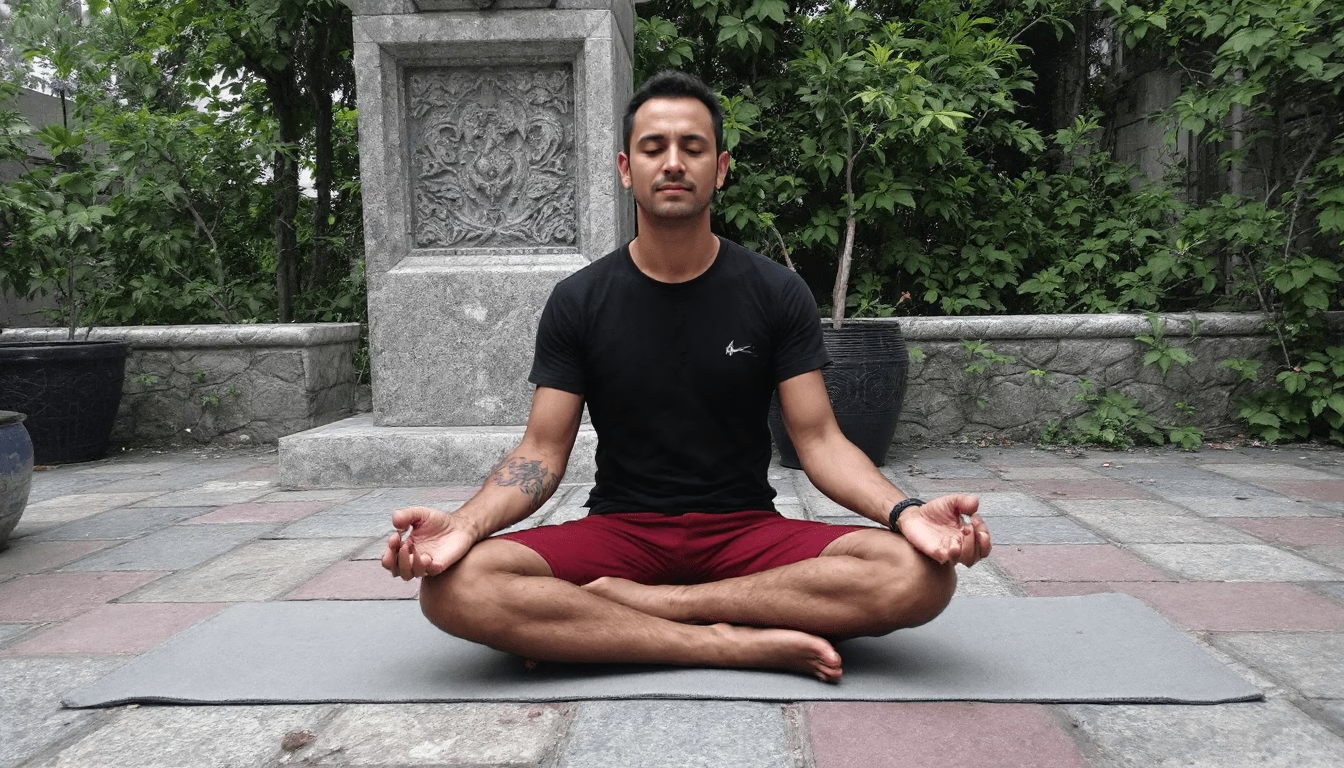
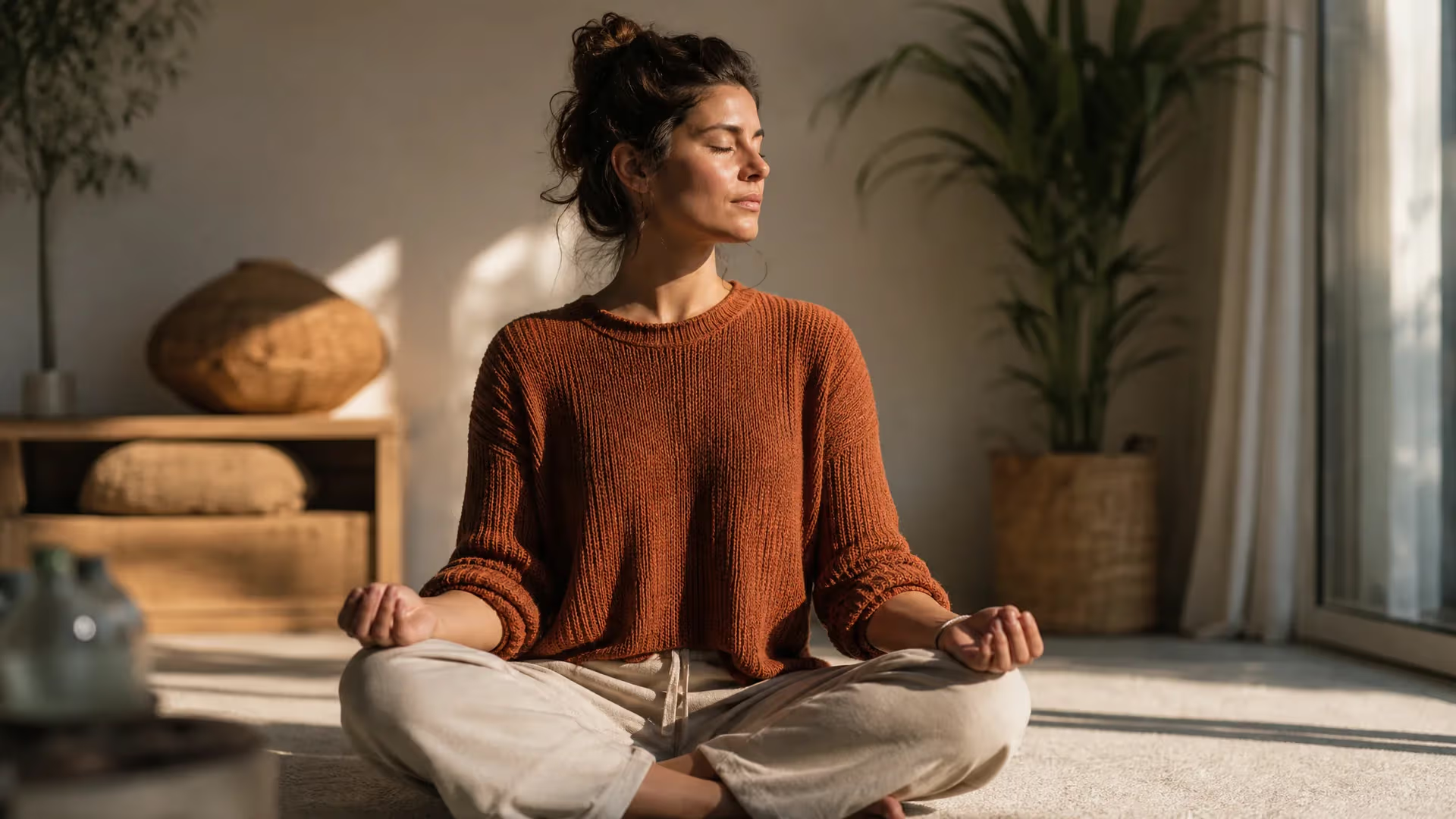
- Sit comfortably with a straight spine.
- Close your eyes or soften your gaze.
- Breathe naturally (don’t force it).
- Count each exhale: 1, 2, 3… up to 10, then restart.
- When your mind wanders (it will), gently return to the count without judgment.
- Continue for 5-10 minutes.
Why it works:
- Counting gives your mind a single focus; it can’t spiral into worry.
- Attention to breath activates the parasympathetic nervous system.
- Each time you notice your mind wandering and return, you’re literally strengthening your prefrontal cortex (the brain region that regulates anxiety).
Expected result: Within 4 weeks of daily practice, you’ll notice anxiety arrives more slowly and leaves faster.
Research: Focused attention meditation reduces cortisol by 25% within 8 weeks (Journal of Occupational Health Psychology, 2003).
Technique 2: Box Breathing (2-5 Minutes, Immediate Relief)
Best for: In-the-moment anxiety, before a stressful situation
How to do it:
- Inhale for 4 counts.
- Hold for 4 counts.
- Exhale for 4 counts.
- Hold for 4 counts.
- Repeat 5-10 times.
Why it works:
- Equal inhale/exhale activates parasympathetic tone.
- The hold periods signal safety to your nervous system.
- This technique is used by Navy SEALs and athletes for stress management; it works fast.
Expected result: Anxiety reduces measurably within 2-3 minutes. Many people use this before presentations, difficult conversations, or when panic rises.
Research: Box breathing reduces cortisol and heart rate within 5 minutes (Journal of Alternative and Complementary Medicine, 2017). It’s one of the fastest anxiety interventions available.
Technique 3: Loving-Kindness Meditation (10 Minutes)
Best for: Anxiety rooted in self-criticism, social anxiety, rumination
How to do it:
- Sit comfortably.
- Think of someone you love unconditionally (a family member, pet, mentor).
- Silently repeat: “May you be happy. May you be healthy. May you be safe. May you live with ease.”
- Spend 2 minutes with this person.
- Now turn the phrases toward yourself: “May I be happy. May I be healthy. May I be safe. May I live with ease.”
- Spend 3-4 minutes here (this is the hardest part, stay with it).
- Expand to a neutral person, then to difficult people, then to all beings.
Why it works:
- Anxiety often involves harsh self-judgment (“I’m weak,” “Something’s wrong with me”).
- Loving-kindness directly counteracts this.
- It activates the brain’s reward and compassion circuits, not the threat-detection circuit.
- You’re training your nervous system to see yourself as safe, not dangerous.
Expected result: Self-directed anxiety decreases. Social anxiety softens. You become less self-critical.
Research: Loving-kindness meditation increases self-compassion by 40% and reduces anxiety by 30% (Mindfulness, 2015). It’s particularly effective for perfectionism and impostor syndrome.
“For the foundational meditation techniques that underpin anxiety-specific practice, see our beginner’s meditation guide.”
Building a Daily Meditation Practice (The Real Path to Freedom)
One meditation session will calm you. Daily practice will transform your nervous system.
Week 1: Start Small
Practice: 5 minutes daily, same time each morning.
Technique: Breath Awareness (simplest).
What to expect: Your mind will wander constantly. This is normal. Each return to the breath is a win.
Why morning? It primes your nervous system for the entire day. Morning meditation produces effects that last 12+ hours.
Week 2-4: Build Consistency
Practice: 10 minutes daily.
Technique: Breath Awareness OR Box Breathing (your choice).
What to expect: By week 2, anxiety onset becomes slightly slower. By week 4, the first noticeable reduction in overall anxiety.
Month 2+: Add Variety
Practice: 10-15 minutes daily, mix techniques
- Monday/Wednesday/Friday: Breath Awareness (10 min).
- Tuesday/Thursday: Box Breathing (5 min) + Loving-Kindness (5 min).
- Weekends: Whatever feels right (10-15 min).
What to expect: By month 2, anxiety is noticeably softer. Panic attacks become rarer and shorter. You sleep better. You’re less irritable.
Research: Consistent daily practice for 8 weeks produces the same anxiety reduction as escitalopram, without medication (JAMA Psychiatry, 2023).
❓Common Questions About Meditation and Anxiety
What if I can’t quiet my mind?
You don’t need to. Meditation isn’t about achieving a blank mind. It’s about noticing where your mind goes and gently returning. The constant mind-wandering? That’s exactly the practice. Each return strengthens your prefrontal cortex.
Research: Even with a “busy mind,” meditation produces measurable anxiety reduction within 8 weeks (Journal of Occupational Health Psychology, 2003).
“Anxiety often accompanies meditation struggles – see why you struggle with meditation.”
How long before I feel relief?
Immediate (minutes): Box breathing reduces acute anxiety within 2-5 minutes.
Short-term (days): After 3-4 days of consistent practice, you may notice sleep improves slightly.
Medium-term (weeks): By week 4, anxiety onset becomes slower, and intensity decreases.
Long-term (months): By 8-12 weeks, structural brain changes occur; anxiety no longer controls you.
Most people notice meaningful change by week 3-4 of daily practice.
What if I have panic disorder or severe anxiety?
Meditation is powerful, but it works best combined with other support:
A therapist trained in CBT or exposure therapy.
Sometimes medication (not instead of meditation, but alongside it).
Lifestyle changes (sleep, exercise, reducing caffeine).
The evidence: Meditation + therapy produces better outcomes than either alone (JAMA Psychiatry, 2023).
If your anxiety is severe, start with professional support, then add meditation as a core tool.
Can I meditate if I’m on anti-anxiety medication?
Yes, absolutely. In fact, meditation + medication often works better than either alone.
Meditation teaches your nervous system to regulate itself. Medication takes the edge off the panic enough for you to practice. Together, they create lasting change.
Many people eventually reduce their medication dosage as their meditation practice deepens, but always under medical supervision.
Why Meditation Beats Avoidance (The Long-Term Advantage)
Here’s what most anxiety treatments miss:
Avoidance feels good short-term. Skip the social event, avoid the conversation, delay the project, and anxiety disappears instantly.
But avoidance teaches your nervous system: “This situation is dangerous. Avoid it.”
Each avoidance strengthens the anxiety.
Meditation + gentle exposure works long-term:
- You practice meditation (nervous system learns to regulate).
- You gradually face the anxiety-provoking situation (nervous system learns it’s safe).
- Over time, the trigger loses its power.
This is why meditation for anxiety isn’t just symptom relief; it’s nervous system retraining.
Research: Mindfulness-based exposure therapy produces 40-60% anxiety reduction that persists 6+ months after treatment ends (Journal of Anxiety Disorders, 2018). Avoidance-based treatment shows relapse rates of 30-50%.
Your Next Steps
- Choose one technique from the three above.
- Commit to 5-10 minutes daily for 30 days (same time, preferably morning).
- Track your anxiety (1-10 scale) before and after each week.
- By week 4, assess: Are anxiety levels lower? Is onset slower? Is recovery faster?
If you’re serious about freedom from anxiety, meditation is the clinical tool with the strongest evidence.
It won’t erase anxiety entirely. But it will give you back control.
“Ready to start? Follow our complete meditation guide for beginners first to master the fundamentals, then practice anxiety-specific techniques daily.”
Recommended Resources:
“For structured anxiety-specific meditation training, see best meditation courses online.”
For guided meditations tailored to anxiety:
- New Skills Academy Mindfulness Courses – Evidence-based techniques for anxiety, stress reduction, and nervous system regulation. Currently 65% off.
New Skills Academy Mindfulness Courses: Reduce Stress, Improve Focus & Build Lasting Calm
Unlock your inner calm with New Skills Academy’s mindfulness courses designed for all experience levels. Discover evidence-based techniques to reduce stress, boost focus, and enhance your overall well-being.
For understanding your nervous system response:
- The Polyvagal Theory by Stephen Porges – The neuroscience behind why meditation works for anxiety.
For combining meditation with therapy:
- Consider CBT or EMDR with a trauma-informed therapist if anxiety is rooted in past experiences.
Related articles to deepen your practice:
- 10 Practical Mindfulness Exercises For Your Everyday Life
- Mindfulness Meditation: Science, Techniques & Daily Practice
- What Is Holistic Living? Definition, Benefits, the 6 Pillars & How to Start
- How to Meditate Alone: 10 Simple Steps for Beginners (That Actually Work)
- Stress Relief Techniques: The Neuroscience of Calm and How to Build It Daily
Muse Headband: A Game-Changer for Meditation
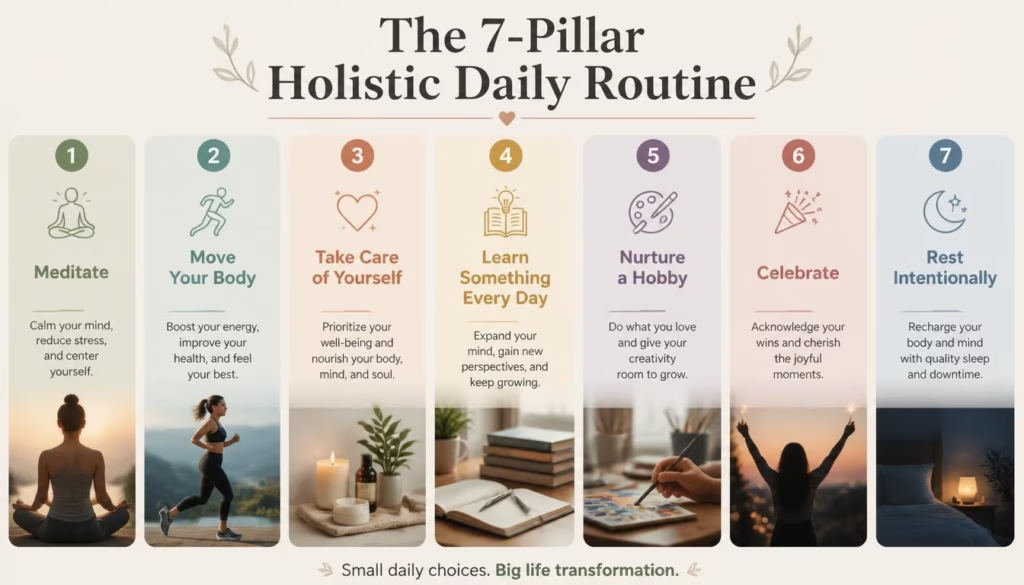
The Holistic Living Routine
Receive Our Expert-Crafted Holistic Routine to Nourish Your Daily Life.
Research Sources:
- Harvard Gazette (2018) – Meditation and brain changes
- Hölzel et al. (2011) – Gray matter changes from meditation
- Journal of Occupational Health Psychology (2003) – Mindfulness-based interventions and cortisol
- Journal of Alternative and Complementary Medicine (2017) – Breathwork and stress reduction
- Psychosomatic Medicine (2015) – Heart rate variability and meditation
- Neuropsychologia (2015) – Emotional regulation networks
- Journal of Anxiety Disorders (2018) – Mindfulness-based exposure therapy
- PLOS ONE (2012) – Default mode network and meditation
- Consciousness and Cognition (2017) – Mind-wandering and attention
- JAMA Psychiatry (2023) – Mindfulness-based stress reduction vs. escitalopram
Learn, Help Family And Friends, And Help The Planet!