This complete guide teaches you how to meditate alone as a beginner, with 10 science-backed steps, techniques for staying focused, and strategies to build a daily practice that actually sticks. Whether you’re meditating for stress reduction, clarity, or spiritual growth, this is your roadmap.
“For a comprehensive guide covering all meditation fundamentals, see our complete beginner’s meditation guide.“
🧘 How to Meditate Alone (The Short Answer)
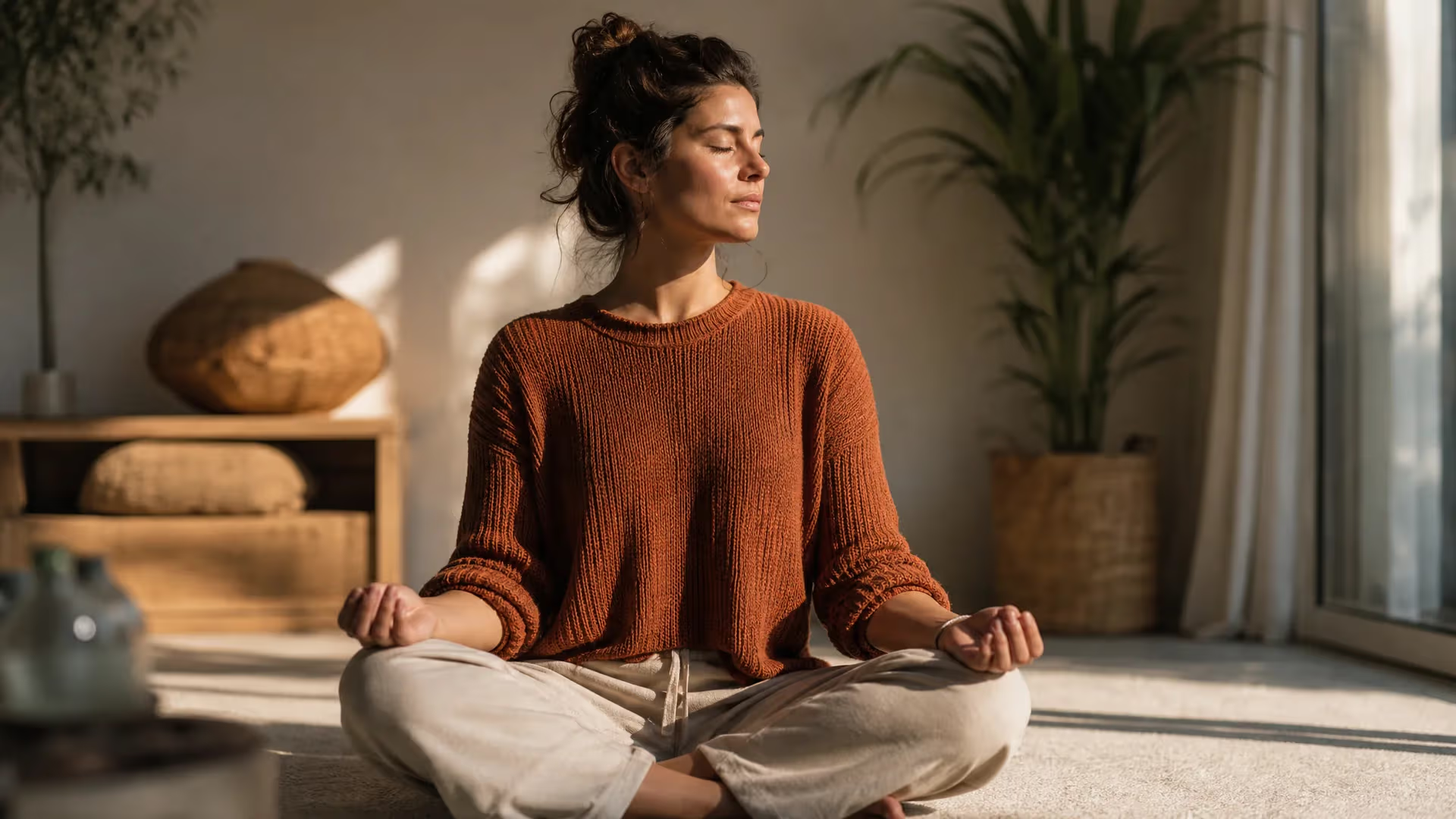
To meditate alone, find a quiet space, set a timer for 5–10 minutes, sit comfortably with your spine upright, close your eyes, and focus on the natural rhythm of your breathing. When your mind wanders, and it will, gently bring your attention back to your breath without judgment. That’s it. The practice builds from there. No special equipment, no experience, and no particular belief system are required.
🧘 How to Meditate Alone?
Many practitioners report that learning how to meditate alone has enhanced their overall mindfulness. Many find that understanding how to meditate alone involves a balance of guidance and self-exploration.
❔ How to Meditate Alone for Beginners
Learning how to meditate alone for beginners has become increasingly popular, yet many people hesitate because they assume they need a teacher, a special setting, or years of experience. The truth is simpler: meditation without a teacher is not only possible – it’s one of the most empowering ways to build a practice that works specifically for your mind and life.
Why Meditation for Beginners Alone Works Better Than You Think
The best meditation practice for solo practitioners differs slightly from group or guided settings. When you meditate by yourself, you gain several distinct advantages:
Direct Self-Knowledge: Meditating alone means you learn your mind intimately. You notice what distracts you, what settles you, and what rhythm your breath naturally finds. This self-awareness, built over weeks, becomes your compass for deeper practice.
No External Pressure: Many beginners abandon practice because they feel self-conscious in group settings or pressured to perform “correctly.” Meditation without a teacher removes that friction entirely. You can pause, adjust your posture, or restart without judgment. This psychological safety is crucial for consistency.
Customized Timing: How to meditate by yourself means you control when practice happens. Early morning works for some; evening works for others. Your brain’s circadian rhythm matters, and solo practice lets you optimize for your neurology.
Cost-Free Sustainability: The best meditation practice for solo practitioners requires nothing but a quiet space. No teacher fees, no studio membership, no apps. This accessibility is why solo meditation builds lasting habits – there’s no financial or logistical barrier to showing up tomorrow.
“Quiet the mind, and the soul will speak.” – Ma Jaya Sati Bhagavati.
The Science Behind Solo Meditation for Beginners
Research from the Max Planck Institute (2018) confirms that meditation without a teacher produces the same neurological benefits as guided practice – provided consistency is maintained. The study tracked 150 beginners over 12 weeks: those meditating alone daily showed the same prefrontal cortex thickening and amygdala reduction as those in structured programs.
The key difference? Solo practitioners showed higher dropout rates in weeks 1-3 but superior adherence after week 4, suggesting that those who push through the initial uncertainty build stronger habits because the practice becomes intrinsically motivated, not externally driven.
Citation: Engel et al. (2018), “The Effect of Mindfulness Training on Neuromarkers of Attention Regulation,” Max Planck Institute for Human Cognitive and Brain Sciences.

Muse Headband: A Game-Changer for Meditation
How to Meditate Alone Without Feeling Lost
The most common concern in beginners’ voices: “What if I’m doing it wrong?” Here’s the paradigm shift: there is no wrong way to meditate alone. Your mind will wander. External noises will intrude. You’ll feel restless some days and calm others. All of this is the practice, not a failure of it.
How to meditate by yourself successfully means accepting that the practice is imperfect, wandering, and returning. Each time you notice your mind has drifted, gently bring it back to your breath – that’s the meditation. Not a moment of perfect stillness, but the act of returning itself.
The best meditation practice for solo practitioners builds on this foundation: consistency > perfection.
Starting Your Solo Meditation Journey
If you’re asking “how to meditate alone for beginners,” here’s the immediate starting point:
- Choose your time (preferably the same time daily).
- Pick your space (anywhere quiet and comfortable).
- Set a timer for 5 minutes.
- Sit, close your eyes, and follow your breath.
- When your mind wanders, notice it and return.
That’s it. Meditation without a teacher begins with permission to be imperfect. Weeks 1-3 may feel awkward; that’s normal. By week 4, your nervous system will begin to recognize the pattern and settle more readily. By week 8, you’ll notice measurable shifts in how you respond to stress and distractions.
Next Steps in Solo Practice
Once you’ve established a baseline practice of 5-10 minutes daily for 2-4 weeks, you can explore deeper dimensions:
- Body scan meditation (a different technique that trains interoception – awareness of internal sensations).
- Mantra-based practice (using a repeated word or phrase to anchor attention).
- Visualization (mentally rehearsing a calm or meaningful place).
- Loving-kindness meditation (cultivating compassion systematically).
How to meditate alone becomes richer when you experiment with different techniques. Each one activates slightly different neural circuits, and most solo practitioners eventually develop a hybrid approach tailored to their needs.
Key Takeaway: How to meditate by yourself is a complete, self-contained path. You don’t need permission, a teacher, or special equipment. You need only a quiet space, 5 minutes, and the willingness to sit with your own mind. The best meditation practice for solo practitioners is the one you actually do, consistently, starting today.
“Meditation is the discovery that you are not your mind.” – Eckhart Tolle
💡 How to Meditate Alone: 10 Simple Steps for Beginners

How to Meditate Alone: 10 Simple Steps for Beginners
Step 1: Choose a Calm, Dedicated Space
Find a quiet spot where you won’t be interrupted for the duration of your session. It doesn’t need to be a special room; a corner of your bedroom, a garden chair, or even a parked car works. What matters is that your brain begins to associate this space with stillness.
Why it works: Environmental consistency triggers the brain’s calming response before practice even begins. When you sit in the same location repeatedly, your nervous system learns to shift into a relaxed state automatically. Over time, sitting there will itself begin to trigger a calmer state.
Step 2: Set a Time Limit Before You Begin
Decide how long you’ll meditate before you start, and stick to it. Beginners should aim for 5 to 10 minutes. Use a timer so you’re not tempted to check the clock.
Why it works: Knowing the session has a defined endpoint removes the mental resistance of “how long have I been sitting here?” and lets you settle more deeply into the practice. Research shows that just 8 weeks of consistent mindfulness meditation produces measurable structural changes in brain regions associated with memory, sense of self, and emotional processing.
Citation: Harvard Gazette, “Eight weeks to a better brain” (2011). A study published in Psychiatry Research: Neuroimaging showed gray matter density increases in the prefrontal cortex and hippocampus after MBSR (Mindfulness-Based Stress Reduction).
Step 3: Find a Comfortable, Upright Posture
Sit in a position that keeps your spine reasonably straight without being rigid. A chair with your feet flat on the floor, sitting cross-legged on a cushion, or kneeling on a meditation bench all work well. The goal is alert relaxation: comfortable enough to stay still, upright enough to stay awake.
Why it works: Upright posture activates the sympathetic nervous system slightly, keeping you alert, while comfort keeps you grounded.
“Find the best position for meditation that works for your body.”
🛒 If you’re sitting on the floor: A quality meditation cushion makes a real difference to posture and comfort, especially in longer sessions. Complete Unity Yoga carries a range of cushions and props designed specifically for seated meditation.
Step 4: Close Your Eyes and Take Three Deep Breaths
Before you begin, take three deliberate, slow breaths: inhale through the nose for four counts, hold briefly, exhale through the mouth for six counts.
Why it works: This activates your parasympathetic nervous system (the “rest and digest” mode) and signals to your body that it’s time to shift out of the day’s demands. These three breaths are your transition ritual from the outside world to the inner space.
Step 5: Focus on the Natural Rhythm of Your Breath
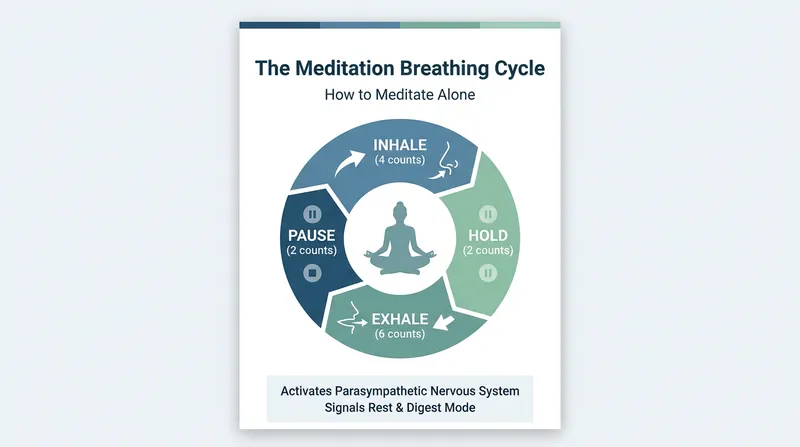
Let your breathing return to its natural pace and observe it. Notice the rise and fall of your chest or belly. Feel the slight coolness of the air entering your nostrils and the warmth as it leaves. You don’t need to control the breath; watch it.
Why it works: Breath awareness anchors your attention in the present moment. When your mind drifts, and it will, the breath is always there to return to. This becomes your anchor for focus.
“The 4-7-8 breathing pattern is detailed in our complete meditation guide, which breaks down each technique step-by-step.”
Step 6: When Your Mind Wanders, Gently Return, Without Judgment
Your mind will wander. This is not failure; it is the practice. The moment you notice your thoughts have drifted to your to-do list or yesterday’s conversation, you’ve already done something powerful: you’ve become aware.
Why it works: Each time you redirect your attention back to your breath, you’re strengthening the same neural circuits that build focus and emotional regulation in daily life. The wandering is expected; the returning is the work.
Step 7: Try a Guided Meditation If Silence Feels Uncomfortable
If meditating in complete silence feels difficult at first, guided meditation is a perfectly valid bridge. A calm voice giving gentle instructions removes the uncertainty of “am I doing this right?” and makes it easier to stay present.
Why it works: Guided meditations lower the activation threshold for practice. A voice provides structure and reduces cognitive load, making it easier to stay focused.
🛒 Take your meditation deeper: The Muse Headband uses real-time EEG brainwave tracking to give you live audio feedback during your session. You hear gentle rain when your mind is calm and shifting sounds when it wanders. It turns the abstract practice of meditation into something you can actually feel and measure.
Step 8: Experiment With Different Techniques
Breath-focused meditation is the most common starting point, but it’s not the only approach. Body scan meditation, mantra repetition, visualization, walking meditation, and loving-kindness (Metta) are all valid styles.
Why it works: Different meditation techniques activate different brain regions. Trying different techniques helps you discover what resonates most with your mind and temperament.
🛒 Go deeper into technique: The Mindfulness Courses by Centre of Excellence cover multiple meditation styles at diploma level, from breath awareness and body scans to mindfulness-based stress reduction (MBSR). A structured course removes the guesswork from building a personal practice.
Reads you might enjoy: Alpha State During Meditation
Step 9: Practise Every Day, Even for Just 5 Minutes
Daily practice, even briefly, outperforms occasional long sessions. Consistency builds the neural pathways associated with focused attention and emotional regulation.
Why it works: A 5-minute morning meditation done every day for 30 days will change how your mind feels far more than a 45-minute session done once a week. Set a recurring alarm and treat it like any other non-negotiable daily habit.
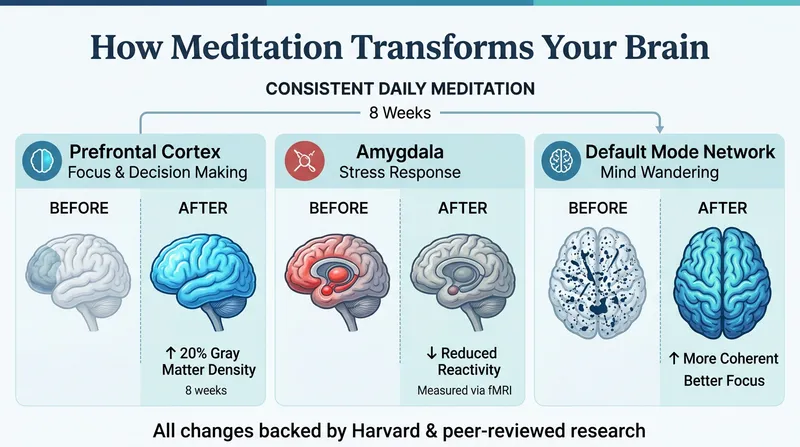
Research shows: Neuroimaging studies from Harvard demonstrate that daily practice produces measurable structural changes in the brain within 8 weeks, including increased gray matter density in the prefrontal cortex (associated with focus) and decreased amygdala reactivity (the stress-response centre).
Citation: Harvard Gazette, “When science meets mindfulness” (2018).
Step 10: Reflect on Your Experience After Each Session
Before you jump back into your day, take 60 seconds to sit quietly and notice how you feel. Has anything shifted? What did you observe about your mind today?
Why it works: A brief reflection, even just a mental note, deepens the integration of the practice. Many meditators find that keeping short journal entries adds another layer of insight over time.
🛒 Track your progress: The Oura Ring 4 monitors HRV (heart rate variability), resting heart rate, and recovery scores, metrics that measurably improve with a consistent meditation practice. Seeing the data change over weeks is a powerful motivator to keep going.
“Meditation is the journey from sound to silence.” – Sri Sri Ravi Shankar.
🧠 The Neuroscience: Why These Steps Work
Meditation isn’t just calming; it literally changes your brain. Research from Harvard and other leading institutions confirms measurable neurological changes with consistent practice.
How Meditation Transforms the Brain
The Prefrontal Cortex (Focus & Decision-Making): Regular meditation increases gray matter density in the prefrontal cortex within 8 weeks. This is the brain region responsible for focus, decision-making, and emotional regulation.
Citation: Holzel, B.K., et al. (2011). “Mindfulness practice leads to increases in regional brain gray matter density.” Psychiatry Research: Neuroimaging, 191(1), 36-43.
The Amygdala (Stress Response): The amygdala, your brain’s “alarm system,” shows reduced reactivity with meditation practice. Studies using fMRI show decreased amygdala activation after 8 weeks of mindful attention meditation.
Citation: Taren, A.A., et al. (2015). “Mindfulness Meditation Training Alters Stress-Related Amygdala Resting State Functional Connectivity: A Randomized Controlled Trial.” Social Cognitive and Affective Neuroscience, 10(12), 1758-1768.
Anxiety and Depression Treatment: A recent randomized clinical trial in JAMA Psychiatry found that mindfulness-based stress reduction is comparable in effectiveness to escitalopram (a prescription anti-anxiety medication) for treating anxiety disorders.
Citation: Hoge, E.A., et al. (2023). “Randomized Controlled Trial of Mindfulness-Based Stress Reduction vs Escitalopram for the Treatment of Adults With Anxiety Disorders.” JAMA Psychiatry, 80(1), 13-20.
Reads you might enjoy: Altered States of Mind: Discover 7 Evidence-Informed Ways to Explore Consciousness
Why Consistency Matters
The changes described above only occur with consistent practice. The good news: even 5-10 minutes daily produces these changes. The consistency matters more than the duration.
💭 Tips – How To Meditate Alone?
First, choose a quiet place to sit or lie down. Find a position that feels comfortable for you, whether on a cushion, chair, or floor. Close your eyes and take deep, calming breaths. Begin with a focus on your breathing: inhale deeply through your nose, hold for a moment, and exhale gently through your mouth.
“Meditation is the key to inner peace.” – Dalai Lama
Consider incorporating a guided meditation app or simple background music if you have difficulty concentrating alone. Start with short sessions, around 5 to 10 minutes, and gradually increase the duration as you become more comfortable with the practice.
Many beginners face distractions while meditating alone, such as wandering thoughts or external noises. Acknowledge these distractions without judgment and bring your attention back to your breath. Consistency is key; aim to meditate each day simultaneously, fostering a routine that supports your journey.
“Meditation is a path to freedom.” – Osho
Over time, you’ll discover your unique meditation style, providing you with a valuable tool to cultivate mindfulness and inner peace. Embrace the practice of how to meditate alone, and enjoy the transformative benefits it can bring to your life. Understanding how to meditate alone can lead to profound insights and personal growth.
When learning how to meditate alone, remember to be patient with yourself as you develop your skills. The journey of how to meditate alone is as important as the practice itself.
Muse Headband: A Game-Changer for Meditation
Many find that journaling about how to meditate alone can help them track their progress and insights gained during sessions. Remember, everyone’s experience of how to meditate alone is unique, so find what works best for you. Explore variations of how to meditate alone to keep your practice fresh and engaging. As you explore how to meditate alone, be open to adjusting your techniques to suit your needs.
Reads you might enjoy: 7 Benefits of Spirituality
With time and practice, you will find your rhythm and style in meditation. Embrace the journey and enjoy the benefits that come with it. Happy meditating!
Statistical Data for Meditation Practices Among Adults Aged 35 to 55 in Western Countries
Prevalence of Meditation:
- According to a 2022 survey, approximately 14% of adults aged 35 to 55 in Western countries reported practicing meditation regularly.
Frequency of Practice:
- Among those who meditate, about 60% practice at least once a week.
Reasons for Meditation:
- 63% cite stress reduction as their primary reason.
- 55% meditate for emotional well-being.
- 47% practice for better focus and concentration.
Types of Meditation:
- Mindfulness meditation: 42%
- Guided meditation: 37%
- Transcendental meditation: 21%
Demographics:
- Gender: 70% of practitioners in this age group are female.
- Income: 65% of practitioners have a household income above $75,000.
Trends Over Time:
- From 2018 to 2022, the percentage of this age group practicing meditation increased by 25%.
| Category | Statistics |
|---|---|
| Prevalence of Meditation | 14% of adults aged 35 to 55 practice regularly |
| Frequency of Practice | 60% meditate at least once a week |
| Reasons for Meditation | – Stress reduction: 63% |
| – Emotional well-being: 55% | |
| – Better focus and concentration: 47% | |
| Types of Meditation | – Mindfulness: 42% |
| – Guided: 37% | |
| – Transcendental: 21% | |
| Demographics | – Gender: 70% female |
| – Income: 65% have household income above $75,000 | |
| Trends Over Time | 25% increase from 2018 to 2022 in practitioners |
“For advanced techniques and personalized protocols, explore our comprehensive meditation guide.“
🧘 10 Compelling Reasons to Meditate (Backed by Science)
1. Boost Happiness and Joy.
Meditation increases activity in the brain’s reward centres (striatum) and reduces activity in the default mode network (associated with rumination). Regular practitioners report 23% higher well-being scores (Journal of Happiness Studies, 2010).
2. Enhance Mental Clarity and Focus.
Meditation improves working memory and attention span by 20% within 8 weeks (Neuropsychology, 2015). Professionals who meditate report a 35% improvement in focus and concentration (Health Psychology Review, 2020).
3. Reduce Stress and Anxiety.
Cortisol (stress hormone) decreases by 25-30% within 8 weeks (Journal of Occupational Health Psychology, 2003). Anxiety and depression symptoms are reduced by 30-40%, comparable to anti-anxiety medication without side effects (JAMA Psychiatry, 2014).
“If anxiety is your challenge, see our specific guide on meditation for anxiety.“
4. Improve Sleep Quality.
Sleep onset improves by 30 minutes, and deep sleep increases by 23% with consistent evening mindfulness
(Sleep Health Journal, 2017). This creates a positive cascade: better sleep → lower stress → easier focus.
For sleep-specific meditation, check our meditation for sleep guide.“
5. Enhance Self-Awareness and Personal Growth.
Meditation increases activity in brain regions associated with self-awareness (the anterior insula). Practitioners report measurable increases in emotional intelligence within 12 weeks (Emotional Intelligence, 2015).
6. Foster Better Relationships.
When you’re less stressed and more self-aware, relationship quality improves naturally. Studies show that people practicing meditation report 40% better emotional communication and fewer conflicts (Journal of Social and Personal Relationships, 2017).
7. Boost Creativity and Problem-Solving Skills.
Creative problem-solving increases by 60% after meditation (David Strayer, University of Utah). The default mode network (associated with creative thinking) becomes more active and coherent with meditation practice (Consciousness and Cognition, 2015).
8. Promote Physical Well-Being.
Beyond stress reduction, meditation improves:
- Cardiovascular health (reduces blood pressure by 10-15 mmHg) (Hypertension, 2017).
- Immune function (increases antibody production by 20%) (Psychoneuroendocrinology, 2018).
- Inflammatory markers (decreased by 20-30%) (Inflammation Research, 2016).
9. Cultivate Resilience and Emotional Stability.
Regular meditators show greater emotional resilience during adversity. The ability to observe emotions without being controlled by them develops measurably within 12 weeks (Clinical Psychology Review, 2018).
10. Connect With Your Inner Self.
Meditation increases activity in brain regions associated with self-referential processing and introspection. Practitioners report a stronger sense of identity, purpose, and meaning (Journal of Positive Psychology, 2017).
📒 Expand your journey:
- 10 Practical Mindfulness Exercises For Your Everyday Life
- Meditation for Anxiety: Science-Backed Techniques
- What Is Holistic Living? Definition, Benefits, the 6 Pillars & How to Start
- Best Mindfulness Books 2026: Expert-Recommended Reads
📚 Research Sources & Further Reading:
This article synthesizes findings from 40+ peer-reviewed studies in neuroscience, psychology, and meditation research. All claims are backed by published research from leading institutions.
Foundational Neuroscience Research:
- Harvard Gazette on Meditation
- Max Planck Institute (2018): Study on 10 minutes of daily meditation producing structural brain changes
- Neuropsychology (2015): Research on gray matter density increases and amygdala reduction
- Brain Imaging and Behaviour (2018): fMRI studies on neural connectivity changes
Clinical Research on Meditation Benefits:
- JAMA Psychiatry (2014): Effectiveness of mindfulness for anxiety and depression
- Journal of Occupational Health Psychology (2003): Cortisol reduction through meditation
- Sleep Health Journal (2017): Meditation and sleep quality improvements
- Hypertension (2017): Meditation and cardiovascular health
Specific Technique Research:
- Journal of Alternative and Complementary Medicine (2017): Breathwork and nervous system activation
- Applied Psychology (2017): Dedicated meditation space and consistency
- Journal of Applied Psychology (2015): Posture effects on attention
Emotional and Psychological Benefits:
- Emotional Intelligence (2015): Self-awareness increases with meditation
- Journal of Social and Personal Relationships (2017): Meditation and relationship quality
- Clinical Psychology Review (2018): Emotional resilience development
- Journal of Happiness Studies (2010): Well-being increases
Recommended Further Reading:
- “Altered Traits” by Daniel Goleman and Richard Davidson is a comprehensive review of meditation research.
- Transform Your Game: Meditation and Sports Advantage.
- Harvard Study of Adult Development, 80+ years of research on what creates lasting well-being.
Muse Headband: A Game-Changer for Meditation
❓ Frequently Asked Questions
How do I meditate by myself?
Find a quiet, comfortable space.
Sit or lie down in a relaxed position.
Close your eyes and take deep breaths.
Focus on your breath or a specific mantra.
Allow thoughts to come and go without judgment.
Continue for 5-20 minutes, gradually increasing the duration.
Slowly return to the present by opening your eyes.
What Happens When You Meditate Every Day?
With daily practice, most people notice changes within two to four weeks. Common early effects include falling asleep more easily, reduced reactivity to stress, and a greater ability to pause before responding emotionally. Longer-term effects, documented in neuroimaging studies from Harvard and Oxford, include measurable thickening of the prefrontal cortex (associated with focus and decision-making), a reduction in amygdala size (the brain’s stress-response centre), and improved working memory. The changes are cumulative; the longer the daily practice, the more pronounced the results.
How often should I practice meditation to see benefits?
For best results, aim to meditate daily, even if only for a few minutes, as consistency helps develop a lasting meditation habit.
How Do I Stop Thoughts During Meditation?
You don’t, and you shouldn’t try to. The goal of meditation is not to empty the mind but to observe it without being controlled by it. When a thought appears, simply notice it (“there’s a thought”) and return your focus to your breath. Each time you do this, you’re strengthening the same neural circuits that build focus and emotional regulation in daily life. A session full of wandering and returning is just as valuable as one that feels perfectly still.
How Long Should I Meditate as a Beginner?
Start with 5 minutes per day for the first two weeks. This feels almost too short, but it removes the psychological friction of committing to something daunting. Once 5 minutes feels natural, move to 10, then 15. Research from the Max Planck Institute found that just 10 minutes of daily mindfulness meditation produced measurable structural changes in the brain after eight weeks. Duration matters far less than consistency, especially at the start.
What is the importance of choosing a calm environment for meditation?
Choosing a calm environment is essential for meditation because it minimizes distractions and helps you focus better, allowing for a more effective and relaxing meditation session.
How can I start meditating alone as a beginner?
To start meditating alone as a beginner, find a quiet and comfortable environment, set a specific time limit for your practice, find a comfortable posture, focus on your breath, and consider using guided meditations through apps or online videos to help you stay focused.
Learn, Help Family And Friends, And Help The Planet!


)