In a world that never stops, the healing power of silence has become a radical act of resistance. Not the uncomfortable quiet of isolation, but the restorative silence that allows your nervous system to reset, your creativity to awaken, and your sense of self to emerge. This isn’t a luxury-it’s a biological necessity. Science now confirms what ancient traditions have always known: silence is one of the most powerful tools available for transforming your physical and mental health.
The average person is exposed to 80+ decibels of noise daily. That’s equivalent to a garbage disposal, constantly. Your nervous system doesn’t distinguish between different types of chaos-it treats it all as a threat. And when your body believes it’s under threat 24/7, the cost compounds: elevated cortisol, disrupted sleep, weakened immunity, and a mind too fractured to think clearly.
This guide reveals exactly how silence restores you-backed by peer-reviewed research-and shows you practical, immediate ways to claim silence in your life today.
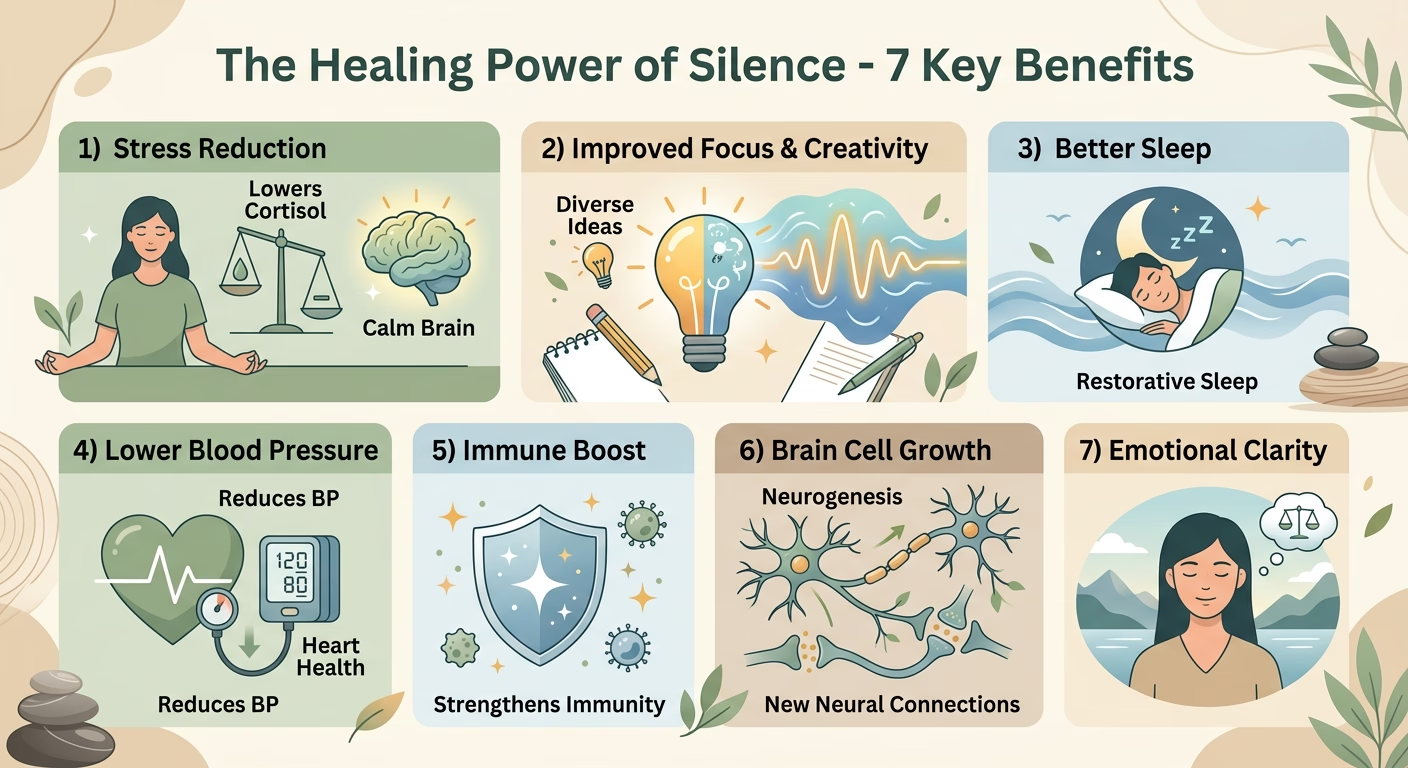
🤫The Healing Power of Silence: Enjoy The Silence
Understanding the Healing Power of Silence: Why Quiet Is Medicine
The healing power of silence begins with a fundamental misunderstanding. Most people think of silence as merely “the absence of sound.” That’s like defining water as “the absence of land.” Silence is an active state-a restorative environment where your body recalibrates, and your mind reorganizes itself.
The Science: What Silence Actually Does to Your Body
When you’re exposed to constant noise, your body enters what researchers call “chronic sympathetic activation.” Research from Nature and the European Heart Journal shows that every 14.9-decibel increase in road noise increases cardiovascular event risk by 7.5%. Noise forces your nervous system into a perpetual state of high alert-the fight-or-flight response that evolved to help you survive predators, now triggered by your neighbor’s leaf blower.
Silence does the opposite. In quiet environments, your parasympathetic nervous system activates the “rest and digest” system. A landmark 2020 study in Frontiers in Human Neuroscience found that just 10 minutes of silence triggered measurable microstructural changes in the brain, associated with improved attention, emotional processing, and self-awareness. Your vagal tone improves. Cortisol drops. Blood pressure normalizes.
The Contrast That Matters
Modern life is a sensory assault by design:
- Notifications: 52 pings per hour on average.
- Noise pollution: Up 300% in urban areas since the 1960s.
- Information overload: 174 newspapers’ worth of data consumed daily.
The biological cost? A 2024 WHO analysis linked noise exposure to hypertension, myocardial infarction, stroke, and anxiety disorders. The contrast is stark: noise erodes you. Silence rebuilds you.

Muse Headband: A Game-Changer for Meditation
Mental Health Benefits of Silence: Reclaim Your Mind
Silence Lowers Stress and Anxiety (Proven)
The most immediate benefit of embracing silence is stress reduction. When you’re in a quiet environment, cortisol-the primary stress hormone-drops measurably within minutes.
How it works: Noise triggers your amygdala, the brain’s threat-detection center. Even if you’re not consciously aware of the noise, your primitive brain is processing it as danger. Silence tells your nervous system: it’s safe here. The result? Your heart rate slows, blood pressure drops, and your prefrontal cortex (the rational brain) can take control again.
Research from Healthline and peer-reviewed sources confirms what therapists have seen for decades: anxious people in quiet spaces show measurable anxiety reduction. This is why hospitals use quiet recovery rooms, why meditation centers eliminate outside sound, and why your mind feels clearer after being in nature.
Silence Sharpens Focus and Unlocks Creativity
Have you noticed your best ideas come in the shower, on a walk, or right before sleep? Not a coincidence. During these moments, your mind is in a state of “controlled wandering”-stimulation-free, but not sleeping.
When external noise disappears, your brain stops allocating resources to filtering irrelevant stimuli. Instead, it can engage in what neuroscientists call “default mode network” activity-the neural state where:
- Insights emerge (you suddenly see a solution you’ve been stuck on).
- Connections form (you link two unrelated ideas into something novel).
- Problems solve themselves (your subconscious continues working while your conscious mind rests).
The creative breakthroughs you’ve had-rearranging furniture, the perfect word choice, a business idea-likely happened in silence. Studies from MIT’s Brain and Cognitive Sciences lab show that silence directly enhances creative problem-solving and pattern recognition. This is why the best writers, designers, and strategists guard their quiet time ferociously.
Silence Builds Self-Awareness and Emotional Intelligence
Noise is a numbing agent. When you’re constantly stimulated, you lose touch with your inner experience-your emotions, values, and true thoughts get buried under the external chatter.
Silence creates space for reflection. In quiet moments:
- You notice what you’re actually feeling (not just reacting to).
- You distinguish between your authentic desires and external pressures.
- You develop the emotional granularity to name and understand your emotional landscape.
This is why meditation practitioners report deeper self-knowledge. Why journaling works. Why the best leaders take contemplative retreats. Silence is where self-awareness is built.
Physical Health Benefits of Silence: Rebuilding Your Body
Blood Pressure Regulation & Cardiovascular Protection
One of the most well-documented physical benefits of silence is its impact on cardiovascular health.
Chronic noise exposure triggers repeated activation of the sympathetic nervous system, causing:
- Arterial stiffness.
- Elevated blood pressure (hypertension).
- Increased risk of heart attack and stroke.
A comprehensive 2024 study published in Circulation Research found that people in high-noise environments showed consistent cardiovascular dysfunction, even when they thought they’d “gotten used to it.” You don’t adapt to chronic stress-your body just pays it forward as disease.
Silence reverses this. Regular exposure to quiet environments allows your cardiovascular system to recover. Blood pressure normalizes. Arterial elasticity improves. Over time, this reduces your lifetime risk of heart disease and stroke-a benefit that compounds for every year you practice.
Enhanced Immune Function
Stress and immune function are inversely related. When you’re stressed, your immune system suppresses-your body assumes it’s running from a tiger and doesn’t have time to fight bacteria.
Silence reduces chronic stress, which allows your immune system to recover. Cortisol drops, T-cell production increases, and your body can focus on actual immune defense rather than survival mode. Research confirms that people who practice regular silence show improved infection recovery and vaccine response-proof that this isn’t just feel-good; it’s measurable physiology.
Restorative Sleep & Recovery
Sleep disturbance is one of the first casualties of a noisy environment. You might not consciously wake, but your brain registers every sound at night, fragmenting your sleep architecture and preventing deep, restorative stages.
Silence at night is transformative:
- REM and deep sleep stages extend (where memory consolidation and emotional processing happen).
- Sleep efficiency improves (you spend less time in bed, but sleep more deeply).
- Next-day cognition and mood stabilize (no grogginess, no irritability).
Studies show that people who prioritize quiet sleep environments report better sleep satisfaction, faster recovery from illness, and improved immune response. This single change-reducing bedroom noise-often produces the biggest health improvement people experience in a year.
Neuroplasticity & Brain Cell Growth
Here’s what most people don’t know: silence literally grows new brain cells.
A landmark 2013 study in Brain Structure and Function found that just 2 hours of silence daily triggered neurogenesis-the growth of new neurons-in the hippocampus, the brain region responsible for memory and learning. Two hours. Not eight. Two.
Follow-up research suggests that silence activates neural plasticity, allowing your brain to reorganize and strengthen neural networks. People who practice regular silence show measurable improvements in:
- Memory formation and recall.
- Focus and sustained attention.
- Emotional regulation.
- Learning capacity.
This is why students who study in silence learn faster, and why musicians who practice in quiet environments develop superior skill, and why contemplative practices are associated with measurable brain expansion in areas tied to attention and emotional processing.
Incorporating Silence Into Daily Life: 7 Practical Ways to Start Today
Understanding the benefits intellectually is one thing. Living them is another. Here are 7 evidence-based practices to weave silence into your life, starting today:
1. Create a Dedicated Quiet Space at Home
The setup: Choose a corner, a closet, even a bathroom-somewhere with minimal external noise. Sound-absorb it:
- Soft rug or yoga mat (absorbs sound).
- Curtains or blankets on windows.
- Plants (greenery absorbs mid-range frequencies).
- Minimal visual clutter (the eye processes chaos the same way the ear does).
Why it works: Your brain learns that this space = safety = rest. After a few visits, just entering triggers parasympathetic activation. Some people call it a meditation corner. Call it whatever you want. What matters is the ritual.
2. Practice the “No-Screen Hour”
The practice: One hour before bed, no screens (phones, tablets, TVs). During this hour:
- Read a physical book.
- Journal your thoughts.
- Sit with tea and breathe.
- Stretch or gentle yoga.
Why it works: Your nervous system needs a buffer between stimulation and sleep. Screens emit blue light and constant notifications-both keep you in sympathetic activation. The hour of silence lets your parasympathetic system engage, preparing your body for deep sleep. You’ll notice improvement within 3 nights.
3. Implement “Silent Commute” Days
If you drive or take transit, 1-2 days per week, replace podcasts/music with silence. No stimulation. Just an observation.
- Notice what you’re thinking about.
- Observe the landscape.
- Let your mind wander.
Why it works: You’re not losing information-you’re gaining restoration. Your commute becomes a 20-30 minute reset rather than another consumption opportunity. People who do this report clearer thinking, better mood, and more creativity within a week.
4. Use Strategic Meditation (Even 10 Minutes)
You don’t need to be a “meditation person” or sit for 45 minutes. Start with 10 minutes of structured silence.
The simplest protocol:
- Sit comfortably in your quiet space.
- Close your eyes.
- Focus on your breath (count: inhale for 4, exhale for 6).
- When your mind wanders, gently return to your breath.
- That’s it.
Research shows that 10 minutes of this daily produces measurable cortisol reduction and improved focus within 2 weeks. The Muse Headband can help-it uses real-time biofeedback to train your attention, making meditation more intuitive and measurable.
5. Redesign Your Workspace
If you work in an open office or noisy environment:
- Use noise-canceling headphones (even without audio, just the physical barrier helps).
- Work from a quiet café or library during focus-intensive tasks.
- Request flexible hours to work during quieter parts of the day.
- Use white noise machines if external silence isn’t possible (they mask jarring sounds).
Why it works: Focus is your most valuable professional asset. Studies show that even 10 minutes of uninterrupted focus produces measurably better work quality. Your manager can’t complain about results.
6. Embrace Digital Detox Strategically
You don’t need to abandon technology. You need designated detox windows:
- No phone for the first hour after waking.
- No phone during meals.
- No phone 1 hour before bed.
- One tech-free day per week (yes, really).
During these windows, you’re not avoiding technology-you’re practicing silence. Your nervous system recalibrates. Notifications lose their grip. You remember what it feels like to be bored, and boredom is where insight happens.
7. Build a Sleep Environment That Prioritizes Silence
- Blackout curtains (remove light, which reduces ambient noise awareness).
- White noise machine or fan (masks irregular sounds that trigger wakefulness).
- Earplugs if external noise is unavoidable.
- Remove your phone from the bedroom (or put it in another room entirely).
Sleep is where your body does its deepest repair. Poor sleep quality accelerates aging and disease. Silence at night isn’t a luxury-it’s health infrastructure.
The Real Barrier: How to Overcome the Discomfort of Silence
Most people encounter silence and immediately feel uncomfortable. Bored. Anxious. That restlessness is exactly the signal you need silence most.
Here’s what’s happening: Your nervous system has adapted to chronic stimulation. Silence feels like withdrawal because, neurologically, it kind of is. You’re removing the dopamine hits of notifications, the adrenaline of background stress, the constant novelty of input.
This passes. Within 3-7 days of practicing silence, your nervous system recalibrates. You’ll notice:
- Quietness feels peaceful instead of eerie.
- Boredom transforms into spaciousness.
- Your mind becomes clearer.
- Sleep deepens dramatically.
Don’t expect immediate bliss. Expect restoration, which is better.
Muse Headband: A Game-Changer for Meditation
Silence as a Competitive Advantage
Here’s the uncomfortable truth about modern culture: The person who can tolerate silence has an edge.
- Better sleep = faster recovery, sharper thinking, better immune function.
- Deeper focus = higher-quality work, faster skill development.
- Clearer thinking = better decisions, better relationships, better life direction.
- Lower stress = longevity, disease prevention, emotional resilience.
While everyone else fragments their attention across 50 apps, you’re building the neurological foundation for exceptional performance. While they’re wired and depleted, you’re rested and capable.
This isn’t about being a minimalist or a monk. It’s about recognizing silence as the rare, valuable resource it is-and protecting it accordingly.
Related reads you might enjoy:
- “How to Start a Mindfulness Practice for Beginners”
- “Morning Routine for Mental Health and Productivity”
- “Sleeping with a Phone: Here’s What the Science Says”
- “Gut-Brain Axis” (stress/nervous system connection)
Frequently Asked Questions:
How can I start practicing silence if I feel uncomfortable with quiet?
That discomfort is completely normal-it’s actually a sign that you desperately need silence.
Your nervous system has adapted to chronic stimulation, so silence initially feels strange or anxious, like neurological withdrawal.
The good news: This passes quickly.
Start with small periods:
Days 1-3: 5 minutes in a quiet room with your eyes closed.
Days 4-7: 10 minutes (use breath counting: 4 seconds inhale, 6 seconds exhale).
Week 2+: Increase to 10-15 minutes as you feel comfortable.
Within 3-7 days, your body recalibrates. Silence shifts from feeling unsettling to peaceful. The initial discomfort was simply neurological adaptation-your brain was conditioned to the dopamine spikes from notifications and constant stimulation.
Helpful tool: The Muse Headband uses real-time biofeedback to make meditation less intimidating-your brain receives immediate feedback when you’re focused, transforming practice into something tangible rather than vague.
What’s the difference between silence and just avoiding noise? Do I need complete silence?
This is a sophisticated question, and the answer is no, you don’t need perfect silence.
True silence = absence of stimuli that require active processing
This means:
✅ White noise or sound machines (mask jarring sounds).
✅ Natural sounds like wind, birds, rain (predictable, rhythmic sounds).
✅ Soft classical or instrumental music (no lyrics, no abrupt changes).
❌ Podcasts, audiobooks, news.
❌ Music with lyrics.
❌ Urban traffic, construction (unpredictable, activates the amygdala).
Why? Your brain isn’t chasing absolute silence-it’s escaping active cognitive processing. Predictable, neutral noise (like rain) doesn’t force your nervous system into high alert. Unpredictable noise (like sirens) keeps it there.
In practice: If you work in an open office and can’t find true silence, noise-canceling headphones with white noise produce benefits similar to a silent room. What matters is giving your brain permission to stop processing threats.
Consistency beats perfection by far. 10 minutes of “near-silence” daily (even with slight background noise) outperforms 2 hours of occasional perfect silence. What counts is the regular reset.
How much daily silence do I need to see real results?
The scientifically proven answer is: just 10 minutes.
Research published in Frontiers in Human Neuroscience showed that 10 minutes of daily silence triggers measurable brain changes associated with improved attention, emotional processing, and self-awareness. Visible results begin within 2 weeks:
| Week 1-2 | Week 3-4 | Month 2+ |
|---|---|---|
| Better sleep quality | Deeper focus | Actual brain cell growth (neurogenesis) |
| Reduced cortisol | Increased creativity | Enhanced memory |
| Lower anxiety | Visible mental clarity | Lasting emotional resilience |
But there’s an important bonus: Studies show that 2 hours of daily silence (doesn’t need to be continuous-could be 10 min + 1 hour during a quiet commute + 50 min at night) triggers neurogenesis, the generation of new brain cells in the hippocampus, responsible for memory and learning.
You don’t need 2 hours to start. Begin with 10 minutes. Your brain responds quickly.
Key Takeaways: The Healing Power of Silence
✓ Silence is biologically necessary, not optional-it restores your nervous system, regulates blood pressure, and improves immune function.
✓ Mental benefits are immediate: Stress reduction (measurable within minutes), improved focus, and enhanced creativity.
✓ Physical transformation takes weeks: Better sleep, improved cardiovascular health, new brain cell growth.
✓ Start small: 10 minutes of daily meditation or one silent hour before bed produces noticeable results within 2 weeks.
✓ Consistency matters more than duration: Regular silence beats occasional retreats.
✓ Silence is a competitive advantage: In a noisy world, the quiet mind wins.
The healing power of silence isn’t mystical. It’s physiology. Your body evolved to need rest, recovery, and reflection. Modern life aggressively denies all three. By claiming silence, you’re not rejecting the world-you’re reclaiming your capacity to engage with it wisely.
Start today. Just 10 minutes. See what happens.
Products & Resources to Support Your Silence Practice
Sensate – If meditation feels impossible, Sensate uses vibration biofeedback to guide your nervous system into parasympathetic activation. Perfect for beginners.
Muse Headband – Real-time brain feedback during meditation. It’s like a personal meditation coach.
New Skills Academy – Mindfulness Courses – Structured guidance if you want deeper practice or to share mindfulness with family.
Books to deepen your understanding:
- Sleeping with Your Smartphone by Leslie A. Perlow – How to reclaim boundaries with technology
- Quiet (Susan Cain) – The cultural power of introversion and reflection
Learn, Help Family And Friends, And Help The Planet!