Safety first: This article is educational, not medical advice. Do not deliberately use sleep deprivation, hyperventilation, extreme fasting, unregulated substances, or sensory deprivation to induce unusual experiences. People with a history of psychosis or mania, severe trauma symptoms, epilepsy, cardiovascular disease, pregnancy, serious respiratory conditions, or medication interactions should seek qualified medical guidance before experimenting with practices that can alter consciousness.
🌀 Altered States of Mind: 7 Ways to Explore Consciousness
❔ What are altered states of mind?
An altered state of mind – more precisely, an altered state of consciousness – is a temporary change in ordinary patterns of attention, perception, emotion, self-awareness, memory, time, or cognition.
Some states occur naturally: dreaming, flow, grief, awe, absorption in music, deep prayer, intense exercise, and the transition between waking and sleep. Others can be cultivated through meditation, hypnosis, breath-based practices, ritual, or therapeutic interventions. Some are induced by drugs, although legal status, medical risk, evidence, and context vary considerably.
“Altered” does not mean automatically superior. A state can feel expansive, peaceful, frightening, disorienting, creative, or meaningless. Its value depends on safety, intention, interpretation, and what happens afterwards.
A useful framework is:
State + setting + intention + integration = potential value.
Without integration, an extraordinary experience may remain a vivid memory rather than becoming insight, behaviour change, or greater well-being. 🧠

Step into the world of learning and personal growth with the Centre of Excellence!
Why do people seek altered states?
People may seek altered consciousness to:
- Reduce stress or rumination.
- Deepen spiritual practice.
- Explore creativity and imagination.
- Process emotions.
- Improve attention or self-awareness.
- Experience awe and connection.
- Understand recurring dreams.
- Investigate therapeutic possibilities.
- Break repetitive patterns of thinking.
Curiosity is legitimate. So is caution. The desire to “unlock the mind” can become unhealthy when it reflects an urge to escape ordinary life, bypass treatment, chase increasingly intense experiences, or prove a spiritual identity.
What changes in an altered state?
Altered states can involve shifts in several dimensions:
- Attention: narrowing, widening, or becoming absorbed.
- Self-processing: less rigid self-narrative or stronger self-focus.
- Time perception: minutes feeling brief or expansive.
- Interoception: changed awareness of bodily sensations.
- Emotion: heightened awe, fear, joy, grief, or calm.
- Perception: unusual imagery, sound, colour, or bodily experience.
- Metacognition: changed awareness of thoughts as thoughts.
- Memory: vivid recall, weak encoding, or reconstructed meaning.
These dimensions do not always move together. Someone may enter flow with intense concentration but little self-reflection. Someone meditating may experience expanded awareness without dramatic imagery. A dream may be vivid but poorly remembered.
1. Meditation: training attention and decentring from thought
Meditation is one of the most accessible ways to explore changes in attention and self-awareness. Mindfulness practices train present-moment awareness, while concentration practices stabilise attention on an object such as breath, sound, or a visual image. Loving-kindness, mantra, open-monitoring, and contemplative prayer cultivate different attentional and emotional qualities.
Research supported by the U.S. National Center for Complementary and Integrative Health suggests that meditation and mindfulness may help some people with anxiety, depression, pain, and stress, although outcomes vary and evidence is not equally strong for every condition.
The most important effect may be decentering: noticing thoughts as events in consciousness rather than automatically treating them as commands or facts.
Advanced practice: Begin with five minutes of breath awareness. When attention wanders, label the event – “planning,” “remembering,” “judging” – and return without punishment. Track whether your relationship with thought changes, not whether you experience something spectacular.
Read: How to Start a Mindfulness Practice for Beginners and Mindfulness Meditation: Brain Science, Daily Practices & How to Build Lasting Focus.
Edge case: Meditation can increase anxiety, dissociation, or traumatic memories for some people. Shorten the practice, use external sensory anchors, practise with a trained professional, or choose movement-based awareness instead.

Altered Traits: How Meditation Changes the Mind, Brain and Body
In their insightful book, Altered Traits, Daniel Goleman and Richard J. Davidson delve into the transformative power of meditation and mindfulness. Goleman explores how these practices can alter our psychological traits and enhance well-being.
2. Breathwork: changing arousal through respiration
Breathing influences autonomic arousal, carbon dioxide balance, heart-rate variability, and interoceptive experience. Slow, comfortable breathing may support relaxation for many people. More intense breathwork can produce tingling, dizziness, emotional release, perceptual changes, or panic – often because rapid breathing lowers carbon dioxide and changes blood chemistry.
This is not proof that a person has accessed a supernatural dimension. It is a reminder that respiration can alter physiology and subjective experience.
Safer starting point: Try gentle nasal breathing without straining, breath-holding, or chasing dizziness. Stop if you feel faint, numb, panicked, confused, or short of breath.
Do not practise intense breath retention or hyperventilation in water, while driving, standing at heights, or without appropriate supervision. People with cardiovascular or respiratory conditions, pregnancy, seizure disorders, or panic vulnerability should seek clinical advice first.
3. Dreaming and lucid dreaming: consciousness during sleep
Dreaming naturally alters perception, time, emotion, memory, and selfhood. In lucid dreaming, the dreamer becomes aware that they are dreaming, sometimes with partial control over the dream narrative.
Lucid dreaming may support creativity, nightmare coping, and self-exploration, but evidence is still developing. It is not a replacement for trauma treatment, and attempts to induce lucidity can disrupt sleep if they involve repeated awakenings or excessive monitoring.
Advanced practice: Keep a brief dream journal immediately after waking. Record emotions, recurring themes, and uncertainties rather than treating dream symbolism as a fixed code. Ask, “What does this dream reveal about my current concerns?” rather than “What prediction does it make?”
Read: Exploring Lucid Dreaming: Unleashing the Boundaries of Reality.
4. Flow: absorption in a demanding, meaningful task
Flow is a state of deep absorption in which attention becomes highly focused, self-consciousness may recede, and action feels coordinated. It tends to arise when challenge and skill are balanced, goals are clear, and feedback is immediate.
Flow is not the same as relaxation. It can be effortful and physiologically activating. Nor is it always beneficial: people can enter flow while gaming, gambling, working compulsively, or scrolling if the environment provides immediate feedback.
Flow experiment: Choose a task that is slightly beyond your current ability. Remove notifications, define a measurable objective, work for 25–45 minutes, and record your attention quality and fatigue afterwards.
The key is not maximum absorption. It is learning which conditions support meaningful engagement without sacrificing sleep, relationships, or health.
5. Sound, music, and rhythmic absorption
Music can alter arousal, emotion, autobiographical memory, movement, and the sense of time. Repetition and rhythm may support synchronisation, trance-like absorption, prayer, dance, or emotional processing.
Sound-based practices are not interchangeable. A calming playlist, chanting, drumming, binaural beats, and loud sensory stimulation have different mechanisms and evidence bases. Claims that a particular frequency “heals the brain” should be treated cautiously unless supported by appropriate research.
Practice: Choose one piece of music. Listen without multitasking and track the sequence of bodily sensations, memories, emotional shifts, and attention changes. End with two minutes of silence to notice the contrast. 🎵
If sound triggers migraines, tinnitus, trauma memories, or sensory overload, stop and choose a quieter practice.
6. Movement, dance, and embodied awareness
Rhythmic movement can change mood, attention, body ownership, social connection, and the experience of self. Running, yoga, martial arts, dance, and repetitive walking can produce absorption or a changed sense of time.
Yoga Teacher Training Diploma Course: Build a Foundation for Teaching Yoga
If you’re passionate about yoga and looking to deepen your practice, the Yoga Teacher Training Diploma Course by the Centre of Excellence is the perfect fit. This comprehensive program is designed to equip you with the knowledge and skills to teach yoga with confidence.
Embodied practices may be particularly useful for people who find still meditation difficult. They also demonstrate that altered consciousness is not only a “brain event”; it is shaped by the nervous system, muscles, breathing, environment, and social context.
Advanced practice: During a ten-minute walk, alternate three minutes of ordinary walking with one minute of noticing foot pressure, joint movement, temperature, sound, and peripheral vision. Avoid turning the practice into a performance.
Do not use extreme exercise, pain, dehydration, or exhaustion to force a state. The objective is greater awareness, not physiological damage.
7. Hypnosis and professionally guided therapeutic imagery
Hypnosis involves focused attention, reduced peripheral awareness, and increased responsiveness to suggestion in some people. It does not mean surrendering free will or becoming unconscious. People vary considerably in hypnotic responsiveness.
The NCCIH notes that hypnosis has been studied for issues such as anxiety related to medical or dental procedures, although evidence depends on the condition and protocol. Clinical hypnosis should be provided by an appropriately trained, licensed professional when used therapeutically.
Guided imagery and contemplative visualisation are related but not identical. They may support relaxation, rehearsal, pain coping, or values-based reflection. They cannot retrieve reliable hidden memories, diagnose disease, or guarantee transformation.
Safe practice: Use a reputable, non-coercive recording for relaxation. Avoid content that promises recovered memories, certainty about past lives, or replacement of medical care.
Step into the world of learning and personal growth with the Centre of Excellence!
What about psychedelics and plant medicines?
Psychedelic and dissociative drugs can profoundly alter perception, emotion, time, self-processing, and meaning. Research is examining compounds such as psilocybin, MDMA, ketamine, and others for specific medical conditions under controlled protocols.
The existence of clinical research does not mean unsupervised use is safe or equivalent to therapy. Risks can include panic, accidents, dangerous behaviour, impaired judgement, persistent perceptual symptoms, medication interactions, and the triggering or worsening of psychosis or mania in vulnerable people. Substance identity and dose may also be uncertain outside regulated settings.
The FDA has issued guidance for psychedelic-drug clinical investigations, reflecting the complexity of studying altered consciousness, including blinding, expectancy, safety monitoring, and long-term follow-up. NIDA also warns that psychedelic drugs may trigger schizophrenia-like illness in people with predisposing factors, although research continues.
This article does not provide instructions for obtaining, dosing, combining, or using illegal substances. The evidence-based path is participation in lawful, properly supervised research or licensed medical care where available – not treating online anecdotes as a safety protocol.
A state is not an insight
One of the most important distinctions in consciousness research is between experience and interpretation.
A person may experience unity and interpret it as contact with the divine. Another may experience the same phenomenology and interpret it as altered self-processing. Both interpretations can be personally meaningful, but the experience alone does not prove one metaphysical explanation.
Use a three-stage integration model:
- Describe: What did I perceive, feel, think, and notice in my body?
- Interpret: What meanings am I assigning, and what alternatives exist?
- Integrate: What small, ethical, observable change follows?
This prevents “spiritual bypassing” – using extraordinary experiences to avoid grief, accountability, treatment, or ordinary responsibilities.
How dopamine and novelty influence the search for altered states
The pursuit of unusual experiences can involve novelty, anticipation, reward learning, social status, and dopamine-related motivational processes. Dopamine is not simply the chemical of pleasure; it helps the brain learn which cues predict salient outcomes and allocate effort toward them.
This creates a potential loop:
Curiosity → anticipation → unusual experience → social sharing or meaning → stronger pursuit
The loop is not automatically unhealthy. It becomes risky when the intensity of the experience must continually increase, ordinary life feels empty, and the person ignores consequences.
Ask yourself:
- Am I seeking insight or escape?
- Would I still value this practice if nobody knew about it?
- Does the experience make daily life more workable?
- Am I becoming more flexible, compassionate, and responsible – or more preoccupied?

Dopamine Nation by Dr. Anna Lembke
Discover ‘Dopamine Nation: Finding Balance in the Age of Indulgence’ by Dr. Anna Lembke, a profound exploration of pleasure, pain, and the science of addiction. Learn how to navigate the modern culture of overindulgence, reset dopamine levels, and embrace discomfort as a pathway to authentic joy.
A seven-day, low-risk exploration plan
- Day 1: Five minutes of breath awareness.
- Day 2: A screen-free walk with sensory attention.
- Day 3: One uninterrupted creative or skill-based task.
- Day 4: A dream journal on waking.
- Day 5: Intentional music listening followed by silence.
- Day 6: Gentle movement or dance without performance goals.
- Day 7: Review which state improved attention, meaning, or connection.
Do one practice at a time. Record sleep, mood, anxiety, energy, and functioning. Stop practices that produce persistent distress, derealisation, insomnia, impulsivity, or unusual beliefs that interfere with daily life.
Integration: turning altered experience into ordinary wisdom
Integration is where the value of an altered state is tested. After an experience, ask:
- What did I learn about attention?
- Which emotions became easier to name?
- What interpretation might be exaggerated?
- What would a sceptical friend notice?
- What action would express the insight without harming anyone?
- What support or professional care do I need?
An experience that encourages better sleep, kinder communication, creative practice, or honest boundaries may have practical value. An experience that encourages grandiosity, isolation, reckless decisions, or contempt for ordinary life deserves caution.
Step into the world of learning and personal growth with the Centre of Excellence!
🌿 Your free holistic routine for grounded exploration
The Free Expert-Crafted Holistic Routine to Nourish Your Daily Life can help you place altered-state exploration inside a wider framework of sleep, movement, nutrition, nature, reflection, relationships, and purposeful action.
The Holistic Living Routine
📧 Receive Our Free Expert-Crafted Holistic Routine to Nourish Your Daily Life.
For optional resources, explore Stress Less, Accomplish More by Emily Fletcher or New Skills Academy Mindfulness Courses. These are educational or affiliate resources, not substitutes for medical or psychological care.
For readers interested in meditation and contemplative research, explore Altered Traits by Daniel Goleman and Richard J. Davidson. The Silva Mind Control Method may also interest readers exploring popular approaches to mental training; read it as a historical self-development resource rather than a substitute for scientific or clinical guidance.
❓ Frequently asked questions
What is an altered state of mind, and how can it be achieved?
An altered state of mind refers to conditions where a person’s mental state is significantly changed, affecting perceptions, emotions, and cognition. It can be achieved through substances, meditation, sleep deprivation, sensory deprivation, or psychological conditions.
How can lucid dreaming be used as a tool for self-exploration?
Lucid dreaming allows individuals to be aware that they are dreaming, enabling them to control and explore their dream worlds. This fosters self-awareness, creativity, and emotional insight, making it a powerful practice for personal development and delving into the subconscious mind.
What role do entheogens play in exploring altered states of mind?
Entheogens, derived from natural sources, interact with brain serotonin receptors to induce profound spiritual experiences, self-awareness, and perception expansion. They are used in cultural rituals and therapeutic settings, but should be approached with caution due to their potent effects.
In what ways does breathwork help explore altered states of consciousness?
Breathwork involves conscious breathing techniques that activate the parasympathetic nervous system, induce relaxation, and expand awareness. It can lead to vivid emotional experiences, insights, and even states similar to meditation or psychedelic experiences, helping to explore deep consciousness.
How does meditation facilitate inner transformation?
Meditation promotes mindfulness and self-reflection by quieting the mind, allowing individuals to access altered states of mind. It enhances self-awareness, reduces stress, and fosters emotional and mental clarity, contributing to personal growth and inner transformation.
Are altered states dangerous?
Some are ordinary and low-risk; others can be psychologically or physically dangerous. Risk depends on the method, intensity, health history, medication, environment, supervision, and interpretation.
Can meditation produce an altered state?
Yes. Meditation can change attention, self-processing, body awareness, emotion, and time perception. Dramatic experiences are not required for meditation to be useful.
Does breathwork change consciousness?
Breathing changes physiology and can alter arousal and perception. Forceful techniques can cause dizziness, panic, fainting, or other risks, so gentle practice and appropriate screening are important.
Are lucid dreams scientifically real?
Lucid dreaming is a documented sleep phenomenon in which the dreamer becomes aware of dreaming. Its applications for creativity and nightmare support remain an active research area.
Do psychedelics automatically create spiritual insight?
No. They can produce intense experiences that people interpret spiritually, psychologically, or neurologically. Risks, legal status, clinical evidence, and individual vulnerability must be considered.
How do I know whether an experience was helpful?
Look at the aftermath. Helpful integration tends to support functioning, ethical behaviour, emotional flexibility, relationships, and realistic action – not only intensity or certainty.
💬 Questions for reflection and discussion
- Which altered state occurs naturally in your life: flow, awe, dreaming, prayer, music, movement, or deep focus?
- Do you seek unusual experiences primarily from curiosity, healing, creativity, spirituality, or escape?
- How should researchers study experiences that are subjective but psychologically transformative?
- What safeguards should be required when altered states are used in therapy?
- Can an experience be meaningful without proving a supernatural explanation?
Share your perspective. Responsible discussion requires curiosity and boundaries: extraordinary experiences deserve respect, but strong feelings are not the same as strong evidence.
The next frontier of consciousness research may combine neuroimaging, computational models, phenomenological interviews, digital biomarkers, and carefully monitored therapeutic studies. Artificial intelligence may help classify patterns of attention and perception, but it will not remove the ethical question of what altered consciousness is for.
Perhaps the future will not be about unlocking the mind as if it were a sealed machine. It may be about learning when to open attention, when to stabilise it, when to question an interpretation, and when to return to ordinary life. The most advanced consciousness practice may be neither escape nor intensity, but the ability to explore the unusual while remaining grounded enough to care for the body, respect evidence, and live differently when the experience is over. 🌌
📒 Related Reads:

⚡ Altered States of Consciousness: What They Are and Safer Ways to Explore Them

💤 Lucid Dreaming: Master Your Dreams in 7 Days – Complete Science-Backed Guide

🛏️ Sleep Quality and Spiritual Growth Connection

🪷 Mindfulness Meditation: Brain Science, Daily Practices & How to Build Lasting Focus
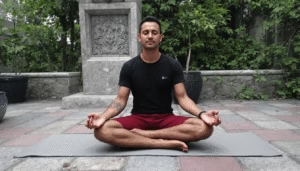
🧘 Meditation for Anxiety: Science-Backed Techniques, 10-Minute Practices & Lasting Relief

🧠 Alpha State During Meditation: What It Feels Like + 10 Signs You’re There (Science-Backed Guide)
References and further reading:
- National Center for Complementary and Integrative Health. “Meditation and Mindfulness: Effectiveness and Safety.”
- National Center for Complementary and Integrative Health. “Hypnosis.”
- National Institute on Drug Abuse. “Psychedelic and Dissociative Drugs.”
- National Institute on Drug Abuse. “Psychedelic and Dissociative Drugs as Medicines.”
- U.S. Food and Drug Administration. “Psychedelic Drugs.”
- U.S. Food and Drug Administration. “Psychedelic Drugs: Considerations for Clinical Investigations.”
- Vaitl, D., et al. (2005). “Psychobiology of Altered States of Consciousness.” Psychological Bulletin, 131(1), 98–127.
- Lutz, A., Slagter, H. A., Dunne, J. D., & Davidson, R. J. (2008). “Attention Regulation and Monitoring in Meditation.” Trends in Cognitive Sciences, 12(4), 163–169.
- Hobson, J. A., & Pace-Schott, E. F. (2002). “The Cognitive Neuroscience of Sleep: Neuronal Systems, Consciousness and Learning.” Nature Reviews Neuroscience, 3, 679–693.
- Yaden, D. B., et al. (2017). “The Varieties of Self-Transcendent Experience.” Review of General Psychology, 21(2), 143–160.
- Bromberg-Martin, E. S., Matsumoto, M., & Hikosaka, O. (2010). “Dopamine in Motivational Control.” Neuron, 68(5), 815–834.
- World Health Organization. “Mental Health.”
- Cahn, B., & Polich, J. (2006). Meditation states and traits: EEG, ERP, and neuroimaging studies. Psychological Bulletin, 132, 180–211.
- Grossman, P., Niemann, L., Schmidt, S., & Walach, H. (2004). Mindfulness-based stress reduction and health benefits: A meta-analysis. Journal of Psychosomatic Research. 57(1), 35–43.
- Kjellgren, A., Sundequist, U., Norlander, T., & Archer, T. (2001). Effects of flotation-REST on muscle tension pain. Pain Research & Management, 6(4), 181–189.
Learn, Help Family And Friends, And Help The Planet!