Are you one of the millions of people who fall asleep with their phone inches from their face? Here’s what science says, and what you can do tonight to sleep better.
📵 Sleeping With Your Phone
❔ Is It Bad to Sleep With Your Phone?
Yes, sleeping with your phone has measurable negative effects on sleep quality, brain function, and long-term health. Phone screens emit blue light that suppresses melatonin production, making it harder to fall asleep. Notifications cause micro-awakenings that fragment deep and REM sleep even when you don’t fully wake up. And the mental stimulation from scrolling keeps your brain activated at exactly the moment it needs to wind down. The effects are cumulative: night after night of phone-disrupted sleep leads to poor memory, mood instability, weakened immunity, and increased risk of anxiety and depression.
The Habit Nobody Talks About Enough
Picture this: it’s 11 PM, you’re in bed, and you’re “just going to check one last thing.” Forty-five minutes later, you’re still scrolling through videos, Instagram reels, or news headlines, and your brain is now more awake than it was an hour ago.
Sound familiar?
Sleeping with a phone nearby, or worse, in your hand, has become one of the most widespread habits of the modern age. A 2023 survey found that over 70% of adults in the US keep their smartphones either on their bedside table or in bed with them. For teenagers, that number climbs even higher.
But here’s the problem: most people don’t realize how significantly this habit affects their sleep quality, mental health, and long-term well-being.
This article dives deep into the science behind sleeping with your phone, breaks down every way it harms your rest, and gives you a realistic, step-by-step plan to break the cycle without making you feel like you have to live off the grid.
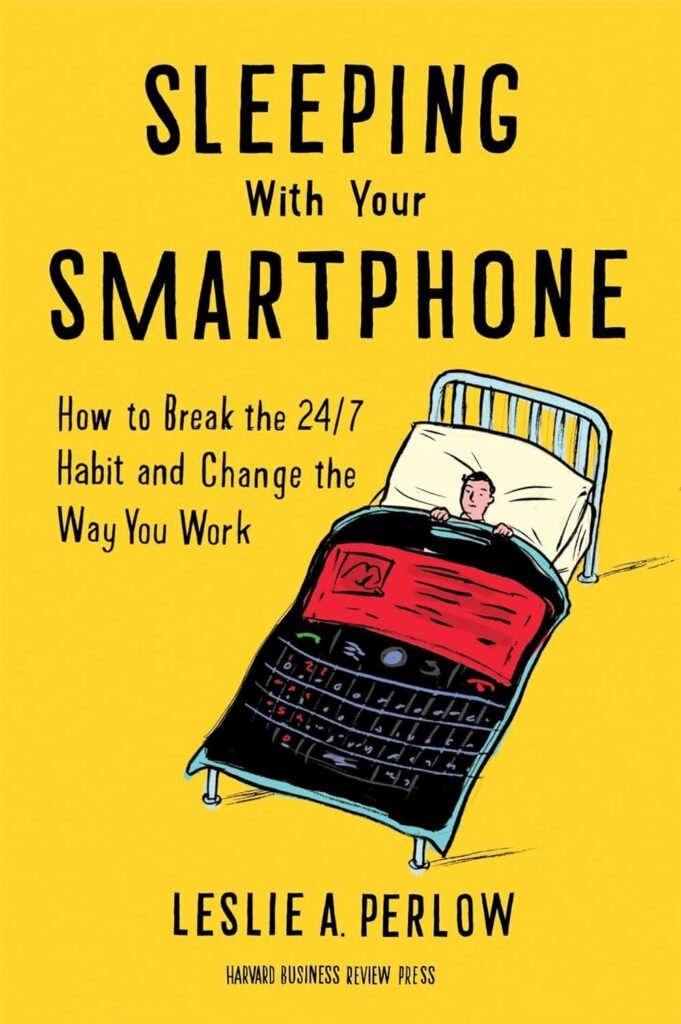
Sleeping with Your Smartphone by Leslie A. Perlow
In a world where our smartphones have become constant companions, Sleeping with Your Smartphone by Leslie A. Perlow offers a refreshing perspective on digital balance.
Why We Can’t Put the Phone Down at Night
Before we talk about effects, it’s worth understanding why this habit is so hard to shake.
Smartphones are engineered to keep you engaged. Every notification, every like, every new message triggers a small dopamine release in the brain, the same neurochemical associated with pleasure and reward. Social media platforms and apps are deliberately designed to be difficult to put down.
At night, when your mind starts to wind down, the pull of the phone feels especially strong. You might reach for it out of boredom, anxiety, loneliness, or simply habit. And because the screen is always within arm’s reach, the barrier to “just checking” is almost zero.
The problem? Your brain doesn’t distinguish between harmless scrolling and a genuinely stimulating event. Either way, it gets activated, right at the moment it should be slowing down for sleep.
The Science of Sleep: What Your Body Needs
To understand why sleeping with a phone habits are so disruptive, you first need a quick overview of how healthy sleep works.
Sleep is divided into multiple cycles, each lasting roughly 90 minutes and made up of distinct stages:
- Light sleep (N1 & N2): Your body begins to relax, heart rate slows, and body temperature drops.
- Deep sleep (N3 / slow-wave sleep): This is the most restorative phase. Your body repairs tissue, builds muscle, and strengthens the immune system.
- REM sleep: The stage where dreaming occurs. Critical for memory consolidation, emotional regulation, and creativity.
A healthy adult needs 7–9 hours of quality sleep, with sufficient time in both deep and REM stages. Disrupting any part of this cycle, even slightly, leads to measurable declines in cognitive function, mood, metabolism, and immune response.
Now let’s look at exactly how your phone is interfering with all of this.

Muse Headband: A Game-Changer for Meditation
What Does Sleeping With Your Phone Do to You?
Sleeping with your phone nearby has five documented negative effects on your health:
- Suppresses melatonin; blue light delays your body’s sleep signal by up to 3 hours
- Keeps your brain stimulated; scrolling content triggers alertness and emotional responses at bedtime
- Fragments your sleep; notifications cause micro-awakenings that disrupt deep and REM stages
- Creates psychological dependency; the habit reinforces anxiety around being without the phone
- May affect brain activity; low-level EMF exposure during sleep is still under study, but the precaution is low-cost
Muse Headband: A Game-Changer for Meditation
5 Major Effects of Sleeping with a Phone
1. Blue Light Suppresses Melatonin Production
This is the most well-documented effect, and it’s a big one.
Your phone screen emits blue light, a short-wavelength, high-energy light that your brain interprets as daylight. When blue light hits your retinas in the evening, it signals to your brain’s suprachiasmatic nucleus (your internal clock) to suppress the production of melatonin, the hormone responsible for making you feel sleepy.
Research published in the Journal of Clinical Endocrinology & Metabolism found that evening exposure to blue light can delay melatonin release by up to 3 hours. That means if you’re scrolling your phone at 10 PM, your brain may not signal “time to sleep” until well after midnight, even if you feel physically tired.
The result? You lie awake longer, take more time to fall asleep, and wake up groggy even after a full night in bed.
What Does Blue Light Do to Your Sleep?
Blue light from phone screens suppresses melatonin, the hormone your brain produces to signal it’s time to sleep. When blue light hits your retinas in the evening, your brain interprets it as daylight and delays melatonin release by up to three hours. This pushes back your natural sleep onset, reduces total sleep time, and makes you feel groggy even after a full night in bed, even if you don’t feel like you’re having trouble sleeping.
2. Mental Stimulation Keeps Your Brain Awake
Blue light is just one piece of the puzzle. The content you consume on your phone is equally problematic.
Whether you’re reading breaking news, having a text argument, watching suspenseful videos, or doom-scrolling social media, your brain is actively processing information and generating emotional responses. Stress, excitement, curiosity, and anger are all activating states that are the opposite of what you need for sleep onset.
A 2022 study from Uppsala University found that people who used social media within 30 minutes of bedtime had significantly more difficulty falling asleep and reported lower sleep quality overall, regardless of how long they spent on their phones.
Your brain needs cognitive wind-down time before sleep. Scrolling your phone eliminates that window.
3. Notifications Cause Micro-Awakenings
Even if you manage to fall asleep with your phone nearby, the battle isn’t over.
Most people sleep with their phone on loud, vibration, or with the screen set to light up for notifications. Every buzz, ping, or screen flash, even if you don’t fully wake up, can cause what sleep researchers call micro-awakenings: brief interruptions to your sleep cycle that fragment deep and REM sleep.
You may not remember waking up, but the damage is cumulative. Night after night of fragmented sleep produces the same cognitive effects as chronic sleep deprivation: poor memory, slower reaction times, mood instability, and increased risk of anxiety and depression.
A simple rule: your bedroom is not your phone’s bedroom. Its notifications are not worth your REM cycles.
4. Electromagnetic Fields (EMFs), What We Know (and Don’t Know)
A more controversial topic, but one worth mentioning honestly.
Smartphones emit low-level radiofrequency electromagnetic fields (RF-EMFs) when they’re actively connected to a network. There’s an ongoing scientific debate about whether prolonged exposure to these fields has measurable biological effects on humans.
The World Health Organization (WHO) currently classifies RF-EMFs as “possibly carcinogenic”, placing them in the same category as coffee and talc, not cigarettes. In other words, the evidence is suggestive but not conclusive.
What is clear from studies on animals and some human research is that RF-EMF exposure may interfere with electrical activity in the brain during sleep, potentially affecting sleep architecture. While we shouldn’t overstate this, keeping your phone at a distance while you sleep is a low-cost precaution with no downside.
5. Psychological Dependency and Sleep Anxiety
Here’s a less obvious but deeply important effect: sleeping with your phone reinforces psychological dependency that can itself cause anxiety.
Many people report feeling genuinely anxious if they can’t check their phone before sleep, or if they wake up in the middle of the night and can’t immediately see whether there are any messages. This is sometimes called nomophobia (no-mobile-phone phobia), and it’s recognized by psychologists as a growing behavioral concern.
This anxiety, in turn, activates the body’s stress response, releasing cortisol, raising heart rate, and making restful sleep even harder to achieve. It becomes a vicious cycle: you feel anxious without your phone, but using your phone makes your sleep worse, which makes you more anxious the next day.
Sleeping with Your Smartphone by Leslie A. Perlow
In a world where our smartphones have become constant companions, Sleeping with Your Smartphone by Leslie A. Perlow offers a refreshing perspective on digital balance.
The Ripple Effects Beyond Sleep
Poor sleep from phone use doesn’t just make you tired. Over time, it can contribute to:
- Weight gain. Sleep deprivation disrupts hunger hormones (ghrelin and leptin), increasing cravings for high-calorie foods.
- Weakened immunity. Deep sleep is when your immune system regenerates. Less deep sleep means more frequent illness.
- Mental health decline. Chronic poor sleep is strongly linked to depression, anxiety, and emotional dysregulation.
- Reduced cognitive performance. Memory consolidation happens during sleep. Poor sleep = weaker learning retention.
- Relationship strain. Poor sleep makes people more reactive, less empathetic, and harder to live with.
The stakes are higher than most people realize. This isn’t just about feeling groggy in the morning.
🪜 Practical Steps: How to Sleep Better Without Abandoning Your Phone Entirely
Let’s be realistic. You’re not going to throw your phone into the ocean. The goal is to create healthier boundaries, not eliminate technology from your life. Here’s how:
✅ Set a “Phone Curfew” 30–60 Minutes Before Bed
Put your phone down at least 30 minutes before you plan to sleep. 60 minutes is even better. Use this time for reading (a physical book), light stretching, journaling, or conversation.
✅ Charge Your Phone Outside the Bedroom
This single change eliminates notifications, reduces temptation, and forces you to use an actual alarm clock. Many people report dramatic sleep improvements from this alone.
✅ Enable Night Mode or Blue Light Filters
If you must use your phone in the evening, activate Night Mode (reduces blue light emission) or use blue light-blocking glasses. This doesn’t eliminate the problem, but it significantly reduces melatonin suppression.
✅ Turn Off Non-Essential Notifications After 9 PM
Go into your phone settings and silence all non-urgent apps. Emergency calls can still come through. Everything else can wait until morning.
✅ Replace the Scroll with a Wind-Down Ritual
The reason people reach for their phones at night is often boredom or anxiety. Build a replacement ritual: a cup of herbal tea, 10 minutes of meditation, light reading, or even a podcast (audio only, screen face-down or off).
✅ Use Your Phone’s Screen Time Tools
Both iPhone (Screen Time) and Android (Digital Wellbeing) have built-in features to automatically lock apps after a set time. Use them. Future-you at midnight will thank past-you who set limits.
✅ Keep Your Bedroom a Sleep-First Space
Beyond the phone, rethink your bedroom environment. Cool temperature (65–68°F / 18–20°C), blackout curtains, and no screens create conditions your brain associates with sleep rather than stimulation.
Muse Headband: A Game-Changer for Meditation
🏗️ How to Stop Sleeping With Your Phone? (and Sleep Better Tonight)
Breaking the phone-in-bed habit doesn’t require a digital detox retreat. These seven practical steps will help you reclaim your sleep, starting tonight.
1. Set a Phone Curfew 30–60 Minutes Before Bed
Put your phone down at least 30 minutes before you plan to sleep – 60 minutes is even better. Use this wind-down window for reading a physical book, light stretching, journaling, or a quiet conversation. Your brain needs this decompression time to shift toward sleep mode.
2. Charge Your Phone Outside the Bedroom
This is the single highest-impact change you can make. Charging your phone in another room eliminates late-night temptation, removes notification disruptions, and forces you to use a dedicated alarm clock. Many people report dramatically improved sleep quality from this change alone.
3. Enable Night Mode or a Blue Light Filter in the Evening
If you must use your phone in the hours before bed, activate Night Mode (iOS) or Night Light (Android). These settings shift the screen’s color temperature to reduce blue light emission and lessen melatonin suppression. Blue light-blocking glasses offer similar protection.
4. Turn Off Non-Essential Notifications After 9 PM
Go into your phone’s settings and silence all non-urgent apps from 9 PM onward. Emergency calls can still come through – everything else can wait until morning. This prevents micro-awakenings that fragment your deep and REM sleep without you even realizing it.
5. Replace Scrolling With a Wind-Down Ritual
The urge to reach for your phone at night is usually driven by boredom or anxiety – not genuine need. Build a replacement ritual that addresses both: a cup of chamomile tea, 10 minutes of meditation, light reading, or an audio-only podcast with the screen face down. Give your nervous system something calmer to land on.
6. Use Your Phone’s Built-In Screen Time Tools
Both iPhone (Screen Time) and Android (Digital Wellbeing) let you automatically lock apps after a set time. Configure them to cut off social media, news, and entertainment apps by 9 or 10 PM. Setting these limits once protects you every night – even when willpower is low.
7. Redesign Your Bedroom as a Sleep-First Space
Beyond the phone, your environment shapes your sleep. Aim for a cool room temperature (65–68°F / 18–20°C), blackout curtains, and zero screens visible from bed. When your brain consistently associates your bedroom with sleep rather than stimulation, falling asleep becomes easier and more natural over time.
What the Latest Research Is Saying
Sleep science is evolving fast. A few notable recent findings:
- A 2024 meta-analysis published in Sleep Medicine Reviews confirmed that pre-sleep smartphone use is independently associated with delayed sleep onset and shorter total sleep time across all age groups, with the strongest effects in adolescents.
- Research into wearable sleep tracking (like the data from Oura Ring and WHOOP users) is now providing large-scale real-world data confirming lab findings: people who use phones in the last hour before bed show measurably lower HRV (heart rate variability) during sleep, a key marker of sleep quality.
- Cognitive behavioral therapy for insomnia (CBT-I) programs increasingly identify phone use as a primary behavioral factor to address, on par with irregular sleep schedules and excessive caffeine consumption.
The scientific consensus is clear and getting clearer: sleeping with a phone is not a neutral habit.
Small Changes, Transformative Results
Your phone isn’t the enemy, but your current relationship with it at night might be.
The effects of sleeping with a phone go far beyond feeling a bit tired. They touch your mental health, physical health, focus, emotional stability, and quality of life in ways that accumulate quietly over months and years.
The good news? The solution doesn’t require a complete lifestyle overhaul. A few intentional changes- a phone curfew, charging it in another room, building a wind-down ritual- can meaningfully transform your sleep quality within days.
Start tonight. Put your phone on the other side of the room before you go to bed. See how you feel tomorrow morning. You might be surprised.
💬 We want to hear from you!
Do you sleep with your phone nearby? Have you ever tried a digital curfew? Share your experience. Your story might help someone else make a positive change. And if this article resonated with you, share it with a friend who could use a better night’s sleep. 🌙
📒 Related reads you might enjoy:
- Transform Your Sleep Routine for Optimal Recovery and Restorative Sleep
- Personal Growth and Personal Development: Key Differences + 10 Proven Tactics (2026)
- Meditation for Sleep: Science-Backed Guide + 12-Minute Protocol + Best Tools
- Sleep Quality and Spiritual Growth Connection
❓ Frequently Asked Questions:
How far away should a phone be when you sleep?
Keep your phone at least 3 feet (approximately 1 metre) away from your bed while sleeping. This distance minimises exposure to radiofrequency electromagnetic fields (EMFs), reduces the chance that notifications will trigger micro-awakenings, and removes the visual temptation to check it if you wake in the night. If you can charge it in another room entirely, that’s the better option.
What is the 3/2/1 bedtime rule?
The 3/2/1 bedtime rule is a guideline for a better night’s sleep:
– 3 hours before bed: Stop eating.
– 2 hours before bed: Stop exercising.
– 1 hour before bed: Unplug from screens.
What is the number one sleep killer?
Stress.
Body, Mind, And Soul For A Fulfilled Life!

)