Most of us treat sleep as the thing that happens after the real work is done. We collapse into bed when the day runs out, hoping to feel less exhausted tomorrow. But what if sleep is not the end of the day? What if it is the beginning of something deeper? The sleep quality and spiritual growth connection is one of the most overlooked ideas in modern wellness, and it deserves a closer look. Rest is not passive. It is the foundation on which every meditation, prayer, journaling session, and moment of genuine self-awareness is built.
🛏️ Sleep Quality and Spiritual Growth Connection
Why Sleep Is More Than Physical Recovery
Think of sleep as the soil, not the fruit. You can plant the finest seeds, a devoted meditation practice, a gratitude journal, and years of inner work, but if the soil is depleted, growth stalls. Chronic poor sleep depletes the soil. Every spiritual tradition that has survived for centuries understood this at some level, even without the neuroscience to explain it.
Sleep does far more than repair muscle tissue and consolidate memories. It regulates emotion, clears metabolic waste from the brain, and resets the nervous system’s baseline. Without those processes running smoothly, the mind is reactive rather than reflective, anxious rather than open.

Muse Headband: A Game-Changer for Meditation
The Nervous System, Rest, and Inner Awareness
Spiritual growth requires a nervous system that can settle. Practices like meditation, contemplative prayer, or breathwork all ask the same thing: slow down, become present, listen inward. A chronically underslept nervous system fights those practices at every step. It stays locked in a low-grade threat response, scanning for danger, looping on worry, struggling to sustain attention.
Quality sleep shifts the nervous system toward its parasympathetic state: the mode of rest, repair, and receptivity. That is exactly the physiological ground you need for inner awareness to take root. Going to bed is not the opposite of spiritual work. It is spiritual work.
The Sleep Quality and Spiritual Growth Connection Explained
How Deep Sleep Clears the Path for Consciousness
Sleep architecture moves through cycles roughly 90 minutes long. Early in the night, slow-wave NREM (non-rapid eye movement) deep sleep dominates. During this stage, the brain clears adenosine, the chemical that builds up with fatigue, and runs what researchers call the glymphatic system, essentially flushing cellular waste from brain tissue. A clear, well-rested mind is not a metaphor; it is a measurable physiological state.
For spiritual practitioners, that clarity matters enormously. Insight, discernment, and the quiet alertness required for genuine self-reflection all depend on a prefrontal cortex that is functioning well. Deep NREM sleep is what restores it. Skimping on sleep does not just make you tired; it narrows the window through which consciousness can operate clearly.
Sleep Cycles and Intuition: What Happens Overnight
As the night progresses, REM (rapid eye movement) sleep takes up more of each cycle. Sleep researchers have found that REM, the stage most associated with vivid dreaming, plays a central role in emotional memory consolidation and creative insight, both foundational to self-awareness and personal growth. During REM, the brain replays emotional experiences stripped of their stress chemistry, helping you metabolize difficult feelings and surface unexpected connections between ideas.
That process maps directly onto what many traditions call intuition: the ability to perceive patterns and meanings that the analytical, waking mind misses. The sleep cycles and intuition relationship is not mystical speculation; it reflects how the sleeping brain actually processes experience. People who consistently reach full REM sleep report stronger emotional clarity and a heightened sense of knowing what feels right. That is intuition with a neurological substrate.
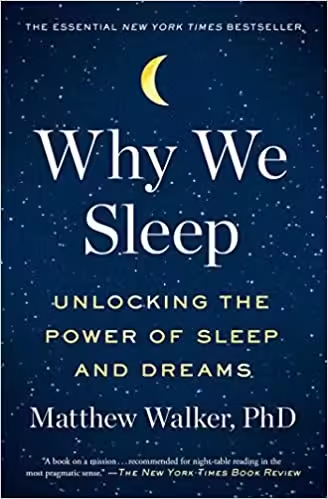
Why We Sleep: Understanding the Science of Sleep and Rest
Ever wondered why you can’t function without your daily dose of Z’s? Matthew Walker’s Why We Sleep holds the answers! This illuminating read explores the mysteries of sleep, blending scientific insights with practical tips, all wrapped in an engaging narrative. You’ll never look at your pillow the same way again!
Why We SleepDream Work for Spiritual Development
Dreams have been taken seriously as spiritual data for as long as human records exist. Ancient Egyptians built incubation temples for healing dreams. The Hebrew Bible is full of prophetic dream narratives. Indigenous cultures across every continent have used dreams as guidance, teaching, and community wisdom. The modern tendency to dismiss dreams as neural noise is historically unusual, and it impoverishes our inner lives.
Dream work for spiritual development treats dreams not as random images but as a dialogue between conscious and unconscious parts of the self. Carl Jung called the unconscious “the great teacher,” and while you need not adopt his entire framework, the core idea is practical: your sleeping mind processes things your waking mind avoids, and that material is worth examining.
How to Start a Simple Dream Journaling Practice
The barrier to entry is low. Keep a notebook and pen on your nightstand, not your phone. The moment you wake, before checking anything, write down whatever fragments remain: images, feelings, colours, people, words. Do not wait until after the shower. Dream memory degrades fast, often within minutes of waking.
You do not need to interpret every dream. Start by simply recording and noticing patterns over days and weeks. Which emotions recur? Which symbols appear more than once? Over time, themes emerge that reflect your current inner landscape with surprising precision.
Readers of The Dream Oak who already maintain a mindfulness or journaling practice are especially well-positioned here. Dream work for spiritual development becomes a natural extension of habits already in place, not an entirely new discipline to build from scratch.
Sacred Sleep Practices Across Traditions
The idea that rest is a self-care ritual is a modern wellness trend that misreads history. Contemplative traditions worldwide have long treated the transition into sleep as spiritually significant.
Yoga Nidra, literally “yogic sleep”, is a guided practice that leads the practitioner to the hypnagogic threshold between waking and sleep. Used in Himalayan and Tantric traditions, it is designed specifically to access subtler states of consciousness while maintaining a thread of awareness. Clinical pilots have examined Yoga Nidra’s effects on the autonomic nervous system and self-awareness, finding reductions in stress markers and increases in reported well-being.

Indigenous Australian cultures frame the Dreamtime not as ordinary night sleep but as a cosmological reality, the dimension in which ancestral knowledge, identity, and creation itself are held. While Dreamtime is not equivalent to bedtime, the concept reveals how deeply non-Western traditions have always linked dreaming, identity, and spiritual truth. The anthropologist Deborah Bird Rose’s work on Aboriginal Australian cosmology explores this connection in detail.
Christian contemplative practice includes the Liturgy of the Hours, in which monks pray at Compline, the final prayer before sleep, as an act of surrender and trust, consciously offering the night to God. The night prayer tradition treats sleep as a sacred threshold, not a blackout.
Across all of these, a consistent idea emerges: the move toward sleep is a move toward something larger than the ordinary self. That shared intuition across unconnected traditions is itself worth taking seriously.
Muse Headband: A Game-Changer for Meditation
Building Your Own Rest as a Self-Care Ritual
Evening Wind-Down Practices That Deepen Sleep and Awareness
You do not need to borrow any single tradition wholesale. The most durable sacred sleep practices are the ones you will actually do. Here is a five-step evening ritual grounded in both sleep science and spiritual intention:
1. Digital sunset, 60 minutes before bed, screens off. Blue-light exposure suppresses melatonin production and keeps the analytical mind activated. Closing screens is not just a sleep hygiene tip; it is a boundary that says this hour belongs to something quieter.
2. Breathwork: five minutes of slow, extended exhale breathing. A 4-count inhale and 6-to-8-count exhale activates the parasympathetic nervous system. This is physiologically measurable, and it mirrors the pranayama practices used in yogic traditions for the same reason: to shift the system out of doing-mode and into being-mode.
3. Gratitude reflection, three genuine specifics, spoken or written. Not a list; a genuine pause with each one. Gratitude downregulates threat-response circuitry and orients the mind toward abundance rather than scarcity. It is also a form of prayer in most traditions, regardless of the language used.
4. Intention-setting: one clear sentence about the inner quality you want to carry into sleep. Something like: Tonight I release what I cannot control, or I am open to clarity. This is the sleep-threshold equivalent of setting an intention before meditation. It signals to the deeper mind what you are listening for.
5. Ambient environment: darkness, cool temperature, and quiet. Science consistently supports 65–68°F (18–20°C) as the optimal sleep temperature range. Darkness cues melatonin. These are not luxuries; they are the physical conditions under which the nervous system can fully release.
If you are new to intentional practices, starting with a beginner mindfulness practice makes the transition into this kind of evening ritual significantly easier; the skills of attention and non-judgment transfer directly.

Sleep Test by Intus Healthcare
Sleep Test by Intus Healthcare is a clinically validated at-home sleep apnoea diagnostic service that delivers hospital-grade accuracy from your bedroom. Order a WatchPAT home test kit, wear the simple wristwatch sensor while you sleep, and receive analysis by NHS-trained sleep clinicians within 2 working days. If you snore, gasp for air at night, experience morning headaches, or struggle with daytime sleepiness, this affordable test can confirm or rule out Obstructive Sleep Apnoea – a highly treatable condition affecting millions. Includes a free follow-up consultation with sleep specialists to discuss your results and treatment options. Over 250,000 people in the UK have used this service to reclaim quality sleep and better health.
Making Sacred Sleep a Non-Negotiable Spiritual Practice
Neuroscientist Matthew Walker has written that sleep is “the single most effective thing we can do to reset our brain and body health each day.” Translate that into spiritual terms, and the implication is direct: no practice, however devoted, can flourish on a chronically sleep-deprived mind. You cannot meditate your way past a depleted nervous system. You cannot journal your way to insight when your prefrontal cortex is running on empty.
The sleep quality and spiritual growth connection ultimately asks us to reframe what counts as spiritual discipline. Discipline is not only about effort and practice, but it is also about intelligent stewardship of the conditions that make growth possible. Protecting your sleep is one of the most concrete, measurable ways to honour your inner life.
Treating your bedtime as a commitment, not a variable, not something bumped by one more episode or one more scroll, is itself an act of self-respect with spiritual weight. It says: ” My inner development matters enough to defend.“
Start with one week. Choose two or three of the evening practices above and hold them consistently for seven nights. Notice what changes in your dream life, your emotional tone in the morning, your capacity for stillness. The sleep and consciousness relationship is not abstract; you can feel it shift within days when you take it seriously.
Your sleep is not recovery time between your real spiritual work. It is the work. Treat it that way, and everything else deepens.
Learn, Help Family And Friends, And Help The Planet!