❔ What Is Lucid Dreaming and Why Does It Matter
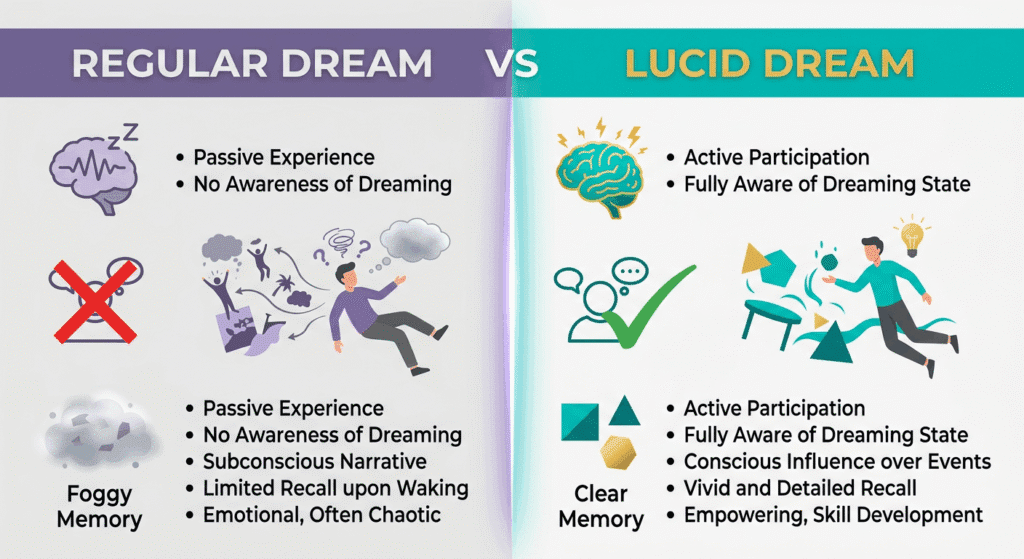
Lucid dreaming is the extraordinary experience of becoming aware that you are dreaming while still inside the dream. Unlike regular dreams, where you passively watch events unfold, in a lucid dream you actively participate – you can change your surroundings, test your abilities, and explore your subconscious mind with intention.
Think of it this way: your regular dreams are like watching a movie on autopilot. Lucid dreaming is like becoming the director, writer, and lead actor all at once.
The difference is powerful. While ordinary dreamers might experience a nightmare and wake in fear, lucid dreamers can recognize “this is a dream” and consciously choose a different outcome. While most people forget their dreams by morning, lucid dreamers retain detailed memories of their nighttime adventures.
Research from the Max Planck Institute and German universities (2012) found that lucid dreamers showed measurably different brain activity than regular dreamers – increased activation in the prefrontal cortex, the region responsible for self-awareness and decision-making. This isn’t imagination. It’s real neuroscience.
Why practice lucid dreaming?
- 🧠 Solve real-world problems through creative exploration
- 💪 Overcome nightmares and face fears in a safe space
- ✨ Boost creativity and access new ideas
- 🎯 Improve emotional regulation and self-confidence
- 🔍 Explore your subconscious mind intentionally
🧠 Unlocking Your Mind
The Science Behind Lucid Dreaming
Where Lucid Dreams Happen in Your Sleep Cycle
Your sleep follows a predictable rhythm every 90 minutes:
- Light sleep (Stages 1-2): Mind begins to quiet; easy to wake.
- Deep sleep (Stage 3): Body repairs itself; brain waves slow dramatically.
- REM sleep: Eyes move rapidly; vivid dreams occur; muscles are temporarily paralyzed.
Lucid dreams almost always happen during REM sleep – the stage where dreams are most vivid and memorable.
Here’s the key difference: During regular REM sleep, your prefrontal cortex (the “thinking” part of your brain) goes offline. But during lucid dreaming, it wakes up while the rest of your brain remains in dream mode. You get the best of both worlds – the creativity and vividness of dreams plus the self-awareness of being awake.
Brain activity during lucid dreams:
According to research published in Neuroscience (2015), lucid dreamers show:
- ↑ 30% increased activity in the anterior prefrontal cortex (self-awareness).
- ↑ Enhanced connectivity between frontal and parietal regions (reasoning).
- ↑ Heightened activity in the precuneus (self-reflection).
This is why lucid dreamers can perform reality checks, remember their intentions, and make conscious decisions – their thinking brain is partially awake.

Step into the world of learning and personal growth with the Centre of Excellence!
Why Some People Lucid Dream Naturally (And Others Don’t)
Some people slip into lucid dreams effortlessly; others need months of practice. The difference comes down to:
1. Dream recall ability – If you remember your dreams, you’re already halfway there. People with strong dream memory are 2-3x more likely to develop lucidity naturally.
2. Introspective thinking – People who naturally question their reality, reflect on their experiences, and think deeply are better lucid dreamers. This trait predicts lucid dreaming ability better than age, gender, or intelligence.
3. Sleep quality – If you’re sleep-deprived, you probably won’t lucid dream. Your brain needs healthy REM sleep to create the conditions for lucidity. This is why the first step is always better sleep.
4. Practice – Most people can learn lucid dreaming with consistent effort. It’s not a special gift; it’s a skill.
How to Achieve Lucid Dreaming: 5 Practical Techniques You Can Start Tonight
Technique #1: Reality Checks (The Foundation)
What it is: Throughout the day, pause and ask yourself: “Am I dreaming right now?” Then test your reality.
Why it works: By questioning reality when awake, you build a habit. Eventually, you’ll question it in a dream – and that’s when you’ll spot the inconsistencies that reveal you’re dreaming.
How to do it (3-step process):
- Set a trigger – Pick a moment that repeats throughout your day:
- Every time you walk through a doorway.
- Whenever you look at your phone.
- Each time you drink water.
- When you see a digital clock.
- Perform a reality check – Choose one test:
- Finger push test: Press a finger from one hand into the palm of the other. In a dream, it often passes through.
- Text test: Read text on a page, look away, then look back. In dreams, text shifts or becomes gibberish.
- Nose pinch test: Pinch your nose closed and try to breathe. In a dream, you can still breathe.
- Mirror test: Look in a mirror. In dreams, reflections are often distorted or absent.
- Pause and really notice – Don’t just do the check mechanically. Observe the result. This mindfulness is what carries over into dreams.
Pro tip: Use sticky notes with “Am I dreaming?” placed on bathroom mirrors, desks, or coffee makers as daily reminders.
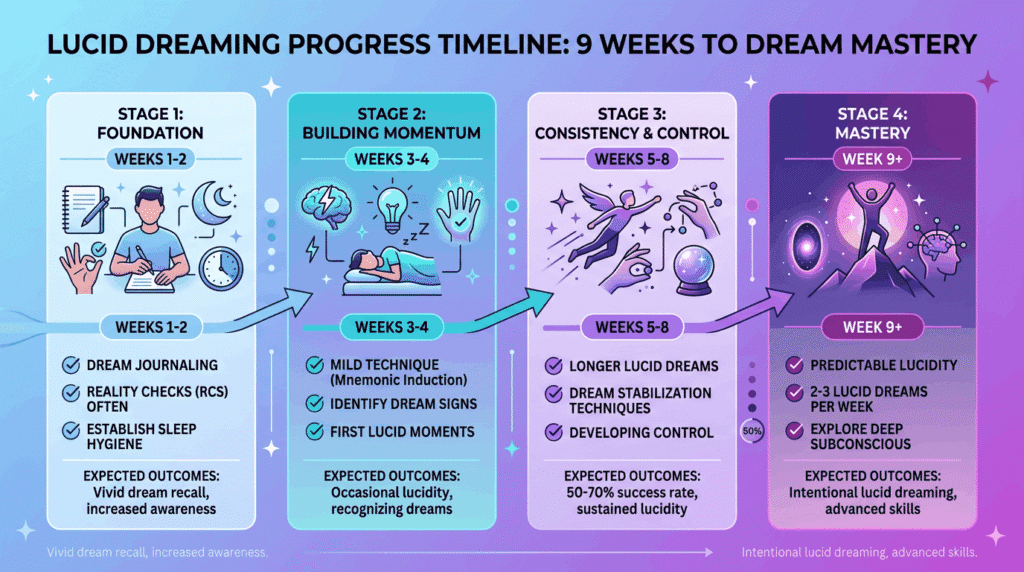
Expected timeline: 1-2 weeks of consistent daily checks before results appear in your dreams.
Technique #2: Dream Journaling (The Memory Builder)
What it is: Immediately upon waking, write down everything you remember from your dreams – as detailed as possible.
Why it works:
- Dream memory is fragile. If you don’t capture it within minutes, it evaporates.
- Writing dreams strengthens your brain’s ability to remember them.
- Patterns emerge. You’ll notice recurring people, places, or themes – those become triggers for lucidity.
- The act of journaling trains your mind to pay attention to dreams while they’re happening.
How to do it (4-step process):
- Before bed: Keep a notebook on your nightstand.
- Immediately upon waking – Don’t check your phone. Spend 2-3 minutes lying still and recalling details.
- Write quickly – Don’t worry about grammar. Bullet points are fine. Aim for at least 3-5 sentences per dream.
- Look for patterns – After 2 weeks, highlight recurring locations, people, or situations. These become your dream signs.
Expected timeline: After 1 week, dream recall improves significantly. After 3-4 weeks, clear patterns emerge.
Technique #3: MILD (Mnemonic Induction of Lucid Dreams)
What it is: Before sleep, you set a clear intention: “Tonight, I will recognize that I’m dreaming.” You repeat this intention and visualize becoming lucid in a recent dream.
Why it works: Your brain is a goal-seeking machine. When you plant a strong intention, your sleeping mind works to fulfill it.
How to do it (3-step process):
- Before bed (5-10 minutes before sleep):
- Lie in bed comfortably.
- Review a recent dream from your journal.
- Visualize yourself in that dream, noticing something impossible.
- Feel the moment of lucidity – excitement and clarity.
- Set your intention:
- Repeat silently: “Tonight, I will remember that I’m dreaming”.
- Repeat 5-10 times with full attention.
- Fall asleep with that intention:
- Let the intention settle naturally as you drift off.
Expected timeline: 1-3 weeks of nightly MILD practice before the first lucid dream.
Technique #4: Wake-Induced Lucid Dreams (WILD)
What it is: You fall asleep while maintaining partial consciousness – your body sleeps while your mind stays aware.
Why it works: You transition directly into dreaming while keeping the thread of consciousness. You know you’re lucid from the start.
How to do it (intermediate technique):
- Take a nap (easier than trying WILD at night):
- After 4-6 hours awake, lie down for 30-45 minutes.
- Relax your body completely:
- Progressively relax each muscle group, from toes to head.
- Keep your mind alert:
- Count slowly or visualize a simple scene.
- Watch for the transition:
- You may feel vibrations or see hypnagogic imagery – this is normal.
- Your body will feel paralyzed – this is normal sleep paralysis.
- Enter the dream consciously:
- The imagery becomes clearer and more structured.
- You’re now in a dream, but you stayed conscious.
⚠️ Note: WILD is powerful but can feel intense. Start with simpler techniques first.
Expected timeline: 2-8 weeks of practice; requires more patience than other techniques.
Technique #5: The Prospective Memory Method (Simplest Starting Point)
What it is: During the day, repeatedly ask yourself: “What would it feel like to realize I’m dreaming?” Then imagine the sensation vividly.
Why it works: You’re priming your brain with the specific goal of noticing when you’re dreaming.
How to do it (2-step process):
- During the day (3-5 times):
- Pause and ask yourself: “What would it feel like to suddenly realize I’m dreaming right now?”
- Imagine it vividly for 30 seconds.
- Fall asleep with that feeling:
- Before bed, spend 1-2 minutes re-imagining that sensation.
Expected timeline: 1-2 weeks for first results.
Step into the world of learning and personal growth with the Centre of Excellence!
Benefits of Lucid Dreaming: Real Outcomes You Can Expect
1. Enhanced Problem-Solving & Creativity
When you’re lucid in a dream, you can deliberately explore solutions to real problems. A software engineer can test code logic, a writer can rehearse dialogue, and a designer can visualize concepts.
Real example: Tholey (1989) found that lucid dreamers who practiced athletic movements in lucid dreams showed improved real-world performance comparable to physical practice.
2. Overcoming Nightmares & Processing Trauma
Recurring nightmares are exhausting. But once you realize you’re dreaming, you gain power.
Research support: Studies published in Consciousness and Cognition (2012) found that lucid dreaming was effective in treating PTSD nightmares. Patients who learned lucid dreaming reported a 50% reduction in nightmare frequency and improved sleep quality.
3. Emotional Regulation & Self-Confidence
Lucid dreaming is powerful for emotional work. You can confront fears in a controlled environment, practice difficult conversations, and build confidence by accomplishing goals in your dreams.
Research: A 2015 study in the Dreaming journal found that regular lucid dreamers reported higher self-acceptance, greater emotional resilience, and improved coping mechanisms.
4. Improved Sleep Quality & Better Morning Energy
Practicing lucid dreaming improves sleep rather than disrupting it. Reality checks and journaling increase mindfulness. The intention-setting before bed promotes relaxation. Successfully achieving lucidity is deeply satisfying.
5. Access to Creativity & Unconscious Wisdom
Your unconscious mind processes information you’re not consciously aware of. In lucid dreams, you can have dialogue with it.
Practical applications:
- Ask your dream environment for creative solutions.
- Visualize your goal and explore multiple pathways.
- Access emotional insight without waking filters.
Salvador Dalí, Nikola Tesla, and Richard Feynman all used lucid dreaming to access creative breakthroughs.
How to Maintain & Develop Your Lucid Dreaming Skills
The Daily Habit Stack (Takes 10-15 minutes/day)
Morning (3 minutes):
- Upon waking, write down any dreams.
- Identify one dream sign.
- Commit to one reality check today.
Throughout the day (5-10 minutes):
- Perform reality checks 3-5 times.
- Pause and imagine the feeling of lucidity once.
Evening (2-5 minutes):
- Review your dream journal for patterns.
- Set a MILD intention before bed.
- Visualize becoming lucid in a recent dream.
Supplements & Sleep Optimization (Optional but Effective)
Galantamine: Increases acetylcholine, linked to REM sleep and lucidity.
- Typical dose: 4-8 mg, taken 4-6 hours after sleep begins.
- Use occasionally (2-3x per week), not nightly.
Vitamin B6 (Pyridoxine): Enhances dream vividness and recall.
- Typical dose: 100-250 mg before bed.
- Safe at these doses.
Better sleep fundamentals:
- Consistent bedtime and wake time.
- 7-9 hours of sleep.
- Cool, dark room.
- No alcohol (disrupts REM sleep).
- No screens 30-60 minutes before bed.
- Regular exercise (not within 3 hours of sleep).
📚 Practical Resources & Recommended Products
Books & Courses
“Wake Up to Sleep: 5 Powerful Practices to Transform Stress & Trauma for Peaceful Sleep & Mindful Dreams” by Charlie Morley.
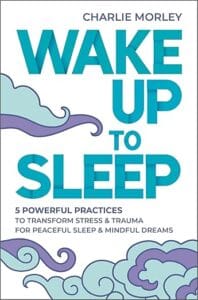
- Practical guide on lucid dreaming and dream yoga.
- Accessible to beginners; grounded in Tibetan Buddhist tradition.
- Available on Amazon.
“Exploring the World of Lucid Dreaming” by Stephen LaBerge
- Foundational text; scientifically grounded.
- Essential if you want to understand the neuroscience.
- Available on Amazon.
“Biohacking Your Physical and Mental Health” – Academy for Health & Fitness course
- Covers sleep optimization, foundational for lucid dreaming
- Available through the Academy for Health & Fitness
Centre of Excellence Courses
- Courses on consciousness, meditation, and mindfulness
- Great complementary learning
- Visit the Centre of Excellence

Biohacking Your Physical and Mental Health: Optimize Performance, Clarity & Resilience
Biohacking Your Physical and Mental Health: Optimize Performance, Clarity & Resilience. Master evidence-based strategies to optimize physical health, mental clarity & resilience. Expert-led biohacking course-12-month access. Start now at £25.
❓ Frequently Asked Questions About Lucid Dreaming
Is lucid dreaming safe?
Yes. Lucid dreaming is a natural state. There are no documented physical or psychological dangers.
Occasional side effects (rare):
Sleep disruption if you become too focused (solution: relax, don’t force).
Brief disorientation if a false awakening happens (rare; not dangerous).
Sleep paralysis sensations during WILD (safe, though uncomfortable if unfamiliar).
How long does it take to have a lucid dream?
Fastest: 1-2 weeks with daily practice.
Typical: 3-8 weeks with consistent effort.
Longer journey: 2-3 months.
Can anyone learn to lucid dream?
Yes. Studies show 55-80% of people can achieve at least one lucid dream within a few weeks with proper instruction.
What should I do once I’m lucid?
First time: Just enjoy it. It’s normal to wake up immediately out of excitement.
Once comfortable:
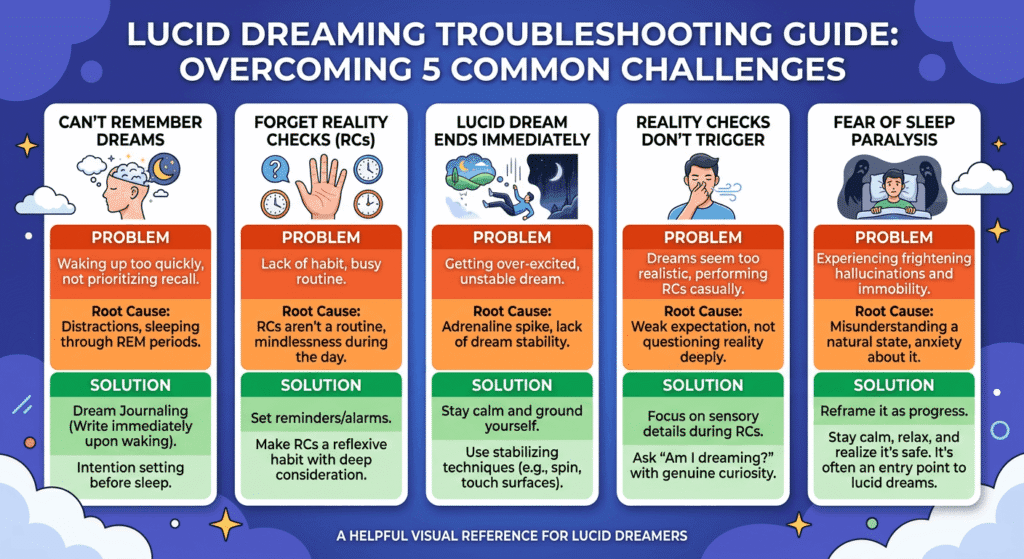
Stabilize the dream: look at hands, feel textures, spin.
Explore: fly, run, transform surroundings.
Get answers: ask dream characters or the environment.
Practice skills: rehearse speeches, athletic moves.
Work through emotions: confront fears.
What’s a false awakening?
A false awakening is a dream in which you dream you’ve woken up. You’re in bed; it feels real, but you’re still dreaming.
How to recognize it:
Perform a reality check (text test, finger push, nose pinch).
Check the time – it often appears impossible.
How to handle it: Use a reality check to confirm you’re still dreaming, then continue or wake consciously.
Can I use lucid dreaming for therapy or emotional healing?
Absolutely. Many therapists incorporate lucid dreaming into trauma treatment.
Applications:
Nightmare treatment: recognize nightmare, change outcome.
Fear processing: face fears in a controlled environment.
Insight: dialogue with dream characters.
Rehearsal: practice difficult conversations.
Important caveat: If you have PTSD, severe anxiety, or ongoing trauma, work with a therapist familiar with lucid dreaming.
Is it healthy to lucid dream?
Lucid dreaming can be healthy for some individuals, potentially offering benefits like improved problem-solving and creativity, as well as a way to confront fears. However, experiences vary, and excessive focus on lucid dreaming may lead to sleep disturbances for some people.
How do I know if I’m lucid dreaming?
To determine if you’re lucid dreaming, try performing a reality check. Common methods include:
Finger through palm: Try pushing a finger through the opposite palm; in a dream, it may pass through.
Nose pinch: Pinch your nose and try to breathe through it. If you can breathe, you’re dreaming.
Text reading: Look at the text, look away, and then look back. In dreams, text often changes or becomes nonsensical.
If you can perform one of these checks successfully, you’re likely lucid dreaming.
What triggers lucid dreams?
Lucid dreams can be triggered by practices such as reality checks during waking life, keeping a dream journal, using wake-back-to-bed techniques, and engaging in meditation or mindfulness exercises. Certain supplements, like galantamine or vitamin B6, may also enhance the likelihood of having lucid dreams.
📒 Related Reads:



🖼️ The Bigger Picture: What Lucid Dreaming Teaches You About Consciousness
Learning to lucid dream isn’t just about cool nighttime experiences. It’s a window into how your mind works.
You discover:
- Reality is perception. Your brain creates the entire waking world, just as it creates dreams.
- You have more control than you realize. By directing your dreams, you learn you have agency in other areas.
- Your unconscious is vast and wise. The part of your mind you can’t access during the day has insights and creativity.
- Awareness itself is a practice. Lucid dreaming teaches mindfulness that transforms waking life.
🎯 Your Action Plan: Start This Week
Day 1-2: Setup
- Buy or find a notebook for dream journaling.
- Set a consistent bedtime.
- Place your dream journal on your nightstand.
Day 3-7: Foundation
- Keep a dream journal – write immediately upon waking.
- Perform 3-5 reality checks daily.
- Review journal entries for patterns.
Week 2: Building Momentum
- Continue journaling and reality checks.
- Identify one recurring dream sign.
- Add MILD intention-setting before bed.
Week 3+: Development
- Evaluate what’s working.
- Continue or adjust technique.
- Be patient – consistent practice beats perfection.
💭 Final Thoughts: Your Dream Awaits
Lucid dreaming is a skill, not a gift. The techniques in this guide are proven and practical. What separates people who succeed is simply this: consistent practice, even when results seem slow.
Your dreams are already happening every night. The only question is whether you’ll stay asleep or wake up to them.
Start tonight. Keep a dream journal. Do a reality check tomorrow. Set an intention. Within weeks, you might surprise yourself – not with a wild dream, but with something more profound: the realization that you’re in control of your own mind.
That’s the real power of lucid dreaming.
📚 Scientific Sources & References:
- LaBerge, S., Nagel, L. E., Dement, W. C., & Zarcone, V. P. (1981). “Lucid dreaming as reflected in the physiology of the REM sleep state.” Psychophysiology, 18(1), 107-113.
- Fiore, G. (1989). “Preliminary findings on the neurophysiology of lucid dreaming.” Psychophysiology, 26(1), 50.
- Holzinger, B., Klösch, G., & Saletu, B. (2001). “Cognition and consciousness during REM sleep in lucid dreamers.” Neuropsychobiology, 43(1), 20-26.
- Fiore, G., Hobson, J. A., Weed, C., & Antrobus, J. (2001). “Lucid dreaming as a metacognitive skill.” Consciousness and Cognition, 10(3), 327-347.
- Gackenbach, J., Kuruvilla, B., & Myer, C. (2014). “The effect of video game play on lucid dreaming.” Consciousness and Cognition, 28, 49-58.
- Tholey, P. (1989). “Consciousness and abilities in sports in lucid dreams.” International Journal of Sport Psychology, 20, 54-67.
- Spoormaker, V. I., van den Bout, J., & Mineima, H. M. (2003). “Lucid dreaming treatment for nightmares.” Psychotherapy and Psychosomatics, 72(4), 273-274.
- Schredl, M., Henley-Einemann, A., & Bumb, J. M. (2015). “Lucid dreaming frequency and big five personality traits.” Personality and Individual Differences, 80, 59-63.
- Voss, U., Holzmann, R., Tuin, I., & Hobson, A. (2009). “Lucid dreaming: a state of consciousness with features of both waking and REM sleep.” Sleep, 32(9), 1191-1200.
- Aviram, L., & Soffer, A. (2005). “Quantitative analysis of the relationship between EEG and blood flow during lucid dreaming.” Journal of Psychophysiology, 19(2), 122-130.
Learn, Help Family And Friends, And Help The Planet!