❔ Why Rumi still matters
Jalāl al-Dīn Muḥammad Balkhī – better known as Rumi, Mawlānā, or Mawlānā Jalāl al-Dīn – has become one of the most recognisable names in world literature. His poetry appears in books of devotion, university courses, social-media posts, therapy rooms, wedding readings, and contemporary discussions of love and spiritual transformation.
Yet Rumi is not simply a dispenser of inspirational quotations. He was a 13th-century Persian poet, jurist, Qur’anic scholar, theologian, teacher, mystic, and performer of a highly intellectual form of Sufi Islam. His work is full of longing, paradox, humour, scriptural allusion, erotic metaphor, ethical struggle, metaphysical speculation, and disciplined spiritual practice.
To read Rumi well is therefore to hold two truths together:
- His poetry can speak powerfully to readers beyond his original religious and linguistic context.
- His poems lose depth when separated from Persian literary culture, Islamic vocabulary, Sufi practice, and the historical world that produced them.
The enduring question is not merely why Rumi is popular. It is what happens when a poet of divine love is translated into a global language of personal transformation. 🌹

Step into the world of learning and personal growth with the Centre of Excellence!
🔶 The Great Sufi Poet and Mystic
Rumi at a glance
- Full name: Jalāl al-Dīn Muḥammad Balkhī
- Common name: Rumi, from Rūm, a historical designation for Anatolia
- Born: 1207, traditionally associated with Balkh in present-day Afghanistan
- Died: 1273, in Konya, present-day Türkiye
- Primary literary language: Persian, with Arabic, Greek, and Turkish elements in his wider intellectual environment
- Tradition: Sunni Islam and the mystical tradition of Sufism
- Major works: Dīvān-e Shams-e Tabrīzī, Masnavī-ye Ma‘navī, Fīhi mā fīh, Majāles-e Sab‘a, and letters
- Central concerns: love, longing, transformation, the self, divine presence, spiritual discipline, music, death, and union
Dates and biographical details should be handled with care. Medieval hagiography often blends historical memory with symbolic storytelling, and some details of Rumi’s life remain debated by scholars.
Early life: migration, scholarship, and a changing world
Rumi was born into a Persianate intellectual world marked by movement and upheaval. His family’s migration westward is often connected to the political and military instability associated with the Mongol expansions, although the precise chronology and motivations are discussed differently in historical sources.
His father, Bahā’ al-Dīn Walad, was a respected religious scholar and preacher. Rumi’s early formation included Qur’anic study, Islamic law, theology, Persian literature, spiritual instruction, and the intellectual inheritance of Central Asian and Middle Eastern Islam.
The family eventually settled in Anatolia, where Rumi became associated with Konya. In medieval sources, Konya appears not merely as a backdrop but as the social and spiritual setting in which Rumi’s public identity developed. He inherited the role of scholar and religious teacher before becoming known primarily as a poet.
This transition matters. Rumi did not begin as an outsider rejecting religious learning. His later ecstatic and poetic expression emerged through, and sometimes in tension with, a substantial scholarly education.
From jurist and teacher to ecstatic poet
Before meeting Shams of Tabriz, Rumi was already a prominent teacher. The popular story that Shams transformed a dull scholar into a liberated mystic is attractive, but too simple.
Rumi’s knowledge of theology, jurisprudence, Qur’anic interpretation, Arabic rhetoric, Persian poetry, and Sufi traditions did not disappear after Shams. Instead, his relationship with Shams appears to have reconfigured how he inhabited that knowledge. Scholarship became more intensely embodied, musical, relational, and poetic.
This is one of the most useful ways to understand Rumi’s transformation: not as a rejection of intellect, but as a crisis in which intellect was forced to encounter love, presence, loss, and the limits of conceptual mastery.
The meeting with Shams of Tabriz
The meeting between Rumi and Shams al-Dīn Muḥammad of Tabriz is one of the most influential encounters in the history of mystical literature. Traditional accounts place it in Konya around 1244.
Shams was a wandering dervish with a challenging spiritual personality. He was not simply a teacher who delivered a set of doctrines to Rumi. Their relationship appears to have been intense, disruptive, and socially difficult for those around them.
After meeting Shams, Rumi’s poetic output expanded dramatically. He composed poems in which Shams becomes beloved, mirror, guide, absent companion, and symbol of the divine presence. The Dīvān-e Shams-e Tabrīzī bears Shams’s name, although the poems are Rumi’s; the name signals devotion, transformation, and the way the beloved becomes a vessel for poetic identity.
The relationship should not be reduced to a romantic anecdote. Its precise nature remains a subject of interpretation, and the sources are shaped by later memory. What can be said with confidence is that Shams became central to Rumi’s poetic and spiritual self-understanding.
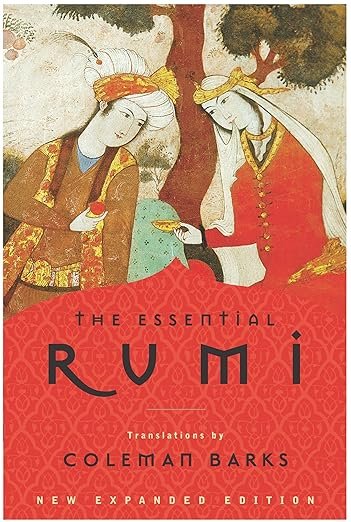
The Essential Rumi, New Expanded Edition
There’s a certain magic to poetry, and ‘The Essential Rumi, New Expanded Edition’ is a treasure trove of wisdom that dances beautifully across the pages. You’ll find yourself irresistibly pulled into Rumi’s enchanting world, where the ordinary becomes extraordinary.
Absence, grief, and poetic transformation
Shams disappeared from Konya more than once. His final fate is uncertain, and traditional accounts vary. His absence became a creative force in Rumi’s poetry.
This is a crucial insight: Rumi’s most celebrated experience of love is inseparable from loss. Longing is not an accidental emotion in his work; it is a method of perception. Absence strips away complacency and reveals attachment, projection, desire, and spiritual hunger.
Rumi’s poetry does not tell readers merely to “follow their heart.” It repeatedly asks what the heart is, what it wants, what it mistakes for fulfilment, and how love changes the person who loves.
For Rumi, longing is not simply a wound to be closed. It is a form of attention.
This helps explain why his work continues to speak to readers experiencing grief, separation, spiritual uncertainty, and creative crisis. It honours transformation without making loss sentimental.
Step into the world of learning and personal growth with the Centre of Excellence!
Rumi’s major works
The Dīvān-e Shams-e Tabrīzī
The Dīvān-e Shams is a vast collection of lyric poetry associated with Shams. It includes ghazals, odes, quatrains, ecstatic expressions, invocations, and poems of separation and union.
Its language is sensuous and unpredictable. Wine, fire, music, the beloved, the reed, the sun, the sea, the garden, and the body may function simultaneously at literal, literary, psychological, and mystical levels.
A reader who extracts one “Rumi quote” from this context may miss the tensions that make the poem alive: desire and discipline, presence and absence, annihilation and identity, silence and song.
The Masnavī-ye Ma‘navī
The Masnavī is Rumi’s six-volume narrative and didactic poem, often called the “Qur’an in Persian” by admirers – an honorific that should not be mistaken for a literal equivalence.
Its approximately 25,000-plus couplets draw on Qur’anic material, prophetic traditions, stories, fables, jokes, theological arguments, ethical reflections, and spiritual instruction. The poem moves associatively rather than following a modern linear essay structure.
Its stories often resist tidy morals. A narrative may begin as a lesson and then turn into a critique of the reader’s assumptions. Rumi’s pedagogy is deliberately indirect: the reader is made to experience confusion, interruption, desire, and reinterpretation.
Fīhi mā fīh
Fīhi mā fīh, often translated as “In It What Is in It,” gathers prose discourses associated with Rumi. It provides a valuable counterpoint to the lyric intensity of his poetry.
The work shows Rumi teaching, answering questions, interpreting religious ideas, and addressing social and spiritual concerns. It helps correct the impression that Rumi was only an ecstatic poet detached from community and instruction.
Majāles-e Sab‘a and letters
The Majāles-e Sab‘a records sermons or discourses, while Rumi’s letters reveal his relationships with students, patrons, family members, officials, and members of the wider community.
Together, these works show the institutional and relational dimensions of his life. Mysticism was not merely an interior state; it was expressed through teaching, correspondence, social obligation, ritual, and community formation.
The philosophical and spiritual architecture of Rumi’s poetry
Love as an epistemology
In Rumi’s work, love is not merely an emotion or a metaphor for romance. It is a way of knowing. Love destabilises the isolated ego and reveals interdependence, vulnerability, and the insufficiency of purely abstract knowledge.
This does not mean that Rumi rejects reason. His poetry is intellectually sophisticated, full of argument and interpretive play. Rather, he questions whether reason, when detached from humility and transformation, can grasp reality fully.
The self as obstacle and instrument
Rumi’s “self” is not a single concept. It may refer to the ego’s vanity, the lower self (nafs), ordinary personality, embodied consciousness, or the individual as a site of divine disclosure.
This creates an important nuance. Spiritual growth in Rumi is not self-erasure in the simplistic sense. It is a transformation of the self’s relationship to desire, power, knowledge, and attachment.
Unity and difference
Rumi’s language of unity is often interpreted as a universalist invitation. That reading contains genuine insight, but it can also flatten theological distinctions. His poetry emerges from Islamic monotheism, Qur’anic imagination, Sufi metaphysics, and Persian literary conventions.
A careful reader can appreciate the expansive quality of his language without treating all religions as interchangeable or removing Rumi from Islam.
Death as transition and unveiling
Rumi’s death is traditionally remembered as a union or “wedding night,” Shab-e ʿArūs. In this framework, death is not merely an ending but a return to the beloved.
The symbolism does not eliminate grief. Rumi’s writing repeatedly allows death to remain emotionally difficult while also placing it within a larger metaphysical horizon. This combination may explain why his work comforts readers without reducing mortality to a reassuring slogan.
Music, sama, and the Mevlevi tradition
Rumi’s spiritual world is associated with sama, a practice of listening, music, poetry, and movement. The Mevlevi tradition later became known for the whirling ceremony of the sema, performed by dervishes in distinctive ritual forms.
It is historically inaccurate to say that Rumi “invented the Whirling Dervishes” in the modern institutional sense. The Mevlevi order developed after his death through the work of his descendants, followers, and later organisational traditions.
The ceremony is not a tourist spectacle detached from meaning. Its movement, music, costume, spatial arrangement, and symbolic gestures belong to a ritual grammar shaped by Sufi devotion. Contemporary performances may vary in religious, cultural, artistic, and touristic contexts.
For Rumi, music could loosen the grip of discursive ego and create a more receptive mode of attention. But sound is not automatically spiritual. Its significance depends on intention, discipline, community, and interpretation. 🎶
Step into the world of learning and personal growth with the Centre of Excellence!
Rumi and the ethics of translation
Rumi’s global popularity depends heavily on translation. Translation is never neutral: it selects, compresses, modernises, and frames.
Many English-language “Rumi quotes” are not direct translations of complete poems. Some are paraphrases, adaptations, composites, or contemporary poems attributed to Rumi because they resemble a popular image of him.
Readers should ask:
- Who translated the poem?
- What Persian edition was used?
- Is the source a complete poem or a fragment?
- What religious and literary vocabulary has been removed?
- Has gender, eroticism, humour, or theological reference been softened?
- Is the translation intended for scholarship, devotion, performance, or inspiration?
Coleman Barks’s adaptations played a major role in Rumi’s popularity in the English-speaking world, but they should not be confused with philologically close translations. Scholars such as William C. Chittick, Franklin D. Lewis, Nicholson, A. J. Arberry, and others provide different approaches, each with its own strengths and limitations.
The right response is not to reject accessible translations. It is to read them as interpretations and, when possible, place them beside more literal or annotated translations.
Rumi in the modern world: popularity and appropriation
Rumi’s global reception is a fascinating case study in literary circulation. His poetry crosses linguistic, national, religious, and commercial boundaries. That reach can invite dialogue, but it can also erase context.
Several tensions deserve attention:
Rumi as a universal mystic
Calling Rumi “universal” can highlight the breadth of his appeal. It can also imply that his Islamic identity is merely incidental. A more accurate formulation is that Rumi’s distinctly Islamic and Persianate work has generated meanings that travel beyond its original setting.
The Persian, Afghan, Iranian, and Turkish claims
Modern national categories do not map neatly onto the 13th-century world. Rumi was born in a region now associated with Afghanistan, wrote primarily in Persian, and spent much of his mature life in Anatolia, now Türkiye. Iran’s Persian literary heritage is central to his reception, while Konya is central to his shrine, Mevlevi legacy, and public memory.
The question “Who owns Rumi?” is less useful than asking how different communities have preserved, interpreted, translated, performed, and sometimes contested him.
Commercial spirituality
Rumi’s words are frequently used to sell wellness, romance, courses, and lifestyle products. This is not automatically wrong; literature has always travelled through patronage and markets. The problem begins when spiritual poetry is reduced to frictionless positivity.
Rumi’s work contains discipline, ethical responsibility, religious devotion, grief, paradox, and criticism of the ego. A version of Rumi that never unsettles the reader is probably missing something important.
Reading Rumi as a practice rather than a quotation hunt
1. Read a complete poem
Choose one poem and read it several times. Note the shifts in speaker, image, argument, and emotional register. Avoid extracting the most flattering line too quickly.
2. Compare translations
Place a readable adaptation beside an annotated translation. Mark what changes: metaphors, pronouns, theological words, gender, rhythm, and references to Qur’an or hadith.
3. Build a context map
For each poem, identify three layers:
- Literary: genre, image, voice, meter, repetition.
- Religious: Qur’anic, prophetic, theological, or Sufi vocabulary.
- Biographical: Shams, loss, teaching, community, or historical setting.
4. Ask what the poem demands
Do not ask only, “How does this make me feel?” Ask, “What habit, attachment, illusion, or ethical responsibility does this poem place before me?”
5. Notice the body
Read aloud. Rumi’s poetry was shaped by sound, rhythm, breath, and performance. The poem may communicate through movement and cadence as much as through abstract meaning.
6. Keep a response journal
Write three sentences after reading:
- The image I cannot forget is…
- The assumption the poem challenged is…
- One action that would honour its insight is…
This turns admiration into participation. 🌿
🌿 Rumi, mindfulness, and holistic living
Rumi should not be retroactively transformed into a modern mindfulness teacher. Nevertheless, his attention to presence, breath, longing, embodied listening, and the transformation of perception can enter fruitful dialogue with contemporary contemplative practice.
Read: The Concept of the Soul and Its Fascinating Aspects and Altered States of Mind: Discover 7 Amazing Ways to Unlock Your Mind for related discussions of consciousness and spiritual experience.
The Free Expert-Crafted Holistic Routine to Nourish Your Daily Life can help translate inspiration into grounded practice through reflection, nature, relationships, sleep, mindful attention, and purposeful action.
The Holistic Living Routine
📧 Receive Our Free Expert-Crafted Holistic Routine to Nourish Your Daily Life.
For readers wanting to explore Rumi through a curated literary resource, The Essential Rumi, New Expanded Edition is an optional affiliate recommendation. It is best approached as an accessible gateway, not as the final word on Rumi’s Persian text or Sufi context.
The Essential Rumi, New Expanded Edition
There’s a certain magic to poetry, and ‘The Essential Rumi, New Expanded Edition’ is a treasure trove of wisdom that dances beautifully across the pages. You’ll find yourself irresistibly pulled into Rumi’s enchanting world, where the ordinary becomes extraordinary.
❓ Frequently asked questions
How did meeting Shams of Tabriz change Rumi’s life and work?
Meeting Shams of Tabriz in 1244 was a turning point for Rumi, leading him from scholarly pursuits to a deeper, more emotional and experiential mysticism. Their intense relationship inspired Rumi’s poetic creativity, particularly evident in the collection
What were the major influences in Rumi’s early life and education?
Rumi’s early life was influenced by his father, Baha’ud-Din Walad, a prominent theologian and mystic, and by the rich cultural environment of Persia and the Middle East due to his family’s migrations during Mongol invasions. His education included Islamic theology, Quranic studies, Persian literature, and mystical traditions, especially through his mentorship under scholars like Burhan al-Din Muhaqqiq.
Who was Rumi, and what is his significance in poetry and Sufism?
Rumi, also known as Jalāl ad-Dīn Muhammad Rūmī, was a 13th-century poet and Sufi mystic born in Balkh, present-day Afghanistan, who later settled in Konya, Turkey. His works emphasize love, unity, and divine essence, and his teachings have transcended cultural boundaries, inspiring people worldwide with his profound spiritual and poetic insights.
Was Rumi Persian, Afghan, Iranian, or Turkish?
These labels reflect modern national frameworks applied to a medieval Persianate world. Rumi was born in Balkh, wrote primarily in Persian, and lived much of his mature life in Anatolia. His legacy is shared and interpreted across several cultural contexts.
What was the relationship between Rumi and Shams of Tabriz?
Shams was a wandering dervish whose relationship with Rumi profoundly influenced Rumi’s poetry and spiritual life. The exact nature of their relationship is interpreted through historical and hagiographical sources and should not be reduced to a simplistic modern category.
What is Rumi’s most important book?
The Masnavī-ye Ma‘navī is often considered his major didactic work, while the Dīvān-e Shams-e Tabrīzī contains his most intense lyric poetry. The answer depends on whether the reader is interested in narrative teaching, theology, lyricism, or spiritual psychology.
Did Rumi invent the Whirling Dervishes?
Rumi’s life and poetry are central to the Mevlevi tradition, but the formal order and its whirling ceremony developed over time, especially after his death. It is more accurate to speak of Rumi as a foundational inspiration than as the sole inventor of the modern ceremony.
Are popular Rumi quotes authentic?
Not always. Many circulating quotations are paraphrases, adaptations, composites, or misattributions. Check the translator, source edition, and whether the quotation comes from a complete poem.
Was Rumi a universalist?
Rumi’s poetry expresses a powerful language of love, unity, and spiritual openness. At the same time, it is rooted in Islam, Persian literature, Qur’anic imagination, and Sufism. “Universalist” should not be used to erase that context.
Why is Rumi still popular?
His poetry addresses love, grief, identity, longing, mortality, transformation, and spiritual crisis with extraordinary imaginative force. His modern popularity is also shaped by translation, publishing, performance, social media, and the global interest in contemplative literature.
💬 Questions for discussion
- Which translation of Rumi has most influenced your understanding of him?
- Does a poem become less meaningful when a translation changes its religious context – or can new contexts create legitimate forms of reception?
- How should readers balance Rumi’s universal appeal with his historical identity as a Muslim Sufi poet?
- What is gained, and what is lost, when Rumi is used in contemporary wellness culture?
- Is longing a problem to solve, or can it become a disciplined way of seeing?
Share your thoughts. A serious conversation about Rumi should allow devotion, scholarship, criticism, cultural memory, and personal experience to meet without collapsing into one another.
Rumi’s future may be shaped less by the production of new inspirational quotations than by the quality of translation and contextual reading. Digital editions, audio performances, AI-assisted translation, and global classrooms will make his work more accessible – but accessibility will not automatically produce understanding.
The next generation of readers may encounter Rumi through interactive annotations that place Persian vocabulary, Sufi concepts, manuscript history, musical performance, and translation choices beside the poem. That possibility is exciting, but it also raises a question: can technology preserve ambiguity, or will it keep converting difficult poetry into instant answers?
Rumi’s deepest legacy may be precisely his resistance to final answers. He invites us toward love, but not sentimental love; toward unity, but not the erasure of difference; toward spiritual transformation, but not the abandonment of discipline. To read him carefully is to discover that the door he opens does not lead away from history, language, religion, or responsibility. It leads further into them – and asks what kind of person we become when longing turns into attention, attention into knowledge, and knowledge into love. ✨
Editorial approach: This article is written for readers who already know something about literature, philosophy, or religious studies. It treats Rumi as a Persian-language Muslim poet and Sufi thinker in his historical context, while also examining the translations, adaptations, and cultural assumptions that shape his modern reputation.
References and further reading
- Lewis, Franklin D. (2000). Rumi: Past and Present, East and West: The Life, Teachings and Poetry of Jalâl al-Din Rumi. Oneworld Publications.
- Chittick, William C. (1983). The Sufi Path of Love: The Spiritual Teachings of Rumi. SUNY Press.
- Encyclopaedia Iranica. “Rumi, Jalāl-al-Din.”
- Encyclopaedia Britannica. “Rumi.”
- Academy of American Poets. “About Jalal al-Din Rumi.”
- Schimmel, Annemarie (1993). The Triumphal Sun: A Study of the Works of Jalāloddin Rumi. SUNY Press.
- Nicholson, Reynold A., trans. (1925–1940). The Mathnawí of Jalálu’ddín Rúmí. Cambridge University Press.
- Arberry, A. J., trans. (1961–1966). Mystical Poems of Rumi. University of Chicago Press.
- Barks, Coleman, trans. (2004). The Essential Rumi: New Expanded Edition. HarperOne.
- UNESCO. “Mevlevi Sema Ceremony.”
- National Endowment for the Humanities. “Rumi and the Poetry of Sufism.”
- Cornell University, “Sufism and Islamic Mysticism.”
Learn, Help Family And Friends, And Help The Planet!