The Neurochemistry of Happiness
What if I told you that happiness isn’t just an emotion-it’s a measurable, controllable biochemical state?
The truth is, your happiness, energy, sleep quality, and mental clarity all depend on four master neurotransmitters and hormones: serotonin, dopamine, melatonin, and oxytocin. These aren’t just abstract neurochemical concepts-they’re real molecules that determine your daily mood, motivation, bonding capacity, and overall sense of well-being.
😃 Hormones: Unlocking A Happier And Healthier Life!
Hormones and Happiness: Understanding the Connection
Hormones are chemical messengers produced by your endocrine system that transmit signals from specialized glands throughout your body via the bloodstream. Unlike neurotransmitters (which act within seconds), hormones work on a broader, slower timescale-but their impact on your long-term happiness, health, and resilience is profound.
Research shows that hormones directly regulate:
- Mood stabilization and emotional resilience.
- Sleep-wake cycles and circadian rhythm.
- Pain perception and inflammatory responses.
- Social bonding and trust capacity.
- Motivation, focus, and reward sensitivity.
The fascinating part? You can measurably increase each of these hormones without drugs through specific dietary, behavioral, and lifestyle interventions backed by neuroscience.

Muse Headband: A Game-Changer for Meditation
The Four Happiness Hormones: A Complete Guide
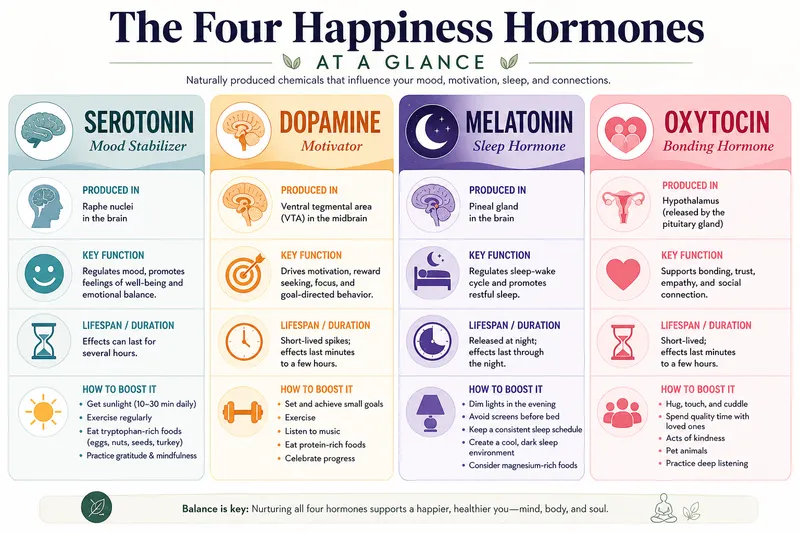
1. Serotonin: The Mood Stabilizer
What it is: Serotonin is a neurotransmitter often called the “happiness hormone.” While it’s synthesized in your brain, approximately 90% of your body’s serotonin is actually produced in your gut, specifically in the colon, by specialized enterochromaffin cells (Jenkins et al., 2015).
Why it matters for happiness and health:
- Stabilizes mood and emotional regulation.
- Promotes feelings of contentment and well-being.
- Regulates sleep patterns and circadian rhythm.
- Controls digestion and gut motility.
- Influences impulse control and social behavior.
The Gut-Brain Connection: How Your Microbiome Controls Serotonin
Here’s what most people miss: your gut bacteria directly manufacture serotonin precursors. The key mechanism is short-chain fatty acids (SCFAs)-specifically butyrate and acetate-which are produced when your gut microbiota ferments fiber.
Recent research from the NIH demonstrates that these SCFAs stimulate the expression of tryptophan hydroxylase 1, the rate-limiting enzyme in serotonin synthesis. This means feeding your gut bacteria properly directly increases your brain’s serotonin availability.
Tryptophan: The Serotonin Precursor You Need to Eat
Serotonin cannot be absorbed directly from food-your body must manufacture it from L-tryptophan, an essential amino acid you must obtain through diet.
Foods high in tryptophan (and healthy carbs to enhance absorption):
- Salmon and fatty fish (omega-3s also reduce inflammation).
- Chicken and turkey.
- Eggs (complete amino acid profile).
- Cheese and dairy products.
- Nuts (almonds, walnuts, sunflower seeds).
- Mushrooms (button, oyster, shiitake).
- Legumes (lentils, chickpeas, beans).
- Whole grains (oats, barley).
- Spirulina and seaweed.
Pro tip: Pair tryptophan-rich foods with carbohydrates. Carbs trigger insulin release, which helps tryptophan cross the blood-brain barrier more efficiently (Young, 2007).
Optimize Your Gut Microbiome for Serotonin Production
To maximize serotonin production, you need:
- Prebiotic fiber (feeds good bacteria): asparagus, garlic, onions, chicory, bananas, oats.
- Probiotic foods (live bacteria): sauerkraut, kimchi, kefir, yogurt, tempeh, miso.
- Polyphenol-rich foods (fuel bacteria): berries, dark chocolate, green tea, red wine.
- Resistant starch (produces butyrate): cold potatoes, cooked-then-cooled rice, green bananas.
2. Dopamine: The Motivation and Reward Molecule
What it is: Dopamine is a neurotransmitter that governs your motivation, drive, focus, and ability to experience pleasure and reward. Importantly, approximately 50% of your body’s dopamine is produced in the gut (Healthline, 2024), though the brain’s dopamine system is what drives behavior.
Why it matters for happiness and health:
- Creates the “drive” to pursue goals (not just pleasure itself).
- Enables learning through reward association.
- Regulates attention and focus.
- Controls movement and motor coordination.
- Influences impulse control and decision-making.
- Powers addiction pathways (both healthy habits and unhealthy ones).
The Dopamine Paradox: It’s About Drive, Not Just Pleasure
A critical misunderstanding: dopamine isn’t simply the “pleasure chemical.” Neuroscientist Andrew Huberman and colleagues at Stanford have shown that dopamine actually fires before reward occurs; it’s what motivates you to pursue a goal. After you achieve it, dopamine drops back to baseline, which is why achievement feels less rewarding than the pursuit.
This explains why constantly chasing instant gratification (scrolling, sugar, shopping) depletes dopamine sensitivity and leaves you unmotivated.
Boost Dopamine Through Tyrosine-Rich Foods
Unlike serotonin, dopamine cannot be absorbed from food directly. However, your body synthesizes dopamine from L-tyrosine, an amino acid that is available through diet.
Foods high in tyrosine:
- Beef, pork, and lamb (highest concentrations).
- Chicken and poultry.
- Fish and cod.
- Eggs and dairy (cheese especially).
- Nuts (almonds, walnuts, peanuts).
- Seeds (pumpkin seeds, sesame).
- Legumes (soybeans, beans, lentils).
- Whole grains.
⚠️ Important note: Tyrosine supplementation works best when combined with adequate B vitamins (B6, B12, folate) and vitamin C, which are required cofactors in dopamine synthesis.
Why Goal-Setting Creates Dopamine Release
Research confirms that the brain releases dopamine in response to goal-setting and goal achievement, but here’s the key: start small. Small, achievable wins create consistent dopamine pulses that build motivation and momentum.
This is why the advice “break big goals into small milestones” is neuroscience, not just productivity advice.
Muse Headband: A Game-Changer for Meditation
3. Melatonin: The Sleep and Circadian Hormone
What it is: Melatonin is a hormone synthesized by the pineal gland in response to darkness. It’s the primary regulator of your sleep-wake cycle and circadian rhythm.
Why it matters for happiness and health:
- Induces sleep and maintains sleep quality.
- Regulates core body temperature for optimal sleep.
- Synchronizes circadian rhythms (mood, digestion, immune function, metabolism).
- Acts as a powerful antioxidant and anti-inflammatory.
- Influences reproductive health and aging processes.
- Linked to overall happiness and life satisfaction (Malmir et al., 2014).
How Light Exposure Controls Melatonin
Your pineal gland produces melatonin in the dark and suppresses it in the light. This simple mechanism controls your entire 24-hour biology.
The optimal melatonin rhythm:
- Morning (6-10 AM): Exposure to bright light suppresses melatonin and raises cortisol (necessary for wakefulness).
- Afternoon: Melatonin remains low; this is peak alertness.
- Evening (after sunset): Melatonin gradually rises in preparation for sleep.
- Night: Melatonin peaks, inducing sleep.
The problem: Modern life, artificial lighting, screens, and late-night work disrupt this natural rhythm, leading to poor sleep, mood disorders, and reduced happiness.
Foods That Support Melatonin Production
While melatonin is found in some foods, the amounts are modest. However, these foods support your body’s natural melatonin synthesis:
- Eggs (contain melatonin directly + tryptophan precursor).
- Fatty fish (salmon, mackerel, sardines).
- Milk and dairy (casein protein aids tryptophan absorption).
- Nuts (almonds, walnuts) – contain both melatonin and tryptophan.
- Mushrooms (especially Shiitake).
- Tart cherry juice (contains naturally bioavailable melatonin).
- Kiwis.
Optimize Melatonin Without Supplements
- Morning light exposure (10-30 minutes): Direct sunlight in the morning synchronizes your circadian rhythm and “anchors” melatonin to nighttime.
- Dim evening light after sunset: Reduces blue light exposure; use blue-light glasses or warm lighting.
- Sleep in complete darkness: Even small amounts of light suppress melatonin.
- Consistent sleep schedule: Going to bed and waking at the same times strengthens melatonin rhythms.
4. Oxytocin: The Bonding and Stress-Relief Hormone
What it is: Oxytocin is a hormone synthesized in the hypothalamus that’s released in response to physical touch, social connection, and positive social experiences. Often called the “love hormone” or “trust hormone.”
Why it matters for happiness and health:
- Enhances bonding, trust, and social connection.
- Reduces anxiety and activates the parasympathetic nervous system (rest-and-digest).
- Lowers cortisol (stress hormone).
- Reduces pain perception.
- Supports immune function and healing.
- Increases generosity and pro-social behavior.
- Plays a critical role in stress resilience.
How to Naturally Boost Oxytocin
Unlike the other three hormones, oxytocin cannot be increased through food. It’s released through social and physical experiences:
Most effective oxytocin triggers:
- Physical touch: Hugs, cuddling, massage, gentle hand-holding (especially skin-to-skin contact).
- Social connection: Meaningful conversations, time with loved ones, community engagement.
- Acts of kindness and generosity: Giving to others triggers oxytocin release.
- Pet interaction: Playing with or petting animals increases oxytocin in both you and the animal.
- Sexual intimacy: Both physical contact and emotional bonding.
- Eye contact: Prolonged, warm eye contact with trusted people.
- Shared meals: Eating together, especially without distractions.
A practical insight: Research shows that warm, safe physical touch signals safety to the brain, which lowers cortisol and increases oxytocin. This is why “hugging it out” is actual neuroscience.
The Seven Evidence-Based Strategies to Boost Hormones and Unlock Happiness
Now that you understand what each hormone does, here’s the actionable framework to increase them systematically.
Strategy 1: Optimize Nutrition with Hormone-Supporting Foods
What research shows: Nutrition is the foundation. Your diet literally becomes your neurotransmitters.
The protocol:
- Daily tryptophan + carbs: Eggs for breakfast, salmon for dinner, whole grains with every meal.
- Daily tyrosine sources: Include protein at breakfast and lunch (chicken, fish, beef, eggs).
- Daily prebiotic + probiotic: Sauerkraut or kimchi at lunch; berries or oats at breakfast.
- Daily omega-3s: 2-3 servings of fatty fish per week, or 1 tbsp ground flaxseed daily.
- Limit dopamine-depleting foods: Ultra-processed foods, excess sugar, and refined carbs spike dopamine temporarily, then crash.
Recommended resource: Atomic Habits by James Clear contains a section on how to anchor nutrient-dense habits to existing routines-essential for consistency.
Strategy 2: Practice Daily Meditation
What research shows: Meditation triggers measurable increases in striatal dopamine release, and this effect is cumulative with regular practice.
Beyond dopamine, mindfulness-based stress reduction (MBSR) has been shown to improve emotional regulation, reduce anxiety, and enhance brain structure.
The protocol:
- Duration: 10-20 minutes daily (consistency matters more than duration).
- Timing: Morning meditation primes dopamine for the day; evening supports oxytocin and melatonin.
- Type: Breath-focused (most effective for dopamine), body-scan (for oxytocin awareness), or loving-kindness (for oxytocin directly).
Enhanced meditation with neurofeedback:
If you want to deepen this practice, the Muse S Brain-Sensing Headband provides real-time feedback on your brain state. It uses EEG sensors to detect when your mind wanders and guides you back to focus through gentle audio cues. This is meditation optimized by neuroscience-you can see exactly when you enter “calm” brain states and learn to deepen them.
Muse transforms meditation from guesswork into a measurable skill you can improve week by week.
Strategy 3: Move Your Body Daily (Especially Cardiovascular Exercise)
What research shows: Acute exercise causes immediate increases in dopamine, serotonin, and norepinephrine. Importantly, aerobic exercise (not just strength training) increases dopamine across both genders.
Long-term, regular cardiovascular exercise supports sustained increases in brain serotonin, and also increases plasma tryptophan availability, the precursor your brain needs to manufacture serotonin.
The protocol:
- Minimum effective dose: 30 minutes of moderate-intensity aerobic exercise, 5 days per week.
- Best timing: Morning exercise primes dopamine for the entire day; evening exercise supports sleep.
- Optimal modalities: Running, cycling, swimming, brisk walking, rowing (activities that elevate heart rate sustainably).
- Bonus effect: Exercise in nature amplifies results (serotonin + dopamine combined).
Strategy 4: Get Strategic Sunlight Exposure
What research shows: Light exposure is one of the most underrated hormone levers.
Early morning sunlight exposure directly increases serotonin synthesis, regulates your circadian rhythm, and primes your body to produce melatonin appropriately at night. Additionally, 10-30 minutes of daily sunlight provides vitamin D, boosts mood, and supports better sleep.
The protocol:
- Morning (within 30 min of waking): 10-30 minutes of direct sunlight (no sunglasses, but don’t stare at the sun).
- Midday (if possible): Additional 10-15 minutes of outdoor time.
- Evening: Dim lighting and warm colors after sunset; use blue-light glasses if using screens.
- Rainy days: Even cloudy sunlight provides benefits; sit by a bright window.
The mechanism: Light exposure synchronizes your circadian clock, which controls serotonin production during the day and melatonin production at night. This is why light therapy is the first-line treatment for seasonal affective disorder (SAD).
Strategy 5: Practice Gratitude (Neurochemically)
What research shows: Gratitude interventions activate brain regions associated with reward, moral cognition, and theory of mind. Importantly, gratitude practice reduces anxiety and depression, with direct evidence of dopamine and serotonin upregulation.
The protocol:
- Daily practice: 5 minutes each morning, write or speak 3 specific things you’re grateful for (be specific: “I’m grateful for the warm coffee and 20 minutes of quiet time,” not just “I’m grateful for coffee”).
- Mechanism: Specificity matters. Vague gratitude doesn’t activate the reward system as effectively as concrete, sensory gratitude.
- Amplify: Share gratitude with someone else (amplifies oxytocin + dopamine).
Strategy 6: Set and Achieve Small Goals
What research shows: Goal-setting and goal achievement both trigger dopamine release, but the structure matters.
The critical insight: Small wins create consistent dopamine pulses. Big, distant goals create anxiety (cortisol spike). The solution: break major goals into micro-milestones.
The protocol:
- Weekly micro-goals: Set 1-2 small, specific, achievable goals per week (30 minutes of exercise, meditate 4 days, prepare 2 new recipes).
- Daily tracking: Visible progress (checkmarks, apps) provides dopamine feedback.
- Celebration: A small acknowledgment of completion sustains motivation.
This is why habit-tracking apps and visible progress markers are so powerful-they literally hack your dopamine system to build momentum.
Strategy 7: Prioritize Social Connection and Physical Touch
What research shows: Social touch is a physiological stress buffer, and oxytocin release from bonding and touch reduces cortisol and activates the parasympathetic nervous system.
Additionally, eating meals with others triggers multiple hormone cascades-serotonin, dopamine, and oxytocin all increase simultaneously.
The protocol:
- Weekly social time: At least 3 interactions per week that involve genuine conversation (not just texting).
- Physical contact: Aim for daily non-sexual touch (hugs, hand-holding, massage).
- Shared meals: Eat at least one meal per week with people you care about.
- Community: One activity per week that connects you to a group or cause.
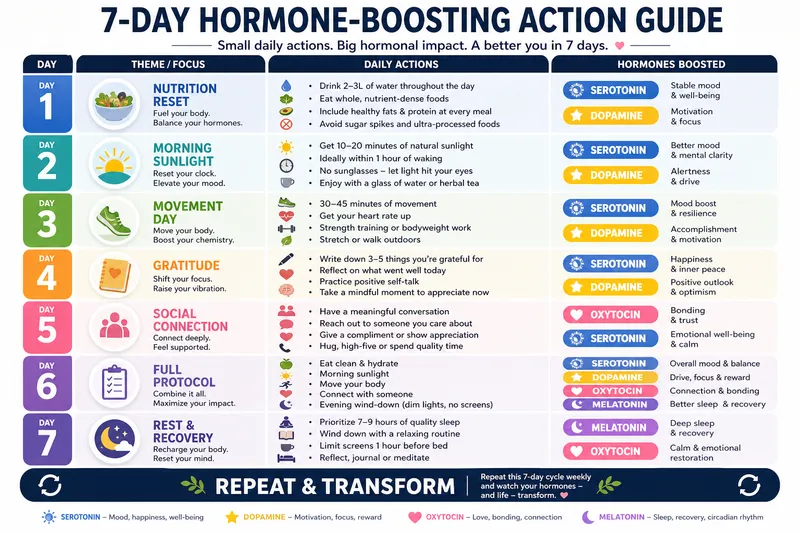
Recommended Products & Resources for Your Hormonal Optimization
Based on your commitment to evidence-based wellness, here are the tools that align with your strategy:
Meditation & Neurofeedback
The Muse S takes meditation from guesswork to neuroscience. Using EEG sensors, it provides real-time feedback when your mind wanders, helping you stay in calm brain states. Track progress over weeks and visualize your improving meditation skills. This is meditation optimized by technology.
Muse Headband: A Game-Changer for Meditation
Behavioral Science & Habit Building
Clear’s system for “stacking” habits-anchoring new behaviors to existing routines-is neuroscience translated into actionable steps. Perfect for building sustainable hormone-boosting practices without relying on willpower alone.
Dopamine Nation by Dr. Anna Lembke
A deep dive into dopamine dysregulation in modern life and how to reset your sensitivity. Essential reading if you feel motivation is lagging or you’re caught in reward-seeking loops.

Dopamine Nation by Dr. Anna Lembke
Discover ‘Dopamine Nation: Finding Balance in the Age of Indulgence’ by Dr. Anna Lembke, a profound exploration of pleasure, pain, and the science of addiction. Learn how to navigate the modern culture of overindulgence, reset dopamine levels, and embrace discomfort as a pathway to authentic joy.
Skill Development in Mindfulness & Wellness
If you’re serious about mastering these hormonal levers, consider structured learning:
Centre of Excellence – Mindfulness Certification
Advanced, science-backed coursework on meditation, mindfulness, and stress reduction. Provides both understanding and practical certification.
New Skills Academy – Nutrition & Wellness Courses
Comprehensive courses on nutrition science, hormone health, and lifestyle optimization. Ideal if you want to deepen your knowledge beyond this article.
❓ Frequently Asked Questions: Hormones and Happiness
How long does it take to see results from these interventions?
Results appear on different timelines:
Immediate (same day): Exercise, meditation, sunlight exposure (mood lift within 1-2 hours).
1-2 weeks: Improved sleep quality, more stable mood, increased motivation.
3-4 weeks: Noticeable changes in baseline happiness, energy levels, and social engagement.
8-12 weeks: Sustained improvements in neuroplasticity, gut health, and hormonal baseline.
The key: consistency matters more than intensity. A 10-minute daily meditation beats sporadic 1-hour sessions.
Can I boost these hormones if I have depression or anxiety?
These interventions are supportive, not replacements for professional treatment. If you have clinical depression or anxiety:
1. Consult a mental health professional first (therapist, psychiatrist).
2. Use these as complementary tools: They work synergistically with medication and therapy.
3. Start small: Begin with one intervention (e.g., morning walks) to avoid overwhelm.
Research shows that exercise, meditation, and social connection are evidence-based treatments for depression, but they work best alongside professional support.
What’s the best time of day for each hormone?
Optimal timing:
Serotonin: Boost in morning/midday (sunlight, exercise, tryptophan at breakfast).
Dopamine: Boost in morning/afternoon (goal-setting, movement, novelty; avoid overstimulation late evening).
Melatonin: Naturally rises in the evening/night (dim lights, cool temperature, consistent sleep schedule).
Oxytocin: Anytime (social connection has no bad time, but evening intimacy supports sleep via oxytocin + melatonin).
Do I need supplements to boost these hormones?
No, but some can help:
Essential: Food-based tryptophan and tyrosine (from real meals).
Optional but evidence-backed:
Omega-3 fish oil (supports serotonin, reduces inflammation).
Magnesium glycinate (supports sleep and GABA; calms the nervous system).
Vitamin D (if deficient; supports mood and immune function).
Probiotics (support gut serotonin production).
Not necessary: Melatonin supplements (your body produces plenty if circadian rhythm is synchronized); serotonin supplements (don’t cross the blood-brain barrier).
How do I know if my hormones are actually improving?
Track these measurable markers:
Mood: Daily mood rating (1-10 scale).
Sleep: Hours slept, sleep quality, ease of falling asleep.
Energy: Energy levels at 2 PM and 9 PM.
Motivation: Ability to focus, complete tasks, and pursue goals.
Social engagement: Frequency and quality of social interactions.
Physical: Digestion quality, pain/inflammation levels.
Use a simple spreadsheet or habit-tracking app (Streaks, Productive, Done) to visualize progress over weeks.
Can I do too much? Is there a limit to how much I can boost hormones?
Generally, no, but there are nuances:
Serotonin: Your body naturally regulates levels; excessive supplementation can cause serotonin syndrome (rare, but serious).
Dopamine: Overstimulation from constant goal-chasing or pleasure-seeking can dysregulate your system (this is the “dopamine tolerance” problem).
Melatonin: Chronic high levels from supplements can disrupt your natural rhythm; food-based sources are safer.
Oxytocin: There’s no known “too much”; connection is universally beneficial.
The principle: Work with your body’s natural rhythms, not against them. Sustainable hormone optimization looks like balanced daily practices, not extremes.
What’s the “easiest” hormone to boost first?
Serotonin via sunlight and movement.
Why? Because:
1. Takes only 15-20 minutes daily.
2. Has immediate mood benefits.
3. Requires no special equipment.
4. No dietary changes needed (though they help).
5. Builds momentum for other interventions.
Start here: 15 minutes of outdoor walking every morning, plus one meal per day with tryptophan-rich protein. Everything else builds from this foundation.
🗺️ Your Happiness Optimization Roadmap: Start This Week
You now have the complete neuroscience of happiness. Here’s how to actually implement it:
Week 1: Foundation (Pick ONE)
Choose the easiest intervention for you:
- Morning sunlight + walking.
- Daily meditation (10 min).
- Nutrition optimization (add tryptophan to each meal).
Week 2: Build (Add ONE)
Add a second intervention:
- Exercise 3 days per week.
- Gratitude practice (5 min daily).
- Social connection (one meaningful interaction).
Week 3: Integrate (Add ONE)
Add a third:
- Goal-setting system.
- Muse meditation (if interested).
- Gut optimization (add fermented foods).
Week 4+: Full Protocol
Once any three are habitual, layer in the rest. By Week 6, you’ll be running the full system.
The metric that matters: How do you feel? More grounded, motivated, connected, rested? That’s hormonal optimization working.
🎯 The Final Truth About Happiness and Hormones
Your hormones aren’t destiny-they’re leverage points.
You can’t think your way into happiness. You can’t willpower your way into sustained motivation. But you can eat foods that provide serotonin precursors. You can walk in the sun and synchronize your circadian rhythm. You can meditate and measure your calm. You can reach out, connect, and trigger oxytocin.
Hormones are the biological foundation of happiness.
And now you know exactly how to optimize them.
📒 Related reads you might enjoy:
- Is It Bad to Sleep with a Phone? Here’s What the Science Says
- Transform Your Sleep Routine for Optimal Recovery and Restorative Sleep
- Dopamine Explained: The Brain’s Reward & Happiness Hormone
- Revitalize Your Life: Overcome Tiredness with Exercise!
- Holistic Daily Routine for Mind, Body & Soul: 7-Step Wellness Guide (2026)
- The Power of Music: How It Transforms Your Mind, Body & Soul
- Simplicity, The Final Stage Of Sophistication! A Science-Backed Guide
📚 References & Sources
All citations in this article are from peer-reviewed, institutional, or high-authority sources:
- Jenkins, T. A., Nguyen, J. C., Polglaze, K. E., & Bertrand, P. P. (2015). Influence of Tryptophan and Serotonin on Mood and Cognition with a Possible Role of the Gut-Brain Axis. Nutrients, 7(3), 1801-1823.
- Lv, X., Liu, Z., Zhang, H., & Tzeng, C. M. (2013). Gut microbiota-derived short-chain fatty acids and depression. Current Drug Targets, 14(8), 872-879.
- Young, S. N. (2007). How to increase serotonin in the human brain without drugs. Journal of Psychiatry & Neuroscience, 32(6), 394-399.
- Kjaer, T. W., Bertelsen, C., Piccini, P., Brooks, D., Alving, J., & Lou, H. C. (2002). Increased dopamine tone during meditation-induced change of consciousness. Nature Neuroscience, 5(4), 370-371.
- Basso, J. C., & Suzuki, W. A. (2017). The Effects of Acute Exercise on Mood, Cognition, Neurotrophic Factors, and Brain-Derived Neurotrophic Factor. Journal of Molecular Psychiatry, 3(1), 1-8.
- Heijnen, S., Hommel, B., Kibele, A., & Sack, A. T. (2016). Neuromodulation of Aerobic Exercise: A Review. Frontiers in Psychology, 6, 1890.
- Oppezzo, M., & Schwartz, D. L. (2014). Give your ideas some legs: The positive effect of walking on creative thinking. Journal of Experimental Psychology: Learning, Memory, and Cognition,
Other References:
- Jamshed R. (2005). One hundred years of hormones. EMBO Rep. Jun; 6(6): 490–496.
- Algoe SB et al., Oxytocin and Social Bonds: The Role of Oxytocin in Perceptions of Romantic Partners’ Bonding Behavior, 2017.
- Jenkins, T. A. et al. Influence of Tryptophan and Serotonin on Mood and Cognition with a Possible Role of the Gut-Brain Axis, 2015.
- Ruining X et al., Oral treatment with Lactobacillus reuteri attenuates depressive-like behaviors and serotonin metabolism alterations induced by chronic social defeat stress, 2020.
- Young, S. N. (2007).How to increase serotonin in the human brain without drugs. Journal of psychiatry & neuroscience: JPN, 32(6), 394.
- Nan Lv, X., Jun Liu, Z., Jing Zhang, H., & Tzeng, C. M. (2013).Aromatherapy and the central nervous system (CNS): therapeutic mechanism and its associated genes. Current Drug Targets, 14(8), 872-879.
- Malmir, M., Khanahmadi, M., & Farhud, D. D. (2014).Happiness and its predictors (in press).[Google Scholar].
- Macchi, M. M., & Bruce, J. N. (2004). Human pineal physiology and significance of melatonin. Frontiers in neuroendocrinology, 25(3-4), 177-195.
- Korf, W., Schomerus, C., & Stehle, J. H. (1998).The pineal organ, its hormone melatonin, and the photoneuroendocrine system.
- Cardinali, D. P. (1981). Melatonin. A mammalian pineal hormone. Endocrine Reviews, 2(3), 327-346.
- Reiter, R. J. (1991).Pineal melatonin: cell biology of its synthesis and of its physiological interactions. Endocrine Reviews, 12(2), 151-180.
- Dragojevic Dikic, S., Jovanovic, A. M., Dikic, S., Jovanovic, T., Jurisic, A., & Dobrosavljevic, A. (2015). Melatonin: a “Higgs boson” in human reproduction. Gynecological Endocrinology, 31(2), 92-101.
- Tamura, H., Nakamura, Y., Korkmaz, A., Manchester, L. C., Tan, D. X., Sugino, N., & Reiter, R. J. (2009).Melatonin and the ovary: physiological and pathophysiological implications. Fertility and Sterility, 92(1), 328-343.
Learn, Help Family And Friends, And Help The Planet!