🌍 The world may not be getting worse – but your feed may be getting louder
There are mornings when the first few minutes online make the entire planet feel dangerous. You see a disaster, an argument, a frightening health story, a political conflict, and someone else’s personal crisis before you have even had breakfast.
The mind naturally searches for an explanation. It may conclude that society is collapsing, that people are becoming crueler, or that danger is everywhere. But there is an important difference between the world and the portion of the world selected for your attention.
📲 Social Media Impact
Social media is not a neutral window. It is a personalised stream designed to keep you looking. Content that creates surprise, anger, fear or moral outrage often receives more attention than quiet progress. Your feed may therefore become an emotional weather system: always changing, always urgent, and rarely representative of ordinary life.
This does not mean that suffering is unreal or that difficult events should be ignored. It means that a healthy mind needs context. The world can contain war, injustice, and environmental danger while also containing medical progress, acts of generosity, educational opportunity, scientific discovery, and millions of ordinary people caring for one another.
✦ Key idea: Your feed is not a census of reality. It is a selection system built around attention.
For a broader framework connecting mental, physical, social, and spiritual wellbeing, read What Is Holistic Living? Definition, 6 Pillars + Science-Backed Benefits.

Step into the world of personal growth with the Centre of Excellence!
🧠 Why negative content captures the mind
Humans are wired to notice potential threats. This helped our ancestors respond quickly to danger. Online, however, the same protective instinct can be activated by events that are distant, rare, or outside our control.
The availability effect makes memorable examples feel more common than they are. The negativity bias gives unpleasant information more psychological weight. The repetition effect makes familiar claims feel true simply because we have encountered them many times.
Social platforms add another layer: recommendation systems learn what holds your attention. If you pause over frightening content, the system may show you more of it. Soon, your feed can create the impression that the whole world consists of crisis, conflict and outrage.
A useful question is: Is this story important, or is it simply emotionally powerful?
That question does not dismiss the story. It restores choice.
📊 Progress and problems can exist together
A balanced worldview does not require pretending everything is fine. It requires holding two truths at once: serious problems exist, and meaningful progress also exists.
The World Bank, World Health Organization, and UNESCO provide long-term data on poverty, health, education, and literacy. These sources cannot make suffering disappear, but they can challenge the assumption that every trend is moving in one direction.
For a readable exploration of why human beings often misread global progress, see *Factfulness* by Hans Rosling. Use data not to become indifferent, but to become more accurate.
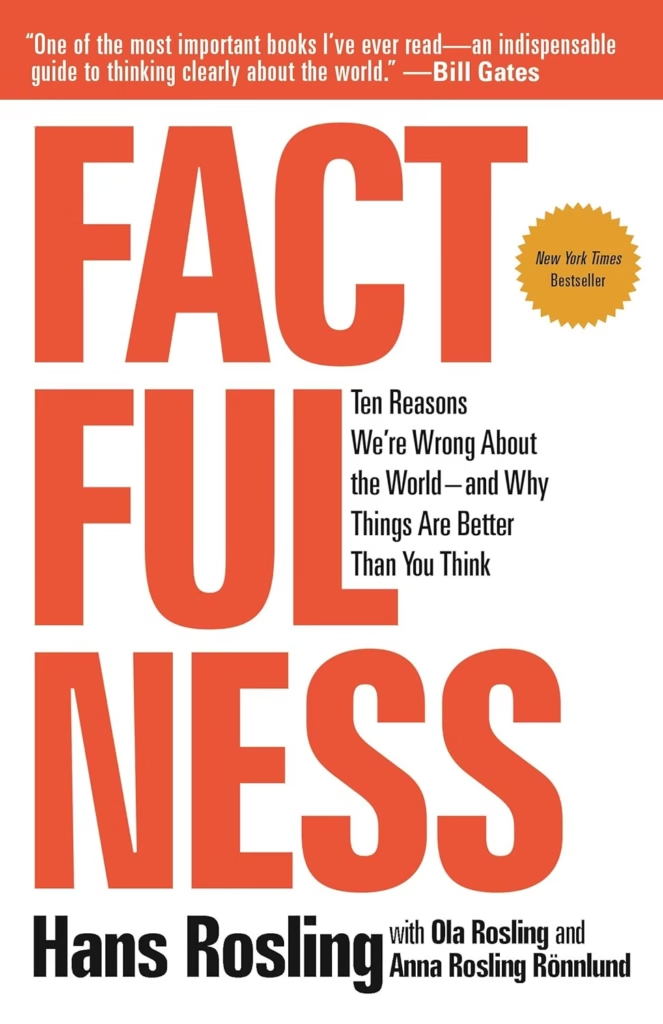
Factfulness by Hans Rosling
Explore ‘Factfulness’ by Hans Rosling, an enlightening book that challenges misconceptions about the world and highlights global progress.
🤝 Social media can support wellbeing too
The social media impact is not automatically harmful. A platform can help you find a supportive community, maintain a long-distance friendship, learn a skill, discover a therapist or organise help after a crisis.
The key difference is often between active use and passive consumption. Active use has an intention: you message someone, learn something, share useful work or participate in a community. Passive consumption has no clear stopping point and often leaves you comparing, worrying, or feeling mentally scattered.
Ask yourself after using an app:
- Do I feel more connected or more isolated?
- Did I learn, create or communicate – or only consume?
- Is my body relaxed, tense or restless?
- Will this use support the person I want to become?
A review of social media and young people’s mental health reflects this complexity: online experiences may offer connection and support while also increasing comparison, distress and problematic use.
Step into the world of personal growth with the Centre of Excellence!
🛠️ Nine ways to build a calmer information diet
1. Create a news window
Choose one or two times to read reliable news. Avoid letting headlines enter every empty moment.
2. Curate your sources
Follow fewer accounts and favour sources that distinguish reporting from opinion, provide evidence and correct errors.
3. Add a progress feed 🌱
Include educators, researchers, environmental projects, community organisations and people explaining constructive solutions.
4. Practise “inform, act, release”
Learn what happened. Decide whether there is one useful action. Then allow yourself to return to your life.
5. Protect morning and evening attention
The first and final hour of the day shape your nervous system. Replace automatic scrolling with tea, movement, journaling, reading, or meditation.
If sleep is suffering, read Master Sleep Hygiene: 4 Proven Tips for Better Rest & Health.
6. Run a seven-day feed audit
Write down your mood before opening an app and ten minutes afterwards. Patterns become easier to see when recorded.
7. Add friction
Disable non-essential notifications, remove apps from your home screen and decide in advance when you will stop.
8. Pause before sharing outrage
Ask whether the claim is verified, whether sharing helps and whether one direct action would be more meaningful.
9. Share realistic hope
Hope is not denial. Share stories that acknowledge difficulty while showing people solving, repairing or caring.
Step into the world of personal growth with the Centre of Excellence!
🪞 Comparison, identity and the edited life
Social media shows outcomes without the ordinary hours behind them. You see the promotion but not the uncertainty, the finished home but not the debt, the confident opinion but not the private doubt.
Comparison becomes especially painful when you compare your complete life with another person’s selected moments. Try comparing process with process instead: What did they practise? What can I learn? What would a small version of that action look like for me?
If an account consistently leaves you feeling inadequate, muting it is not weakness. It is attention management. You may also enjoy The Power of Gratitude, which offers a way to notice what is present without denying what needs to change.
💌 A simple seven-day reset
For one week, choose a fixed news window, remove unnecessary notifications, follow three useful sources, and spend ten minutes each evening writing: “What did I see today, and what deserves my attention tomorrow?”
Use The Holistic Living Routine – practical reflections for clearer thinking, calmer attention and more intentional days.
Receive Our Expert-Crafted Holistic Routine to Nourish Your Daily Life.
🌟 Conclusion
The world is not as bad as your most alarming feed suggests, but neither is it perfect. A mature relationship with social media does not require optimism at all costs. It requires discernment.
Stay informed without becoming permanently alarmed. Care about injustice without allowing outrage to consume every hour. Choose sources that widen your understanding rather than narrowing it to fear.
You do not have to carry the entire world in your nervous system to be a person who cares.
❓ FAQs
Does social media make the world seem worse?
It can. Platforms often amplify emotionally intense content, while negative events are easier to remember than gradual progress.
Is social media always harmful?
No. Active connection, learning and supportive communities can be beneficial. Passive, compulsive use may harm mood, sleep and attention.
How can I stop doomscrolling?
Create a news window, disable notifications, use reliable sources and replace scrolling with a specific restorative activity.
What is a healthy amount of social media?
There is no universal number. Judge use by its effect on sleep, mood, relationships, focus and behaviour.
Affiliate disclosure:
Some links are affiliate links. If you purchase through them, The Dream Oak may receive a commission at no extra cost to you.
Learn, Help Family And Friends, And Help The Planet!