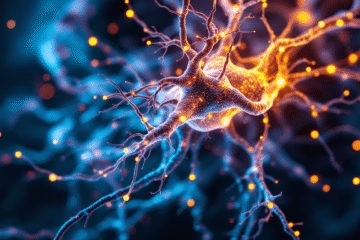
Your beliefs shape your reality. Not metaphorically – neurologically. Every limiting belief (I’m not smart enough, I can’t succeed, I’m too old) is a neural pathway you’ve reinforced thousands of times. Neuro-Linguistic Programming (NLP) is a framework for rewiring these pathways in weeks instead of years.
In this guide, you’ll learn: the science of how beliefs become hardwired; the 3 core NLP techniques that rewire beliefs at speed; why willpower fails (and what works instead); and a 7-day protocol to start reprogramming your mind today.
As you work through these principles, you’ll discover how NLP connects to the broader framework of what constitutes holistic living, because true transformation touches your mind, body, and soul simultaneously.
🌀Neuro-Linguistic Programming
Download our Free Expert-Crafted Holistic Routine – which integrates NLP belief work with mindfulness practice, sleep optimization, and purposeful living. Join 300+ subscribers building their ideal life.
What Neuro-Linguistic Programming Really Is
NLP was developed in the 1970s by Richard Bandler and John Grinder, who studied how world-class therapists (like Milton Erickson) achieved extraordinary results. They asked: What’s the underlying structure of their excellence? How do they help people overcome phobias, trauma, and limiting beliefs so quickly?
What they discovered was that excellence – whether in therapy, sales, sports, or relationships – follows a pattern:
- Neurology (your nervous system processes experience).
- Linguistics (your language shapes what you perceive and believe).
- Programming (your beliefs and habits can be reprogrammed).
The key insight: Your beliefs aren’t facts; they’re learned patterns. And if they were learned, they can be unlearned.
Example: A person who believes “I’m bad with money” has reinforced this belief through:
- Repeated experiences (spending without planning).
- Internal dialogue (telling themselves “I’m bad with money”).
- Neurological anchors (feeling anxious whenever they see their bank balance).
This is the “structure” of the belief. NLP offers tools to change each component.
Why it works:
The neuroscience is clear. Beliefs activate specific neural pathways. Repeated activation strengthens those pathways (neuroplasticity). Change the pattern, and you change the pathway. This isn’t willpower; it’s neurobiology.
This aligns perfectly with the science of intentional living through simplicity – both practices involve consciously rewiring your neural pathways to support your goals.
Common misconception: NLP isn’t mind control or manipulation. It’s a toolkit for understanding how your own mind works and taking conscious control of your beliefs.

Unparalleled online learning experiences, New Skills Academy!
The Neuroscience: How Beliefs Become Hardwired
Your brain processes 11 million bits of information per second. But your conscious mind can handle only ~40 bits/second. What determines which 40 bits you notice?
Your beliefs.
Your beliefs act as a filter. If you believe “I’m not creative,” your brain filters OUT evidence of your creativity and filters IN evidence that confirms the belief. (You solve a problem creatively, but dismiss it as “just luck.”) This is the Reticular Activating System (RAS) at work.
The mechanism:
- Belief formation: A repeated experience creates a neural pathway.
- Belief reinforcement: Each similar experience strengthens the pathway (Hebbian plasticity: neurons that fire together wire together).
- Belief automation: After ~66 days of repetition, the belief becomes automatic – you don’t consciously think it; you feel it as truth.
- Life alignment: Your behavior aligns with your belief. (If you believe “I’m not deserving,” you unconsciously sabotage success.)
The research:
fMRI studies show that when you hold a limiting belief, specific brain regions activate – the amygdala (fear center), the anterior insula (self-doubt), the ventromedial prefrontal cortex (self-referential thinking). Changing the belief deactivates these regions and activates the prefrontal cortex (clarity, intentionality).
The breakthrough: Beliefs can be changed. Not through willpower alone (which depletes), but through pattern interruption and neurological anchoring.
This is where NLP differs from other self-help approaches. It’s not about thinking positive thoughts (which often fails). It’s about changing the neural structure of the belief itself. This principle extends to understanding how your energy levels are directly tied to your core beliefs – change your beliefs, and your vitality follows.
As Dr. Joseph Murphy explores in The Power of Your Subconscious Mind, your subconscious believes what you repeatedly tell it. NLP accelerates this process by combining neurology, language, and behavioral change into a coherent system.


Marisa Peer’s Programs: Build Confidence and Unlock Your Potential
Unlock your potential with Marisa Peer’s transformative programs. Experience a unique blend of cognitive behavioral therapy, hypnosis, and neuro-linguistic programming (NLP) designed to help you break free from limiting beliefs.
The 3 Core NLP Techniques That Rewire Beliefs
Technique 1 – Anchoring (Creating Neurological Shortcuts)
What it is:
An anchor is a neurological trigger that instantly activates a resourceful state. A smell can trigger a memory. A song can trigger an emotion. NLP uses this principle intentionally to create anchors that serve you.
How it works:
- Recall a peak state: Remember a time you felt confident, calm, or powerful. Fully re-experience it (see what you saw, hear what you heard, feel what you felt).
- Create the anchor: At the peak of that emotional state, make a unique gesture (press thumb + forefinger together, tap your chest, clench your fist).
- Repeat 5-7 times: Each repetition strengthens the neurological link.
- Test & use: Now, whenever you recreate that gesture, you instantly access that state.
Why it works: Your nervous system learns associations. Pair a gesture with a peak state, and the gesture becomes a trigger for that state. No willpower required – it’s automatic.
Practical example:
A person with social anxiety creates a “confidence anchor.” They remember a time they felt totally comfortable and confident (perhaps speaking with a close friend). They anchor it with a specific pressure point on their palm. Now, before entering a social situation, they activate the anchor and access that confidence neurologically.
Real-world impact: Studies show that environmental anchors (a specific location, a song, a physical object) can reduce anxiety and increase performance by 30-40% within weeks.
Technique 2 – Reframing (Changing the Meaning)
What it is:
A reframe changes the meaning you assign to an experience without changing the experience itself. The same event can be a disaster OR an opportunity, depending on the frame.
How it works:
- Identify the limiting frame: “I failed at my business. I’m a failure.”
- Find the hidden positive: What’s the silver lining? What did you learn? How did you grow? (Even failure teaches resilience.)
- Reframe: “I failed at my business. I learned $50,000 worth of lessons for $10,000, and I’m still standing. I’m resilient.”
- Embody the reframe: Live as if the reframe is true. Notice evidence that confirms it.
Why it works: The same event creates different neural pathways depending on the meaning assigned. Reframe the meaning, reprogram the pathway.
Practical example:
A musician auditions for a prestigious orchestra and doesn’t get selected.
Limiting frame: “I’m not good enough. I’ll never make it professionally.”
Reframe: “I didn’t fit this orchestra’s needs, but the feedback I received shows exactly where to improve. I’m one audition closer to the right fit.”
The second frame activates motivation and learning. The first activates despair.
This reframing process is essential to building stress relief techniques – when you reframe your relationship with stress itself, it loses its power over you.
Technique 3 – Modeling (Learning Excellence From Others)
What it is:
Modeling is reverse-engineering excellence. If someone else has achieved a result you want, you can deconstruct their mindset, strategies, and behaviors – and rebuild them in yourself.
How it works:
- Find a model: Someone who has what you want (confidence, financial success, health, relationships).
- Deconstruct their beliefs: What do they believe about themselves and the world? (Ask directly or infer from their behavior.)
- Deconstruct their strategy: What steps do they take? In what order? What rules do they follow?
- Reconstruct in yourself: Adopt their beliefs and strategies. Practice until automatic.
Why it works: Excellence is a learnable set of patterns. If those patterns are neurological (beliefs) and behavioral (strategies), they can be modeled and transferred.
Practical example:
You admire someone’s ability to stay calm under pressure. You ask them: What do you believe about pressure? (Answer: “Pressure is feedback, not a threat.”) What do you do when pressure arises? (Answer: “I take 3 deep breaths, remind myself of past successes, then focus on one small action.”)
Now you have the belief and the protocol. You practice it. Your nervous system learns the new pattern. Within weeks, you’ve modeled their calm.
This modeling approach is foundational to how meditation deepens your practice – when you model the nervous system state of an experienced meditator, you can achieve that state faster yourself.
Unparalleled online learning experiences, New Skills Academy!
Building NLP as a Daily Practice
NLP works best when integrated into a sustainable lifestyle. The Feng Shui Diploma Course complements NLP beautifully by teaching how to arrange your physical environment to support your reprogrammed beliefs – the external environment reinforces the internal rewiring.
Your daily NLP practice (15 minutes):
Morning (5 minutes):
- Activate your confidence anchor (the gesture or ritual you’ve built).
- Recall your reprogrammed belief: “I am capable. I am deserving. I am growing.”
- Set one intention aligned with this belief.
Midday (5 minutes):
- Check in: Is my behavior aligned with my new belief?
- If not, reframe what’s happening.
- Reinforce your anchor.
Evening (5 minutes):
- Review the day: Where did I show my new belief?
- Celebrate evidence that the new belief is becoming real.
- Prime yourself for tomorrow.
Why this works: Repetition = neuroplasticity. You’re literally rewiring your brain, one day at a time.
Your 7-Day NLP Belief Reprogramming Protocol
Day 1: Identify Your Limiting Belief
Action:
Write down one belief that limits you. (Examples: “I’m not smart enough,” “I can’t change,” “I don’t deserve success,” “I’m too old.”)
Why: You can’t change a belief you don’t name.
Day 2: Find the Origin
Action:
Where did this belief come from? (A parent’s words, a failure you interpreted as proof, a comparison to others?)
Write it down. Understanding the origin weakens its grip.
Why: Most limiting beliefs were formed in childhood or during trauma. As an adult, you can consciously choose different beliefs.
Day 3: Create an Anchor
Action:
Recall a time you felt powerful, capable, or confident. Fully re-experience it (sight, sound, feeling). At the peak, create a unique gesture (palm press, chest tap, fist clench).
Repeat 5 times.
Why: You’re building a neurological shortcut to a resourceful state.
Day 4: Reframe the Belief
Action:
Take your limiting belief and find the hidden positive or growth edge.
Example:
- Limiting: “I’m not smart enough.”
- Reframe: “I’m learning. Every challenge teaches me something. I’m getting smarter with every attempt.”
Write the reframe. Say it 10 times. Feel the difference.
Why: A new frame activates new neural pathways. Repetition strengthens them.
Day 5: Model Someone Excellent
Action:
Identify someone who embodies what you want to believe about yourself. (Could be someone you know, a historical figure, or a character in a book.)
Write down: What do they believe? What do they do? How do they talk to themselves?
Start adopting one behavior or belief from them.
Why: You’re borrowing excellence while you build your own.
Day 6: Practice the New Belief
Action:
Take a small action that’s impossible if you hold the old belief, but possible if you hold the new belief.
Example:
- Old belief: “I’m not creative.”
- New belief: “I’m learning to express my creativity.”
- Action: Create something (draw, write, build) for 10 minutes. Doesn’t need to be “good.”
Why: Behavior reinforces belief. New actions wire new neural pathways.
Day 7: Declare the New Identity
Action:
Write a statement of your new belief as if it’s already true.
Example: “I am capable of learning and growing. I am resilient. I deserve success.”
Say it every morning for one week. Notice what changes.
Why: Identity beliefs are the strongest. When you claim a new identity, your entire nervous system aligns to prove it true.
❓FAQ – Neuro-Linguistic Programming
Q: Is NLP scientifically proven?
A: The core mechanisms (neuroplasticity, anchoring, reframing) are supported by neuroscience research. fMRI studies show that changing beliefs changes brain activation patterns. However, NLP itself is a framework, not a medical treatment. It’s best used alongside professional support if you’re dealing with trauma or serious mental health concerns.
Q: How long does belief change take?
A: Small shifts can happen in hours (anchoring, reframing). Stable identity change typically takes 3-12 weeks of consistent practice. The rule is ~66 days for automaticity, but everyone’s different.
Q: Can NLP be used unethically?
A: Yes. Because NLP is powerful, it can be misused to manipulate. The ethical use is to help people access their own power – not to control them for someone else’s benefit.
Q: Do I need a coach or can I self-teach?
A: You can self-teach using books and frameworks (like the 7-day protocol above). A coach accelerates the process and helps you stay accountable. For deeper work, especially with trauma, a trained professional is valuable. These Neuro-Linguistic Programming Courses provide structured guidance if you want expert support.
Q: How does NLP connect to holistic living?
A: NLP is one pillar of holistic living – it transforms your mind. When combined with physical self-care, mindfulness practice, and purposeful growth, you create transformation across all dimensions of your life.
The Bottom Line
Neuro-Linguistic Programming is a toolkit for understanding how your mind works and taking conscious control of your beliefs. Your beliefs shape your neural pathways. Your neural pathways shape your behavior. Your behavior shapes your results.
Change the belief, and you change everything.
Start with the 7-day protocol. Notice what shifts. Then, if you want to deepen the work, explore these NLP courses or read the classics (Jose Silva, Joseph Murphy). The foundation is small, consistent action paired with the intention to change.

Unlock Your Potential with Neuro-Linguistic Programming Courses
Explore transformative Neuro-Linguistic Programming Courses to enhance your communication, behavior, and mindset skills effectively.
Your next step:
- Identify one limiting belief (today).
- Work through the 7-day protocol (this week).
- Join our community (download the Free Holistic Routine and get weekly tips on mindset, sleep, and living with purpose).
Download our Free Expert-Crafted Holistic Routine
Ready to reprogram your beliefs as part of a holistic transformation? Download our Free Expert-Crafted Holistic Routine – a personalized guide integrating NLP belief work, sleep optimization, morning mindfulness, and purposeful living.
Join 300+ subscribers building their ideal life, one belief at a time.
References:
- Kudliskis, V. (2013). Neuro‐linguistic programming and altered states: encouraging preparation for learning in the classroom for students with special educational needs. British Journal of Special Education, 40(2), 86-95.
- Sturt, J., Ali, S., Robertson, W., Metcalfe, D., Grove, A., Bourne, C., & Bridle, C. (2012). Neurolinguistic programming: a systematic review of the effects on health outcomes. British Journal of General Practice, 62(604), e757-e764.
- Tosey, P., & Mathison, J. (2010). Neuro‐linguistic programming is an innovation in education and teaching. Innovations in education and teaching international, 47(3), 317-326.
- Wiseman, R., Watt, C., ten Brinke, L., Porter, S., Couper, S. L., & Rankin, C. (2012). The eyes don’t have it: Lie detection and neuro-linguistic programming. PloS one, 7(7), e40259.
- Craft, A. (2001). Neuro‐linguistic programming and learning theory. The Curriculum Journal, 12(1), 125-136.
Learn, Help Family And Friends, And Help The Planet!