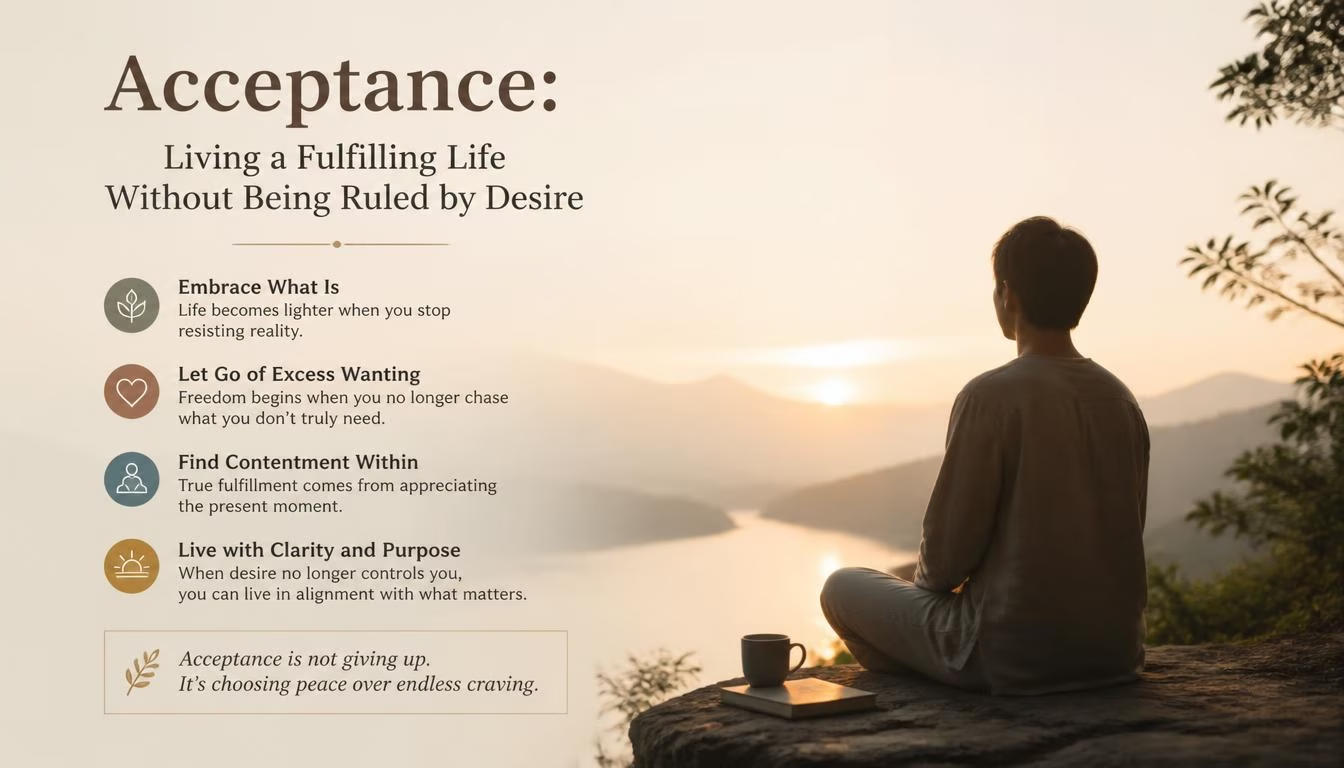
❔ Can acceptance make life more fulfilling?
Many people assume a fulfilling life requires the successful acquisition of more: more money, recognition, experiences, certainty, beauty, influence, or control. Desire can be energizing, but it can also create a moving horizon. The moment one goal is reached, another appears – and the nervous system remains trained to experience the present as insufficient.
Acceptance offers a different possibility: not a life without goals, pleasure, or ambition, but a life in which desire is observed rather than obeyed automatically.
This distinction is essential. Acceptance is not resignation. It does not mean approving of injustice, tolerating abuse, abandoning growth, or pretending that pain is pleasant. In contemporary psychological terms, acceptance is the willingness to make room for present-moment thoughts, emotions, bodily sensations, and circumstances without adding unnecessary resistance to the fact that they are already occurring.
It is closely related to psychological flexibility – the capacity to stay in contact with the present, adjust behavior to changing conditions, and act according to values even when difficult internal experiences are present.
Dopamine gives this subject an important neuroscience dimension. Dopamine is not simply a “happiness chemical.” It helps the brain learn from reward prediction, assign motivational relevance, anticipate outcomes, and mobilize effort. Desire can therefore become a learning loop: cue, anticipation, pursuit, reward, disappointment or satisfaction, and renewed pursuit.
Acceptance interrupts the automaticity of that loop. It gives you enough space to ask:
Is this desire expressing a meaningful value – or is it merely asking me to escape the discomfort of this moment? 🧠
If you are exploring this question through a wider approach to holistic living, acceptance is not passive. It is a practice of seeing reality accurately enough to choose your next action wisely.
🌟 Living a Fulfilling Life Without Being Ruled by Desire

Step into the world of personal growth with the Centre of Excellence!
What acceptance actually means
Acceptance can be understood on three levels:
- Acknowledgment: recognizing what is happening internally and externally.
- Non-escalation: reducing the secondary struggle created by “this should not be happening.”
- Values-based response: choosing what to do next instead of allowing the strongest urge to decide for you.
Imagine receiving disappointing news. The primary experience may be sadness, fear, anger, or physical tension. The secondary struggle might be: “I must not feel this,” “I should already be over it,” or “This proves that my life is failing.” Acceptance does not remove the primary emotion immediately. It reduces the additional layer of conflict that consumes attention and often prolongs distress.
This is why acceptance is not the same as liking a situation. You can accept that a relationship has ended while still grieving it. You can accept uncertainty while taking responsible steps to reduce risk. You can accept anger while refusing to act aggressively.
The goal is not emotional flatness. It is response flexibility. 🌿
Acceptance, desire, and the dopamine reward system
Dopamine is involved in several brain pathways and behaviors, including reward learning, effort allocation, motivation, movement, and attention. It does not operate as a single reservoir that determines how happy a person is.
A useful concept is reward prediction error. The brain compares what it expects with what actually happens:
- An outcome better than expected can strengthen learning and pursuit.
- An expected outcome can produce a smaller update.
- A reward that fails to appear can generate disappointment and behavioral adjustment.
This system is adaptive. It helps us learn where food, safety, knowledge, connection, and opportunity may be found. Problems arise when modern environments repeatedly provide intense, immediate, and unpredictable rewards – notifications, social approval, gambling-like interfaces, shopping prompts, or highly stimulating content.
The brain may begin to overvalue the cue and the anticipation, even when the experience itself produces little lasting satisfaction. This is the difference between wanting and liking. We may strongly want to check, buy, consume, or pursue something without genuinely enjoying the result.
Acceptance creates a pause between wanting and acting. During that pause, you can notice:
- The body sensation associated with craving
- The story predicting relief or happiness
- The urgency of the impulse
- The likely short-term reward
- The longer-term cost
- The value you want your behavior to serve
This does not mean every desire should be rejected. Some desires point toward creativity, intimacy, learning, justice, or meaningful contribution. The skill is to distinguish values-based aspiration from compulsive escape.
Step into the world of personal growth with the Centre of Excellence!
Desire is not the enemy of fulfillment
The title “living without desires” can sound like a call to eliminate ambition. That interpretation is too narrow.
Desire has multiple forms:
- Basic desire: food, rest, safety, shelter, affection
- Instrumental desire: wanting a tool or resource to complete a task
- Approach motivation: moving toward learning, connection, or achievement
- Status desire: seeking recognition, rank, or approval
- Experiential craving: wanting stimulation, novelty, or relief
- Values-based aspiration: wanting to express a principle through action
Suppressing all desire would be neither realistic nor healthy. Desire motivates movement and learning. The challenge is not to become desireless; it is to stop treating every desire as a command or every unmet desire as proof of deprivation.
A mature relationship with desire allows preference without psychological dependence. You can prefer success without believing you are worthless without it. You can enjoy comfort without believing discomfort is intolerable. You can pursue intimacy without treating another person as the solution to your identity.
This is where acceptance and personal growth meet. For a broader framework, the five pillars of personal growth can help connect inner acceptance with intentional development.
Acceptance compared with resignation and avoidance
Confusing acceptance with resignation creates two opposite errors.
Resignation says: “Nothing can change, so action is pointless.”
Avoidance says: “This feeling is unbearable, so I must distract myself immediately.”
Acceptance says: “This is what is present. Now what action is possible, wise, and aligned with my values?”
Acceptance can therefore coexist with boundaries, protest, treatment, planning, and decisive change. Someone can accept that a workplace is harmful and still leave it. A person can accept grief and seek companionship. A person can accept a health diagnosis and pursue appropriate care.
In Acceptance and Commitment Therapy, this orientation is connected to psychological flexibility and committed action. Research on acceptance-based approaches suggests that acceptance and mindfulness may be useful mechanisms for reducing reactivity and supporting adaptive behavior, although outcomes depend on the intervention, population, and condition being studied.
Acceptance is not a universal cure. It is a way of changing the relationship with experience so that difficult thoughts and feelings have less power to dictate behavior.
Step into the world of personal growth with the Centre of Excellence!
Practical ways to cultivate acceptance
1. Name the experience precisely
Replace “I feel bad” with a more specific observation:
- “I notice disappointment in my chest.”
- “I am having the thought that I am falling behind.”
- “I notice an urge to check for reassurance.”
- “There is uncertainty, and my mind is producing catastrophic predictions.”
Precise language creates psychological distance without denying the experience. It shifts the statement from “I am a failure” to “I am noticing a painful self-evaluative thought.”
This technique is closely related to cognitive defusion, in which thoughts are observed as mental events rather than treated as literal instructions.
2. Use the three-part craving pause
When a strong desire appears, pause for 90 seconds and record:
- Cue: What happened immediately before the urge?
- Prediction: What does my mind say this action will provide?
- Choice: What response serves my values after the urge passes?
The purpose is not to suppress the urge. It is to observe its rise, peak, and change. Cravings are dynamic events, not permanent commands.
3. Practice acceptance with the body first
Intellectual acceptance is often easier than embodied acceptance. Begin with physical sensations: unclench the jaw, lower the shoulders, feel the feet, and breathe without demanding instant calm.
Try five minutes of mindful breathing or a body scan. The ten practical mindfulness exercises for everyday life can provide accessible options, while Stress Less, Accomplish More may appeal to readers who want a more structured meditation resource.
Mindfulness does not guarantee a dopamine increase or erase desire. Its value is attentional: it helps you notice the difference between sensation, interpretation, urge, and action.
4. Separate controllable action from uncontrollable outcome
Write two columns:
Influence: preparation, communication, effort, boundaries, seeking help, rest, learning.
Cannot control: another person’s opinion, the exact timing of success, the past, random events, the outcome.
Acceptance means investing energy in the first column while acknowledging the reality of the second. This is not a denial of consequences. It is an allocation of attention.
5. Practice “both-and” thinking
Binary thinking turns ordinary complexity into emotional emergencies. Replace “I must accept this or fight it” with:
- “I accept that this is happening, and I will take action.”
- “I am grateful for what exists, and I still want improvement.”
- “I feel afraid, and I can move carefully.”
- “I do not like this outcome, and I can stop arguing with the fact that it happened.”
This is particularly useful when desire is mixed with grief, ambition with anxiety, or pleasure with guilt.
6. Build natural rewards instead of chasing constant stimulation
Acceptance becomes harder when the nervous system is continually trained to demand novelty. Create regular opportunities for lower-intensity rewards:
- Walking outdoors
- Reading deeply
- Cooking slowly
- Learning a skill
- Making something by hand
- Talking with someone without multitasking
- Listening to music attentively
- Resting without filling every gap
Ways Nature Contributes to Our Well-Being: The Science of Green Space, Blue Space and Human Flourishing explores why outdoor experiences can support restoration and connection. These activities may not compete with a rapid digital reward in intensity, but they can provide a more durable sense of meaning and integration.
7. Use values as a compass, not another performance metric
Ask:
- What kind of person do I want to be in this situation?
- What quality do I want to express – courage, honesty, kindness, patience, curiosity?
- What action would matter even if nobody praised it?
Values are directions, not finish lines. You never permanently “complete” compassion or courage. This makes them more stable than status goals, which depend on comparison and external validation.
Acceptance and the pursuit of happiness
The pursuit of happiness can become paradoxical. When happiness is treated as a required emotional state, ordinary sadness, boredom, frustration, and uncertainty are interpreted as failures. The person then pursues happiness through increasingly intense experiences, which may increase dissatisfaction with normal life.
Acceptance changes the target. Instead of demanding constant pleasure, aim for meaningful engagement and emotional range. A fulfilling life includes joy, but also effort, grief, responsibility, awe, irritation, tenderness, uncertainty, and rest.
This does not mean settling for preventable suffering. If circumstances can be improved, improvement is worthwhile. The point is to avoid making contentment conditional on the complete removal of difficulty.
The World Health Organization describes mental health as a state of mental well-being that supports coping with life’s stresses, realizing abilities, learning, working, and contributing to community. That definition is more expansive than constant happiness. It includes functioning, connection, and capacity – not perpetual pleasure.
Borderline cases: when acceptance advice can cause harm
Acceptance language must be used carefully.
Trauma: Telling someone to accept traumatic circumstances without safety, support, or trauma-informed care can sound like blame. Start with protection and professional help.
Abuse: Acceptance of another person’s behavior is not a requirement for remaining in an unsafe relationship. Acceptance can mean acknowledging the facts clearly enough to set a boundary.
Depression: Reduced desire and pleasure may be symptoms of depression rather than evidence of spiritual progress. Persistent anhedonia deserves assessment.
Addiction and compulsion: Acceptance of an urge is different from acting on it. A person may need treatment, accountability, environmental changes, and medical support.
Chronic illness or disability: Acceptance should not be used to demand positivity or deny legitimate barriers. Adaptive acceptance includes grief, accommodation, advocacy, and realistic pacing.
Injustice: Inner peace is not a reason to ignore social harm. Acceptance of present facts can support clearer action against conditions that should change.
These cases reveal an important principle: acceptance is not an ethical instruction to tolerate everything. It is a perceptual and behavioral skill that should increase clarity, agency, and care.

Unlock Your Potential with Neuro-Linguistic Programming Courses
Explore transformative Neuro-Linguistic Programming Courses to enhance your communication, behavior, and mindset skills effectively.
🌿 A dopamine-aware daily practice for acceptance
Try this ten-minute sequence:
- One minute: Identify the strongest desire or resistance present.
- Two minutes: Describe the physical sensation without judging it.
- Two minutes: Write the reward your mind predicts and the cost it ignores.
- Two minutes: Name the value you want to serve.
- Two minutes: Choose one small action aligned with that value.
- One minute: Release the demand that the action must produce a specific outcome.
This practice respects dopamine’s role in motivation without turning neuroscience into a self-optimization superstition. You are not trying to manipulate a single chemical. You are learning to create a better relationship with anticipation, reward, discomfort, and choice.
✨ Your free holistic routine for a more accepting life
Acceptance grows through repetition. A realistic routine can create space for quiet reflection, movement, nourishing food, meaningful work, connection, and recovery – conditions that make it easier to notice desire without being dominated by it.
Start with the Holistic Routine Created by a Free Expert to Nourish Your Daily Life. Adapt it to your health, schedule, responsibilities, and values. The goal is not to construct a perfect lifestyle, but to create regular moments in which you can return to the present and choose deliberately.
The Holistic Living Routine
📧 Receive Our Free Expert-Crafted Holistic Routine to Nourish Your Daily Life.
You may also explore the importance of authenticity and the benefits of humor as complementary perspectives. Acceptance does not require a solemn personality; it can make room for sincerity, play, and a lighter relationship with the self.
❓ Frequently asked questions about acceptance and desire
What practical steps can be taken to cultivate acceptance in daily life?
Practicing mindfulness through meditation, deep breathing, or mindful walking helps to stay present and observe thoughts objectively. Engaging in gratitude exercises, such as maintaining a gratitude journal, shifts focus to what is already good. Cognitive reframing helps alter negative perspectives by challenging harmful thought patterns and practicing self-compassion. Starting small and gradually integrating these practices can develop a resilient and accepting mindset.
What are the benefits of letting go of wanting and embracing acceptance?
Letting go of wanting can significantly reduce stress and anxiety, increase feelings of contentment and gratitude, improve relationships through greater empathy and acceptance, and enhance resilience when facing challenges. Embracing acceptance shifts focus from external desires to internal satisfaction, promoting a more peaceful and fulfilling life.
What does the philosophy of acceptance mean, and how does it differ from resignation?
Acceptance involves a conscious decision to acknowledge life as it is, appreciating circumstances, emotions, and experiences without excessive longing or desire. Unlike resignation, which implies capitulating to fate, acceptance is an active process that recognizes the present moment’s realities and fosters internal fulfillment and gratitude, leading to greater peace and contentment.
How do philosophical perspectives like Buddhism and Stoicism view desire?
Buddhism considers desire or craving as one of the root causes of suffering and encourages recognizing the impermanence of desires to cultivate detachment and inner peace. Stoicism advocates for accepting what is beyond our control, emphasizing internal virtues such as resilience and wisdom, and suggests that external validation often leads to emotional turmoil, thus promoting self-sufficiency and emotional stability.
What is desire, and how does it affect our lives?
Desire is a fundamental aspect of human experience that involves longing or yearning for something perceived as missing, such as possessions, relationships, or experiences. It can motivate us to pursue goals and drive personal growth, but it can also cause dissatisfaction and suffering if it becomes excessive or insatiable, leading to a perpetual chase for happiness.
Does acceptance mean giving up my goals?
No. Acceptance means acknowledging the present conditions without unnecessary denial. You can pursue ambitious goals while accepting uncertainty, imperfect progress, and outcomes you cannot fully control.
Can acceptance reduce dopamine cravings?
Acceptance may reduce automatic responding to cravings by creating awareness and psychological distance. It does not eliminate dopamine or guarantee that urges disappear. The aim is to choose behavior rather than react automatically.
Is desire the cause of suffering?
Desire is not inherently harmful. Basic needs, curiosity, love, and values-based aspirations can guide healthy action. Suffering often increases when desire becomes rigid, compulsive, identity-defining, or dependent on a specific outcome.
What is the difference between acceptance and resignation?
Resignation abandons agency. Acceptance acknowledges reality and then asks what action remains possible. Acceptance can lead to boundaries, treatment, protest, learning, or change.
How can I practice acceptance when I feel strong emotions?
Name the emotion, locate it in the body, allow it to be present without immediate action, and choose a response aligned with your values. If the emotion is overwhelming, persistent, or connected to trauma, seek professional support.
Can mindfulness change the brain’s reward system?
Mindfulness research suggests possible changes in attention, emotional regulation, stress reactivity, and reward processing, but findings vary by practice, study design, and population. Avoid claims that mindfulness simply “boosts dopamine” or permanently uniformly rewires the brain.

New Skills Academy Mindfulness Courses: Reduce Stress, Improve Focus & Build Lasting Calm
Unlock your inner calm with New Skills Academy’s mindfulness courses designed for all experience levels. Discover evidence-based techniques to reduce stress, boost focus, and enhance your overall well-being.
💬 Questions for reflection and discussion
- Which desire currently gives you energy, and which desire repeatedly drains it?
- What do you predict a particular reward will make you feel – and how long does that feeling usually last?
- Where would acceptance create clarity without reducing your ambition?
- Are you trying to remove an emotion that is asking to be understood?
- What would you pursue if recognition were delayed but the action still expressed your values?
Share your perspective. Acceptance becomes more meaningful when it is examined through real experiences rather than reduced to a slogan.
A fulfilling life may not be the life in which desire disappears. It may be the life in which desire becomes information rather than authority. The brain will continue to anticipate, compare, seek novelty, and learn from reward. We cannot – and should not want to – remove that capacity.
The more interesting future lies in learning how to shape the environments that train our attention. As research on dopamine, mindfulness, and psychological flexibility develops, personal growth may move away from chasing constant pleasure and toward cultivating wiser reward landscapes: relationships that deepen, work that matters, bodies that are cared for, and experiences that remain valuable after the stimulation ends.
Acceptance does not promise that life will deliver everything you want. It offers something more demanding and potentially more liberating: the ability to meet what is here, recognize what matters, and act without requiring reality to become perfect before life can begin. 🌅
Accepting hurts less!
Editorial note: Acceptance practices can support reflection and emotional regulation, but they are not a substitute for medical or psychological care. If you are experiencing persistent depression, trauma symptoms, compulsive behavior, suicidal thoughts, or severe anxiety, seek qualified professional support.
References:
- Kashdan, T. B., & Rottenberg, J. (2010). “Psychological Flexibility as a Fundamental Aspect of Health.” Clinical Psychology Review, 30(7), 865–878.
- Lindsay, E. K., & Creswell, J. D. (2017). “Mechanisms of Mindfulness Training: Monitor and Acceptance Theory.” Clinical Psychology Review, 51, 48–59.
- Keng, S.-L., Smoski, M. J., & Robins, C. J. (2011). “Effects of Mindfulness on Psychological Health.” Clinical Psychology Review, 31(6), 1041–1056.
- Garland, E. L., et al. (2014). “Mindfulness-Oriented Recovery Enhancement Remediates Hedonic Dysregulation in Opioid Users.” Mindfulness, 5, 645–657.
- Bromberg-Martin, E. S., Matsumoto, M., & Hikosaka, O. (2010). “Dopamine in Motivational Control: Rewarding, Aversive, and Alerting.” Neuron, 68(5), 815–834.
- Schultz, W. (2016). “Dopamine Reward Prediction-Error Signalling: A Two-Component Response.” Nature Reviews Neuroscience, 17, 183–195.
- World Health Organization. “Mental Health.”
- National Institute of Mental Health. “Depression.”
- National Institute on Drug Abuse. “Drugs and the Brain.”
Learn, Help Family And Friends, And Help The Planet!