✨ Can a sentence change the direction of your life?
A sentence repeated at the right moment can interrupt an old pattern. It cannot erase grief, cure illness, or guarantee success, but it can influence what you notice, what you attempt, and how you respond after a setback.
That is the practical idea behind the Coué Method, associated with French pharmacist and psychologist Émile Coué.
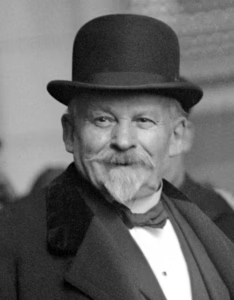
His famous phrase – “Every day, in every way, I am getting better and better” – became one of the best-known examples of autosuggestion.
The phrase is often misunderstood as a promise that positive thinking can control reality. A more useful interpretation is gentler: repeated language can influence attention, self-talk and behaviour. When the words are believable and connected to action, they can become a small daily compass.
🧠 Grounded principle: words can influence attention, but action gives them credibility.
For a wider mind-body approach, read What Is Holistic Living? Definition, 6 Pillars + Science-Backed Benefits.
“Every day, in every way, I am getting better and better”
What is the Coué Method?
The method combines constructive suggestion, repetition, and relaxed attention. Rather than forcing yourself to feel happy, you return to a phrase until it becomes familiar enough to influence your next choice.
Coué believed imagination could influence will and behaviour. Modern psychology uses more cautious language. Self-affirmation may help people reconnect with important values and respond to challenges with less defensiveness, but effects are usually modest and depend on context.
A phrase is most useful when it is specific, realistic and emotionally safe. “I am already completely confident” may feel false. “I am learning to take one courageous step” creates a bridge between today and the direction you want to follow.

Step into the world of personal growth with the Centre of Excellence!
🔬 What research suggests
Research on self-affirmation has explored whether reflecting on core values can support wellbeing and behaviour. A meta-analysis of self-affirmation interventions found generally small, context-dependent effects. Research on self-affirmation and brain activity has examined systems involved in self-processing and valuation.
The balanced conclusion is not that affirmations are magic or useless. They may help as a reflective practice when they reduce defensiveness, clarify values, and encourage a concrete next step.
Why unrealistic affirmations can make you feel worse
If a person feels anxious and repeats “I am perfectly calm,” the gap between the statement and their experience may increase frustration. This is why bridge affirmations are often more compassionate:
A good affirmation does not argue with your pain. It reminds you that pain is not the whole of your identity or future.
⏱️ A seven-minute daily practice
Minute 1: Arrive
Sit comfortably. Notice your breath, your posture, and the main emotion present. You do not need to change anything immediately.
Minutes 2–3: Choose one quality
Select patience, courage, focus, self-respect, kindness or persistence. One quality is easier to practise than a vague promise to transform your whole life.
Minutes 4–5: Repeat your phrase
Say it slowly, silently or aloud. If your mind resists, revise the sentence until it feels honest.
Minute 6: Visualise behaviour
Picture one real moment in which you will practise the quality: pausing before replying, taking a walk, opening the document or asking for help.
Minute 7: Choose an action
Write one action small enough to complete today. The affirmation becomes meaningful when it changes behaviour.
✧ Formula: meaningful value + believable language + repeated attention + observable action.
🌿 How to avoid toxic positivity
Name what is true
“I feel disappointed, and I can decide what to do next” is stronger than pretending disappointment does not exist.
Use process language
Replace “I never fail” with “I can learn from this attempt.”
Connect words to identity
Instead of “I will exercise every day,” try “I am becoming someone who keeps promises to my body.”
Match the phrase to the season
A phrase that helps before a presentation may feel inappropriate during grief. Self-suggestion should be flexible and compassionate.
Review evidence at night
Ask: Where did I act in alignment with my chosen value today? This turns vague positivity into observable growth.
Explore The Silva Mind Control Method and Personal Development Courses as optional educational resources, not substitutes for professional care. Journaling can also help; see The Power of Journaling.
Step into the world of personal growth with the Centre of Excellence!
🔁 Affirmations and habits
Words orient attention. Attention influences choices. Repeated choices become habits. The phrase is the cue, but the environment makes the behaviour easier or harder.
If your phrase is “I protect my attention,” silence notifications. If it is “I care for my body,” prepare walking shoes. If it is “I am learning,” leave the book open on your desk.
A useful implementation sentence is: When situation X happens, I will practise behaviour Y. For example: “When I feel overwhelmed, I will take three slow breaths before opening another app.”
💌 A calmer growth routine
Use The Holistic Living Routine – one practical prompt at a time for growth that feels grounded, compassionate and human.
Receive Our Expert-Crafted Holistic Routine to Nourish Your Daily Life.
⚠️ Responsible use
The Coué Method should never imply that illness results from insufficient positivity or that people are responsible for every painful event. It does not replace therapy, medical assessment, medication or social support.
If an affirmation increases shame, pressure or emotional suppression, stop and choose a more honest statement. The goal is not to perform happiness. It is to develop a kinder and more workable relationship with yourself.
Step into the world of personal growth with the Centre of Excellence!
🌟 Conclusion
The Coué Method remains valuable when separated from magical promises. A repeated suggestion can focus attention, reinforce identity, and prepare a useful action.
“I can meet today with awareness, kindness and one honest step.”
That is not wishful thinking. It is a direction you can practise.
FAQs
Are there any limitations or critiques of the Coué Method?
Yes, some critics question its efficacy, noting that it may not work for everyone, especially those with severe mental health issues, and caution against relying solely on positive thinking without addressing underlying problems.
What are the benefits of practicing the Coué Method?
Practitioners often experience improved mental health, increased emotional resilience, greater life satisfaction, and enhanced self-esteem by fostering positive thinking and self-belief.
What techniques are commonly used in the Coué Method?
Key techniques include daily affirmations, visualization, and mental repetition, all of which help embed positive thoughts, build motivation, and support personal growth.
How does the Coué Method work to impact behavior and mindset?
The Coué Method works by encouraging the regular repetition of positive affirmations, which helps reprogram the subconscious mind, foster optimism, and trigger behavioral change through belief and mental reinforcement.
What is the core principle of the Coué Method?
The core principle of the Coué Method is the use of positive affirmations and autosuggestion to influence the subconscious mind, thereby promoting self-improvement and emotional well-being.
What is the Coué Method?
It is a self-suggestion practice associated with Émile Coué that uses repeated constructive language to influence attention, self-talk and behaviour.
Does the Coué Method work?
It may help as a reflective and motivational practice. Evidence suggests effects are generally modest and depend on context, credibility and action.
Can affirmations cure anxiety or depression?
No. They may complement professional support but cannot replace qualified care.
What if an affirmation feels false?
Use a bridge statement that acknowledges reality and points towards a small action.
How often should I practise?
Try five to seven minutes daily for two weeks, then evaluate whether the practice improves attention, self-compassion or behaviour.
Affiliate disclosure:
Some links are affiliate links. If you purchase through them, The Dream Oak may receive a commission at no extra cost to you.
Learn, Help Family And Friends, And Help The Planet!