A well-designed morning routine for mental health and productivity does more than tick tasks off a list. It shapes the neurological state you carry into the rest of your day – and that state determines how much you actually accomplish. Here’s exactly how to build one.
Most popular advice focuses on doing more before 8 a.m.: cold showers, journaling sprints, aggressive to-do lists. That approach optimises for output while ignoring the inner conditions that make output sustainable. This guide takes a different angle, weaving together exercise science, mindfulness research, and intentional practice into a holistic framework centered on mind, body, and soul.
🌄 Morning Routine
Why Your Morning Sets the Tone for Everything
The first hour after waking is a genuine neurological window. Cortisol levels peak within 30–45 minutes of waking, a phenomenon called the cortisol awakening response (CAR). This spike primes alertness and memory consolidation, making it one of the most biologically significant moments of the day.
How you respond to that window shapes your focus and mood for hours afterward.
Most routines treat this window as a logistical problem to solve: get caffeinated, check notifications, start executing. But rushing into demands before the nervous system has settled tends to amplify stress rather than harness the natural energy of the CAR.
The holistic framework here works differently. It asks three questions at once: What does my body need to wake up gently? What does my mind need to arrive at clarity? What does my inner self need to feel oriented and purposeful? Answer all three, and productivity follows naturally, not as a forced output, but as a by-product of genuine readiness.

Muse Headband: A Game-Changer for Meditation
The Science Behind Best Morning Habits for Mental Clarity
Sleep inertia and the transition into wakefulness
Sleep inertia is the grogginess you feel immediately after waking. It reflects the brain’s gradual transition from sleep architecture, particularly slow-wave sleep, back to full waking consciousness. During this window, reaction time, decision-making, and working memory are all temporarily reduced.
The mistake most people make is treating sleep inertia as a problem to override. Aggressively checking your phone, jumping into email, or making high-stakes decisions during this phase works against your biology. The brain needs 15–30 minutes to fully shift gears. Gentle, low-demand activity during this transition- hydrating, light stretching, and sitting quietly respects that process and shortens the groggy window rather than fighting it.
This is exactly what the best morning habits for mental clarity protect: the quality of your cognitive baseline before the day’s demands stack up.

How cortisol and light exposure anchor your circadian rhythm
Morning bright-light exposure is one of the highest-leverage, lowest-effort habits available. Getting natural sunlight within 30 minutes of waking sends a strong signal to the suprachiasmatic nucleus, the brain’s circadian clock, that the day has begun. This anchors your sleep-wake cycle, improves nighttime sleep quality, and boosts daytime alertness by regulating melatonin and serotonin production.
On overcast days, outdoor light still delivers far more intensity than indoor lighting. Even 5–10 minutes outside makes a measurable difference. Pair that light exposure with a short walk, and you stack circadian regulation with gentle movement: two evidence-based habits for the cost of one.
This is how to start your day intentionally at the biological level. Before any goal-setting or productivity system, your brain needs light, time, and a gentle on-ramp.
Grounding Exercises for Morning: Anchoring Mind and Body
Physical grounding: movement and breathwork
Before the mind can arrive at clarity, the body needs to feel safe. Physical grounding exercises for morning work activate the parasympathetic nervous system, shifting the body out of its post-sleep or stress-primed state into a calmer, more regulated baseline.
Diaphragmatic breathing is the most direct tool. Breathing slowly into the belly (rather than the chest) for four counts in and six counts out activates the vagus nerve and lowers heart rate within minutes. No equipment, no space required, just two minutes on the edge of your bed.
Gentle movement amplifies this effect. A five-minute stretching sequence or a short walk around the block loosens the fascia tightened during sleep, raises body temperature slightly, and releases endorphins. Athletes and high-performers, from military operators to elite distance runners, have long used deliberate morning movement not just for fitness but as a stress-inoculation tool, acclimating the nervous system to mild physiological stress before cognitive demands arrive.
You do not need a gym. You need intent and ten minutes.
Sensory grounding: the 5-4-3-2-1 practice
The 5-4-3-2-1 technique is a simple sensory awareness exercise drawn from cognitive-behavioural and somatic therapy traditions. It works by anchoring attention in the present moment through the five senses:
- 5 things you can see.
- 4 things you can physically feel (feet on the floor, warmth of a mug).
- 3 things you can hear.
- 2 things you can smell.
- 1 thing you can taste.
This takes under two minutes. It interrupts the anxious forward-planning that often hijacks the morning brain and replaces it with present-moment awareness. For anyone prone to morning anxiety or racing thoughts, it is one of the most effective low-barrier grounding exercises available.
Morning Meditation Routine: Building Inner Stillness
Choosing the right meditation style for your mornings
Mindfulness researchers consistently find that brief, regular practice, even five minutes daily, produces measurable reductions in cortisol and self-reported anxiety over four to eight weeks. Crucially, short daily sessions outperform longer but irregular ones. Consistency is the mechanism, not duration.
A practical morning meditation routine does not require silence, a cushion, or years of experience. Three formats work well for beginners:
- Breathe focus, count ten breaths, return when you drift. Repeat for five minutes.
- Body scan: move attention slowly from feet to head, noticing sensation without judgment.
- Silent sitting: simply observe thoughts arising and passing without engaging them.
Start with whichever feels least intimidating. The only rule is that you do it before checking your phone.
Spiritual practices as an extension of meditation
Meditation and spiritual practice overlap, but they are not the same thing. For readers who hold a spiritual worldview, the morning is a natural time for prayer, devotional reading, or rituals that connect to something larger than the day’s agenda. For secular readers, the same psychological function- meaning-making and orientation- can come through journaling, gratitude practice, or intention-setting.
Neither path is prescriptively better. What matters is that some part of the morning is devoted to why you are doing what you are doing, not just what you need to do next.
If you want a structured starting point for the meditation side of this practice, the beginner’s guide to starting a mindfulness practice at The Dream Oak walks through the first seven days in practical, approachable steps.
Healthy Morning Ritual Ideas: Building Your Personalised Stack
The four pillars: move, still, nourish, intend
The most sustainable healthy morning ritual ideas are modular, small, stackable habits that can scale up when life allows and scale down when it doesn’t. The four-pillar framework does exactly that:
1. Move (5–20 minutes): Stretching, a walk, yoga, or bodyweight movement. The goal is nervous system regulation, not caloric burn.
2. Still (5–10 minutes): Meditation, breath focus, silent sitting, or prayer. This is the non-negotiable anchor of the whole routine.
3. Nourish (as long as it takes to drink a glass of water). Hydrate first; the body is mildly dehydrated after sleep. A real breakfast follows, but the single most important nutritional act is rehydrating before caffeine.
4. Intend (2–5 minutes) Write one sentence: What is the most important thing I will do today, and why does it matter? One sentence. Not a full journal entry. Not a goals list. One clear intention sets the direction of the whole day.
A sample 20-minute weekday skeleton:
- 6:00, Wake, hydrate, 5-4-3-2-1 grounding.
- 6:05, Breathwork (2 min) + light movement (8 min).
- 6:13, Meditation or stillness (5 min).
- 6:18, Intention-setting (2 min).
- 6:20, Breakfast / start the day.
A 20-minute version executed consistently beats a 90-minute routine abandoned by Wednesday. Build for the hardest day of your week, not the easiest.
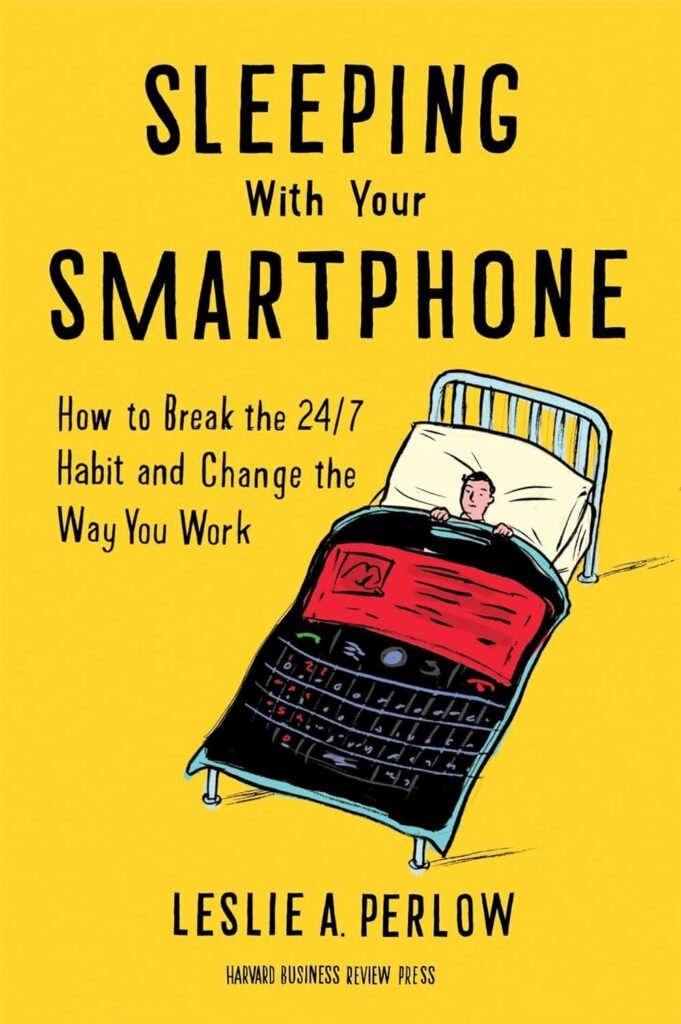
Sleeping with Your Smartphone: How to Break the Habit and Reclaim Your Rest
In a world where our smartphones have become constant companions, Sleeping with Your Smartphone by Leslie A. Perlow offers a refreshing perspective on digital balance.
Common Pitfalls That Undermine Your Morning Routine
1. Reaching for your phone first thing. The phone routes your attention outward, to notifications, news, and other people’s priorities, before you have established your own. Even five minutes of screen exposure during sleep inertia floods the amygdala with stimuli before the prefrontal cortex is fully online. Keep the phone in another room, or at a minimum, face down and silenced until after your routine is complete.
2. Building a routine too ambitious to survive contact with real life. A morning routine designed for a free Saturday will collapse the first Tuesday your child is sick, or your alarm fails. Design your default around your worst-case morning, not your ideal one. Two anchored habits, stillness and intention, are enough to constitute a real routine.
3. Neglecting sleep as the upstream variable. The best morning routine cannot compensate for chronic sleep debt. Sleep quality determines cortisol regulation, emotional reactivity, and the effectiveness of every habit stacked on top. If your mornings feel impossible, the most important intervention may be a consistent bedtime, not an earlier alarm.
How to Start Your Day Intentionally: A 7-Day Experiment
You do not need to commit to a new morning routine. You need to run a seven-day experiment.
The distinction matters psychologically. Commitment triggers resistance; experimentation invites curiosity. For the next seven days, treat your mornings as data collection, not self-improvement performance.
Days 1–3: Add just two practices. On waking, do two minutes of diaphragmatic breathing (grounding). Before you start work, write one sentence of intention. Nothing else changes.
Days 4–5: Layer in five minutes of movement, a walk, some stretching, whatever feels natural. Notice whether it changes your energy in the first hour at work.
Days 6–7: Add five minutes of stillness before or after movement. No phone until the routine is complete on both days.
At the end of seven days, you will have real personal data: which habits shifted your mood, which felt forced, and what a realistic minimum looks like for you. That data is worth more than any prescriptive system.

The Dream Oak’s growth-from-the-inside-out philosophy is built on exactly this principle: lasting change starts with inner alignment, not external pressure. A morning routine for mental health and productivity is not a productivity hack. It is a daily act of choosing who you are before the world tells you what to do.
Ready to Start?
Download the free Daily Routine Checklist below – a simple, printable one-pager with all seven pillars, so you can check in with yourself every day.
🌿 My Daily Routine Checklist
At The Dream Oak, we write about the connection between mind, body, and soul – because a fulfilled life grows from all three. Browse more articles on mindfulness, personal growth, and health & wellness.
Bookmark this article as your seven-day reference guide. Return to it mid-week when momentum dips. And when you are ready to go deeper, explore the rest of The Dream Oak’s holistic living content, because the morning is just the beginning.
Learn, Help Family And Friends, And Help The Planet!