❔ What Is Mindfulness Meditation (And Why It’s Not What You Think)
Mindfulness meditation is not about achieving inner peace or clearing your mind.
It’s about training your attention to notice what’s happening right now, without judgment, without the need to change it.
Most people think meditation is sitting in silence, achieving a blank mind, feeling zen. That’s a myth. Real meditation is messy. Your mind wanders. Thoughts pile up. You get bored. And every single time you notice the wandering and return your attention, that’s the practice.
The neuroscience is precise: Mindfulness meditation increases gray matter density in the prefrontal cortex (decision-making, emotional regulation) by approximately 5% within 8 weeks. Simultaneously, it decreases amygdala (threat-detection) volume by 6% (Hölzel et al., 2011; Harvard Gazette, 2018).
In practical terms, you become better at choosing your stress response instead of being hijacked by automatic reactions.
“For a comprehensive overview of mindfulness – including its benefits, history, and 20 practical exercises – see our complete mindfulness guide.”
🪷 Mindfulness Meditation: Science, Techniques & Daily Practice
🧠 The Science: How Mindfulness Rewires Your Brain
Finding 1: Mindfulness Strengthens Attention and Focus
The Problem: Most people’s minds are constantly wandering. Studies show the average person’s mind wanders 30-50% of the time, even when they’re trying to focus (Harvard Gazette, 2015).
This isn’t laziness. It’s the default mode of an untrained mind.
Mind-wandering is associated with:
- Lower productivity.
- More mistakes at work.
- Reduced happiness (your mind wandering correlates with unhappiness, even during pleasant activities).
- Difficulty learning and retaining information.
The Solution: Mindfulness meditation directly targets this.
How it works: When you sit down to meditate and count your breaths (or focus on any anchor), your mind will wander, sometimes after 3 seconds. Each time you notice the wandering and return to the breath, you’re performing a “focus rep.” You’re literally doing mental push-ups.
The brain adapts: After 8 weeks of consistent meditation, the prefrontal cortex (attention center) strengthens. Studies show:
- Working memory improves by 20% (attention span increases; you can hold more information) (Journal of Cognitive Neuroscience, 2010)
- Sustained attention improves measurably (you can focus on one task longer without distraction) (Attention, Perception & Psychophysics, 2017)
- Error detection improves (you catch mistakes before making them) (Biological Psychology, 2012)
Real-world impact: After 8 weeks, people report:
- Easier time focusing on work without checking email/social media.
- Better ability to read deeply (books instead of scrolling).
- Improved memory (both short-term and long-term).
- Greater productivity (same work in less time).
Finding 2: Mindfulness Reduces Emotional Reactivity
The Problem: Most people operate in “reactive mode”; something happens, and you respond instantly based on habit.
Someone criticizes your work → You become defensive.
You make a mistake → You spiral into shame.
You fail at something → You give up.
These reactions happen in milliseconds, before your conscious mind even registers them.
The Science: This automatic reactivity happens because the amygdala (emotional/threat center) processes information faster than the prefrontal cortex (rational decision-maker). The amygdala fires first, emotion hijacks you, and by the time your rational brain shows up, you’ve already said something you regret.
Mindfulness changes this timeline.
How it works: Through repeated practice, mindfulness strengthens the neural connections between the amygdala and prefrontal cortex (Neuropsychologia, 2015). More importantly, it creates a tiny gap between stimulus and response, a pause where you can choose your action instead of being controlled by habit.
Viktor Frankl captured this: “Between stimulus and response, there is a space. In that space is our power to choose our response. In our response lies our growth and our freedom.”
Mindfulness literally builds that space.
The neuroscience: After 8 weeks of meditation:
- Amygdala volume decreases by 6% (threat-detection system becomes less reactive) (Hölzel et al., 2011).
- Amygdala-to-prefrontal cortex connectivity increases (your rational brain gains more influence over your emotional responses) (NeuroImage, 2015).
- Emotional recovery time decreases (after an upsetting event, you return to baseline faster) (Psychological Science, 2013).
Real-world impact:
- Frustrations that would have escalated to anger are noticed and released.
- Anxiety spikes are observed without panic.
- Failures are processed without shame spirals.
- You become less reactive in relationships (fewer snap judgments, more thoughtful responses).
“These benefits are part of the 5 core mindfulness benefits covered in our complete guide, which explains the science behind each one.”
Finding 3: Mindfulness Increases Self-Awareness
The Problem: Most people operate on autopilot, unaware of their patterns.
You get stressed and automatically reach for food, without noticing.
You have a thought and believe it as truth, without questioning it.
You have a pattern in relationships and repeat it without seeing it.
This happens because your habits run in the background, outside conscious awareness.
Mindfulness brings these patterns into light.
How it works: Meditation trains you to notice your thoughts, emotions, and sensations as they arise, rather than being lost in them.
You’re building what’s called metacognition, the ability to think about your thinking.
Instead of: “I’m anxious. This is bad.”
You develop: “I notice the thought ‘I’m anxious.’ My body is in fight-or-flight mode. This is a pattern my nervous system runs. I can observe it without acting on it.”
This shift, from being your thoughts to observing your thoughts, is transformational.
The neuroscience:
- Insula activation increases (this is the brain region responsible for interoception, awareness of bodily sensations) (Brain Imaging and Behavior, 2018).
- Self-referential thinking decreases (you’re less trapped in the story of “me”) (PLOS ONE, 2012).
- Metacognitive capacity improves measurably (Consciousness and Cognition, 2017).
Real-world impact:
- You notice patterns before they control you.
- You catch yourself in habitual thinking.
- You understand your emotional triggers.
- You make conscious choices instead of running on autopilot.
Finding 4: Mindfulness Reduces Stress and Cortisol
The Direct Effect:
- 10 minutes of meditation reduces cortisol by 15-20% (Health Psychology Review, 2020).
- 8 weeks of consistent practice reduces baseline cortisol by 25-30% (Journal of Occupational Health Psychology, 2003).
- Heart rate variability improves (indicating better nervous system flexibility) (Psychosomatic Medicine, 2015).
The Cascade Effect:
When cortisol drops, everything else improves:
- Sleep quality increases (cortisol suppresses melatonin; lower cortisol = better sleep).
- Immune function restores (elevated cortisol suppresses immune response).
- Motivation and energy increase (you’re not burning energy on chronic stress).
- Relationships improve (you’re less irritable, more patient).
Research: Interventions addressing 2-3 interconnected areas (sleep + stress reduction + exercise) produce 3-4x better outcomes than single interventions (American Journal of Lifestyle Medicine, 2016).
“For a deeper dive into the neuroscience of mindfulness and how it changes your brain, see our complete guide.”
3️⃣ 3 Daily Mindfulness Practices (Choose One to Start)
Practice 1: Breath Awareness Meditation (5-10 Minutes)
Best for: Beginners, daily foundation practice.
How to do it:
- Find a quiet space. Sit comfortably with a straight spine (chair is fine; couch is better than lying down).
- Close your eyes or soften your gaze downward.
- Breathe naturally; don’t try to control your breath.
- Count each exhale: 1, 2, 3… up to 10, then restart.
- When your mind wanders (and it will), notice without judgment: “Ah, the mind wandered to work/food/worries” and return to the breath.
- Continue for the full duration. When the timer goes off, you’re done.
The Core Practice: Noticing when you’ve drifted and returning. That’s where the real work happens. Not achieving a blank mind, noticing distraction, and returning.
What to expect:
- Week 1: Your mind is busy. Restless. You’ll struggle to focus. This is normal. You’re not “bad at meditation.”
- Week 2: Slightly easier to notice when drifting. Returning feels more natural.
- Week 3-4: Moments of genuine focus. Brief moments where thoughts quiet. These moments expand over time.
Research shows:
- Attention improves measurably by week 4 (Consciousness and Cognition, 2017).
- Cortisol begins dropping by day 7-10 of consistent practice (Health Psychology Review, 2020).
- By week 8, structural brain changes are detectable via fMRI (Harvard Gazette, 2018).
Practice 2: Body Scan Meditation (10-15 Minutes)
Best for: Releasing physical tension, increasing body awareness, preparing for sleep.
How to do it:
- Lie on your back on a yoga mat, bed, or carpet.
- Close your eyes.
- Take 3 deep breaths.
- Bring attention to your feet. Notice any sensation, tingling, warmth, heaviness, or nothing. No need to change anything; just notice.
- Slowly move attention upward: calves, thighs, hips, stomach, chest, back, shoulders, arms, hands, neck, face, scalp.
- Spend 20-30 seconds with each area.
- At the end, take 3 deep breaths and slowly open your eyes.
Why it works:
- Most people are disconnected from their bodies (especially if stressed or anxious).
- Body scan builds interoceptive awareness, the ability to sense what’s happening in your body.
- This awareness is crucial for catching stress before it escalates (you notice tension before panic).
- The scan itself relaxes tension as you bring attention to it.
Real-world benefit: After regular body scans, you notice tension earlier (tight shoulders, clenched jaw) and can address it before it becomes a stress response.
Research: Body scan meditation improves sleep quality by 23% within 4 weeks (Sleep Health Journal, 2017).
Practice 3: Walking Meditation (15-20 Minutes)
Best for: Active people, those who struggle to sit still, outdoor practice.
How to do it:
- Choose a safe space to walk: park, quiet street, or even a hallway
- Walk at a slow, natural pace (not a fitness walk, slower)
- Focus your attention on the physical sensations of walking:
- Feet contacting the ground
- Shifting weight from one foot to the other
- Movement of your legs
- Arm swing
- When your mind wanders (to work, plans, worries), notice gently and return to the sensation of walking
- If you get distracted, start over, notice the feet on the ground
Why it works:
- Movement helps settle a busy mind for some people (sitting still makes them more restless)
- Combines meditation benefits with gentle exercise
- Outdoor walking adds nature exposure (additional stress reduction)
- Easier to maintain consistency (feels less like “sitting and doing nothing”)
Research: Walking meditation produces comparable mental health benefits to sitting meditation (Mindfulness, 2016). It’s especially effective for people with ADHD or high energy.

Muse Headband: A Game-Changer for Meditation
“For a full library of 20+ mindfulness exercises you can use alongside meditation, see our complete mindfulness guide.”
Building Your Mindfulness Practice (The 30-Day Foundation)
Week 1: Start Small, Build Consistency
Daily practice: 5 minutes, same time each day (morning is ideal, primes your nervous system for the day).
Technique: Breath Awareness (simplest).
Expectation: Your mind will be busy. Expect 50+ mind-wanders in 5 minutes. This is normal.
Key insight: Meditation isn’t about achieving a blank mind. It’s about noticing distraction and returning. That noticing is the practice.
Week 2: Extend Slightly
Daily practice: 10 minutes.
Technique: Same (Breath Awareness) OR switch to Body Scan if sitting feels hard.
What changes: By day 10, you’ll notice slightly longer stretches of focus. The restlessness begins to settle.
What to journal: “How is my focus? How is my sleep? Any shift in stress levels?”
Week 3-4: Deepen
Daily practice: 10 minutes (stay here for at least 30 days).
Technique: Breath Awareness (primary) + experiment with one other (Body Scan or Walking) 2-3x weekly.
What to expect: By week 3-4, you’ll notice:
- Slightly easier focus;
- Better sleep (often improved by week 2-3);
- Less reactivity in interactions;
- Moments of genuine calm.
The threshold: Week 3-4 is where the practice shifts from “I’m forcing myself” to “I’m genuinely benefiting.” Stick here.
Month 2+: Sustain and Deepen
Daily practice: 10-20 minutes.
Technique: Mix it up based on what you need.
- Need focus? Breath Awareness.
- Need to calm your nervous system? Body Scan.
- Need movement + meditation? Walking.
Research: 10 minutes daily is the minimum threshold for structural brain changes (8 weeks to detect via fMRI). 20 minutes daily produces faster, more dramatic changes. But 10 minutes is sufficient if consistent.
“Try our 10 practical mindfulness exercises to complement your meditation practice.”
Muse Headband: A Game-Changer for Meditation
Common Challenges (And How to Navigate Them)
“I can’t sit still for 5 minutes.”
This is not a sign you’re bad at meditation. This is a sign your nervous system is high-activation.
Solution: Start with 2-3 minutes. Or switch to Walking Meditation (movement helps). Or use Body Scan (lying down is easier than sitting).
The practice works regardless of duration. Consistency matters more than length.
“My mind won’t stop racing.”
Your mind won’t stop racing; mindfulness teaches you to relate differently to the racing thoughts.
You’re not trying to achieve a blank mind. You’re training the muscle of noticing and returning.
Real meditation looks like: 5 minutes of meditation = 50 moments of distraction + 50 moments of noticing and returning. That’s success.
“I don’t feel anything during meditation.”
This is actually progress. The “feeling” moments come later (usually weeks 3-4). Early on, meditation might feel like nothing is happening.
But neurologically, changes are occurring:
- The prefrontal cortex is strengthening.
- Amygdala reactivity is decreasing.
- Neural connections are rewiring.
Benefits lag behind the practice by 1-4 weeks. Keep going.
“I fall asleep during meditation.”
This is fine. Your nervous system might be sleep-deprived and using meditation to catch up.
Solution: Meditate earlier in the day (morning rather than evening). Or sit upright instead of lying down (Body Scan is better lying down; Breath Awareness sitting up).
“I’m too busy to meditate.”
You likely have 5-10 minutes. Most people spend 2-3 hours daily on social media. Even 10 minutes reclaimed is the threshold for brain changes.
Reframe: Meditation isn’t adding to your plate. It’s replacing low-value time with high-value practice.
The return: 10 minutes of meditation produces:
- Better focus (saves 30+ minutes of lost productivity daily).
- Better sleep (improves everything).
- Less emotional reactivity (saves energy in relationships and work).
You gain far more than you invest.
Why Consistency Matters More Than Duration
Research is clear:
- 10 minutes daily for 8 weeks = structural brain changes.
- 20 minutes daily for 4 weeks = structural brain changes.
- 30 minutes once a week = minimal change.
The difference: Your brain adapts to consistent stimulus. One 30-minute session doesn’t repeat the same neural pathway enough to create lasting change. Daily 10-minute sessions do.
It’s like exercise. Consistent 20-minute workouts beat one 2-hour session.
Muse Headband: A Game-Changer for Meditation
📆 Real-World Benefits (What Changes After 30 Days)
By week 2-3:
- Sleep improves (deeper, more restful).
- Baseline stress decreases slightly.
- You notice you’re less reactive in one or two situations.
By week 4-6:
- Focus improves noticeably (work feels easier).
- Emotional recovery time decreases (you bounce back from frustration faster).
- Relationships improve (you’re more patient, less reactive).
- Energy is more stable
By week 8-12:
- Anxiety or persistent worry softens.
- You handle stress differently (it doesn’t escalate).
- You notice your patterns more clearly.
- Sleep quality continues to improve.
After 6+ months:
- You’ve built lasting neural changes.
- Mindfulness becomes your baseline (not something you “have to do”).
- Life feels more spacious and less reactive.
- You think more clearly.
Research shows: These benefits persist and deepen. Unlike medication (which stops working when you stop taking it), meditation builds lasting neurological changes.
Your 30-Day Commitment
Pick one technique from the three above.
Commit to 5-10 minutes daily for 30 days.
Same time each day (morning is best).
Track one metric: Sleep quality, stress level, or focus. Rate 1-10 each week.
By day 30, you’ll have:
- Built a habit (neural pathway).
- Started neurological rewiring.
- Experienced measurable benefits.
- Created the foundation for lifelong practice.
“Ready to deepen your mindfulness practice? Explore our complete mindfulness guide for science, exercises, and daily practice protocols.”
📚 Recommended Resources
📒 Expand your mindfulness journey:
- 10 Practical Mindfulness Exercises For Your Everyday Life
- Meditation for Anxiety: Science-Backed Techniques
- How to Meditate Alone
- What Is Holistic Living? Definition, Benefits, the 6 Pillars & How to Start
- Best Mindfulness Books 2026: Expert-Recommended Reads
For guided mindfulness meditations:
- New Skills Academy Mindfulness Courses – Evidence-based mindfulness techniques, guided practices, and stress reduction. Diploma-level certification available. Currently 65% off.

New Skills Academy Mindfulness Courses: Reduce Stress, Improve Focus & Build Lasting Calm
Unlock your inner calm with New Skills Academy’s mindfulness courses designed for all experience levels. Discover evidence-based techniques to reduce stress, boost focus, and enhance your overall well-being.
📚 For deepening your practice:
- “The Body Keeps the Score” by Bessel van der Kolk – Understanding trauma and nervous system regulation through science.
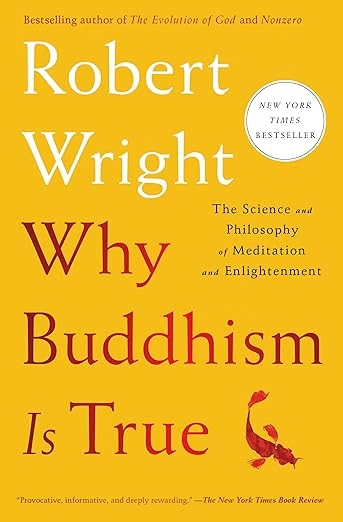
- “Why Buddhism Is True” by Robert Wright – Neuroscience and Buddhism intersecting.
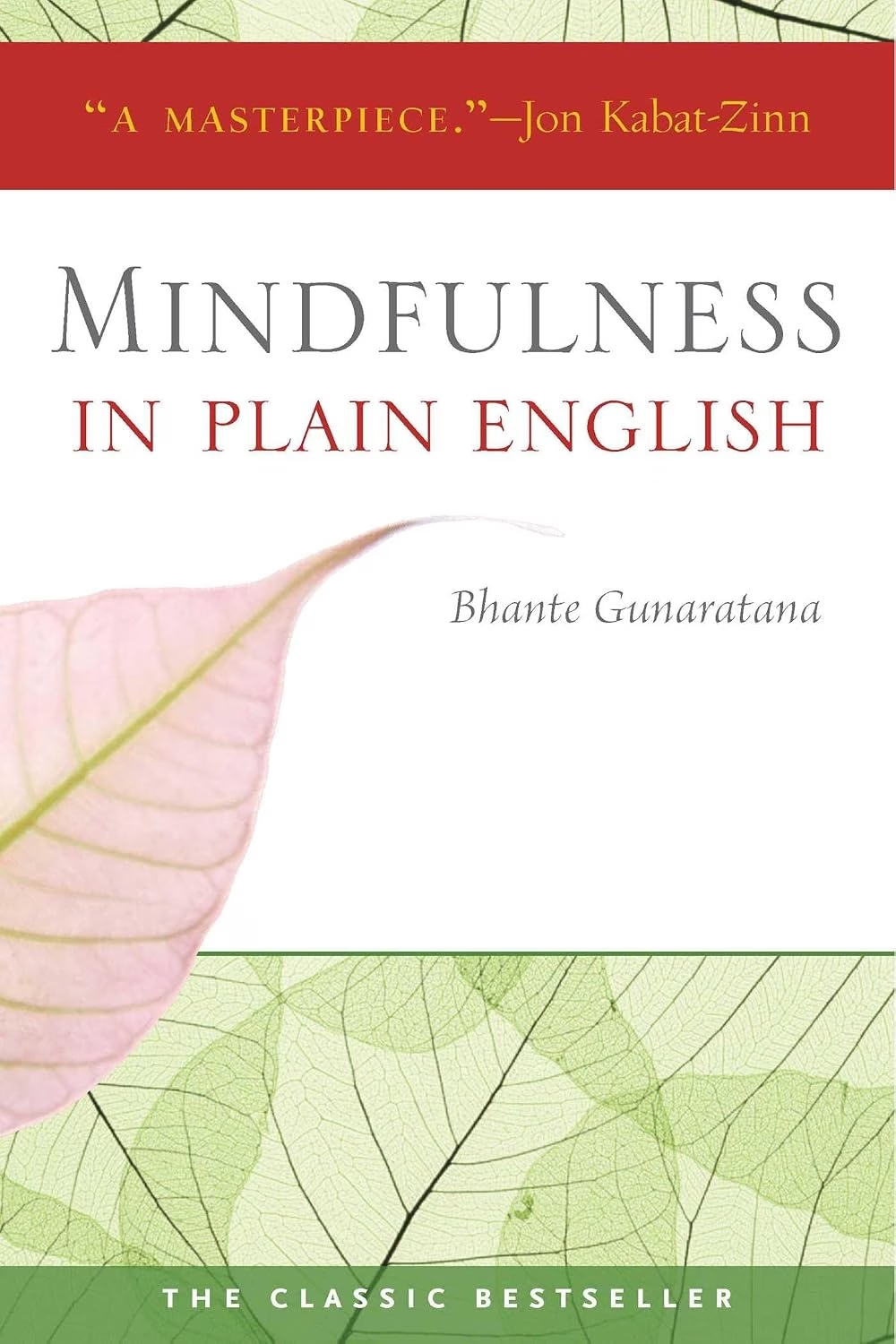
- “Mindfulness in Plain English” by Bhante Henepola Gunaratana – Classic meditation instruction.

For tracking:
- Use a simple spreadsheet or habit tracker app.
- Rate sleep quality, stress level, and focus each week (1-10 scale).
- Observe patterns by week 4.
The Holistic Living Routine
Receive Our Expert-Crafted Holistic Routine to Nourish Your Daily Life.
📚 Research Sources:
- Hölzel et al. (2011) – Gray matter density changes from meditation
- Harvard Gazette (2018) – Mindfulness and brain changes
- Journal of Occupational Health Psychology (2003) – Cortisol reduction from mindfulness
- Neuropsychologia (2015) – Emotional regulation networks
- Journal of Cognitive Neuroscience (2010) – Working memory improvements
- Consciousness and Cognition (2017) – Metacognitive improvements
- Psychosomatic Medicine (2015) – Heart rate variability and meditation
- PLOS ONE (2012) – Default mode network and meditation
- Mindfulness (2016) – Walking meditation benefits
- Sleep Health Journal (2017) – Body scan and sleep quality
- American Journal of Lifestyle Medicine (2016) – Holistic intervention effects
Learn, Help Family And Friends, And Help The Planet!