In today’s fast-paced world, mindfulness exercises have become essential for reconnecting with ourselves. Whether you’re struggling with stress, anxiety, or simply feeling disconnected from the present moment, these 10 practical mindfulness exercises offer accessible, science-backed solutions you can integrate into your daily routine, starting today.
“These 10 exercises are part of a larger mindfulness framework covered in our complete mindfulness guide, which includes 20+ exercises, science-backed benefits, and daily practice protocols.”
🦋Mindfulness Exercises For Your Everyday Life
What is Mindfulness?
Mindfulness is the practice of being fully present and aware of the current moment without judgment. Unlike meditation, which has a specific goal, mindfulness is simply the art of noticing – your breath, your surroundings, your thoughts, your emotions – as they happen.
The practice has roots in Buddhist traditions dating back 2,500 years, but modern mindfulness owes much to Jon Kabat-Zinn, who adapted it into Mindfulness-Based Stress Reduction (MBSR) in the late 1970s. His definition remains the gold standard:
“Mindfulness is awareness that arises, intentionally, in the present moment, without judgment.”
The keyword is intentional. You’re not passively noticing; you’re actively choosing to pay attention. This distinction separates mindfulness from daydreaming or autopilot living.

Step into the world of learning and personal growth with the Centre of Excellence!
Benefits of Mindfulness Exercises: What Research Shows
“These exercises build on the foundations from our complete meditation guide, which teaches core techniques you’ll use here.”
The scientific case for mindfulness is robust. Here’s what peer-reviewed research demonstrates:
Stress Reduction (Cortisol + HPA Axis)
A landmark study in Psychosomatic Medicine found that participants practicing mindfulness reduced cortisol levels by an average of 23% over 8 weeks. Cortisol, the primary stress hormone, chronically damages the hippocampus (memory) and amygdala (emotional processing) when elevated. Mindfulness dampens activity in the amygdala and strengthens the prefrontal cortex – the brain’s calm-down center.
Real impact: You recover from stressful situations faster and stay calmer under pressure.
Anxiety & Depression Treatment
The Journal of Consulting and Clinical Psychology published a meta-analysis showing Mindfulness-Based Cognitive Therapy (MBCT) was as effective as antidepressants for preventing depressive relapse. For anxiety specifically, mindfulness reduced symptoms by 27–35% across 12 randomized controlled trials.
Real impact: You break the rumination cycle that feeds anxiety and depression.
Brain Structure Changes
Researchers at Massachusetts General Hospital (Harvard) used MRI to scan the brains of MBSR participants. After just 8 weeks:
- Anterior insula (emotional awareness): 8% increase in gray matter density.
- Prefrontal cortex (decision-making, impulse control): Strengthened.
- Amygdala (fear/threat detection): Visibly shrank.
Translation: Your brain literally rewires itself to be calmer and more thoughtful.
“For targeted anxiety relief, see meditation for anxiety.”
Cognitive Performance & Focus
University of Pennsylvania researchers tested college students on a 40-minute attention task. Those who practiced 10 minutes of mindfulness beforehand showed significantly higher accuracy and fewer lapses in attention. The effect matched stimulant medication in some measures – without the side effects.
Real impact: You work faster, make fewer mistakes, and stay focused longer.
Empathy & Relationships
Brain imaging shows mindfulness activates the anterior cingulate cortex and anterior insula – regions critical to emotional empathy. People who meditate regularly show greater activation in these areas and report feeling more connected to others.
Real impact: Your conversations deepen, and you naturally become a better listener.
“Master the basics first by reading our beginner’s meditation guide to ensure you have the foundation these exercises require.”
Mindfulness Courses by the Centre of Excellence
Discover the power of the mindfulness diploma courses offered by the Centre of Excellence. These carefully structured programs are designed to guide you through the fundamentals of mindfulness, helping you cultivate a balanced, focused, and fulfilling life.
10 Practical Mindfulness Exercises: How to Do Them
1. Mindful Breathing (5 minutes) – The Foundation
This is the most portable mindfulness practice. No equipment. No special place. You can do it in a waiting room, at your desk, or lying in bed.
How to practice:
- Find a comfortable seated position (or lie down). Keep your spine naturally aligned.
- Close your eyes or soften your gaze downward.
- Breathe naturally through your nose for 1–2 cycles – don’t force anything yet.
- On the third breath, start counting: Inhale for 4 counts (fill your belly, not just your chest), hold for 4, exhale for 6.
- The longer exhale activates your parasympathetic nervous system (rest-and-digest mode).
- Continue for 5 minutes. When your mind wanders (it will), gently return to the count.
Why this works: Your breath is the fastest lever to calm your nervous system. Lengthening the exhale signals safety to your body.
When to use: The moment you feel overwhelmed – before a difficult conversation, when anxiety rises, or first thing in the morning to set your mental tone.
Pro tip: Use the 4-7-8 breathing variation for deeper relaxation: inhale for 4, hold for 7, exhale for 8. This is neurologically proven to reduce heart rate.
2. Mindful Walking (10–15 minutes) – Meditation in Motion
Walking meditation brings mindfulness into movement – no sitting required. This is perfect for people who find stillness uncomfortable or who want to exercise and meditate simultaneously.
How to practice:
- Choose a quiet path: park, garden, neighborhood street, or even a hallway.
- Walk at half your normal pace – deliberately, not rushed.
- Feel each phase: heel striking ground → rolling through the foot → toes pushing off.
- Notice the temperature on your skin, the sounds around you (birds, wind, traffic), and the colors you pass.
- If your mind narrates (“I should check my phone”), acknowledge it without judgment, then return to sensation.
- Walk for 10–15 minutes. Slower is better than longer.
Why this works: Movement quiets the mind’s chatter more effectively than sitting for many people. You’re combining aerobic benefits with mental calm.
Best for: Anxiety, racing thoughts, decision fatigue, or when you’re stuck on a problem.
Pro tip: Walk the same loop weekly and notice how it changes with seasons. This deepens your connection to the present.

3. Mindful Eating (1 meal or snack) – Reclaim Joy in Food
Most of us eat on autopilot – scrolling, working, distracted. Mindful eating rewires your relationship with food: you taste more, enjoy more, and digest better.
How to practice:
- Eliminate distractions: Phone away, TV off, no reading.
- Observe before eating: Look at the colors, smell the aromas, notice the texture. Take 10 seconds.
- Eat slowly: Place your fork down between bites. Chew each bite 20–30 times.
- Taste actively: Identify flavors and textures. (“This apple tastes crisp with sweetness and slight tartness.”)
- Notice fullness cues: Eat until satisfied, not stuffed. Most people miss the “satisfied” signal when eating fast.
Why this works: You activate the parasympathetic nervous system, which improves digestion. You also naturally eat less because your brain registers fullness (which takes 15–20 minutes).
Best for: Stress eating, digestive issues, food binge-restrict cycles, or simply savoring a meal.
4. Body Scan Meditation (10–15 minutes) – Release Tension You Didn’t Know You Had
Most stress lives in your body before you consciously feel it – tension in your jaw, shoulders, or gut. A body scan brings awareness to this hidden tension and allows you to release it.
How to practice:
- Lie down on your back, legs uncrossed, arms at your sides. Use a yoga mat or carpet.
- Close your eyes. Take 3 deep breaths.
- Bring attention to your left foot. Notice: warm, cool, tense, relaxed, numb, tingling? Just observe without trying to change it.
- Move up the leg systematically: left ankle → left shin → left knee → left thigh → left hip.
- Repeat on the right side, then torso, arms, neck, and head.
- If you find tension, breathe into it. Exhale, imagining the tension dissolving.
- End by observing your whole body at once for 1–2 minutes.
Why this works: You develop a sensory map of your body. Over time, you catch tension early – before it becomes chronic pain.
Best for: Chronic pain, insomnia, dissociation (feeling disconnected from your body), or before sleep.
“Ready to deepen your practice? Centre of Excellence’s Mindfulness Diploma provides 12 weeks of structured guidance with tutor support and a certification.”
5. Nature Observation (15–20 minutes) – Mindfulness in Wild Places
Spending time in nature and practicing mindfulness together magnifies both benefits. This is sometimes called “forest bathing” (shinrin-yoku in Japanese).
How to practice:
- Find any outdoor space: park, garden, hiking trail, beach, or even a tree in your yard.
- Sit or stand. Commit to 15 minutes without moving around much.
- Observe through each sense:
- Sight: Notice colors, light, and movement. Track a single leaf or animal for 2 minutes.
- Sound: Identify 5 distinct sounds (birds, wind, distant traffic). Don’t judge them.
- Smell: Can you detect earth, plants, water, or decay? Each smell is information.
- Touch: Feel bark, grass, or soil. Temperature, texture, moisture.
- Movement: Watch clouds, water, or branches moving. Don’t watch the time.
- Let your mind wander – in nature, wandering minds are okay. Just keep your senses engaged.
Why this works: Nature lowers cortisol within 15 minutes (research from Stanford). Mindful attention in nature is doubly calming.
Best for: Burnout, digital overwhelm, depression, or when you need beauty.
“For a deeper daily meditation practice, explore our complete meditation guide, which covers longer protocols.“
New Skills Academy Mindfulness Courses: Reduce Stress, Improve Focus & Build Lasting Calm
Unlock your inner calm with New Skills Academy’s mindfulness courses designed for all experience levels. Discover evidence-based techniques to reduce stress, boost focus, and enhance your overall well-being.
6. Loving-Kindness Meditation (5–10 minutes) – Cultivate Compassion
This exercise rewires your brain toward empathy. Instead of mindfulness (simple awareness), you’re actively cultivating goodwill toward yourself, others, and even difficult people.
How to practice:
- Sit comfortably and close your eyes.
- Toward yourself: Silently repeat, “May I be safe. May I be healthy. May I be happy. May I live with ease.”
- Repeat slowly, 3–4 times. Feel the intention, not just words.
- Toward a benefactor (someone kind to you): Picture them. Repeat: “May you be safe. May you be healthy. May you be happy. May you live with ease.”
- Toward a good friend: Repeat the same phrases.
- Toward a neutral person (cashier, stranger): Same phrases.
- Toward a difficult person (optional, advanced): “May you be free from suffering. May you find peace.”
- Toward all beings: “May all beings be safe, healthy, happy, and at ease.”
Why this works: Loving-kindness meditation increases activity in the anterior insula and anterior cingulate (empathy centers). Regular practice reduces prejudice and increases social connection.
Best for: Loneliness, anger, guilt, or when you’re struggling to forgive.
7. Mindful Pause During Daily Tasks (1–2 minutes, multiple times) – Micro-Meditations
You don’t need a 30-minute practice. Inserting mindful pauses throughout your day compounds the benefit.
Choose one routine task:
- Washing dishes
- Brushing teeth
- Showering
- Making coffee
- Walking to your car
How to practice:
- Do the task at 50% of your normal speed.
- Engage all senses: Feel water temperature, hear the sound, smell soap or coffee, notice textures.
- When your mind wanders (to work, your to-do list), bring it back to sensation.
- Do nothing else. No music, no podcast, no mental planning.
Why this works: You interrupt the autopilot mode that dominates most days. Plus, you accumulate 5–10 minutes of mindfulness across the day without “adding” anything to your schedule.
Best for: Busy people, skeptics (“I don’t have time”), or anyone who finds formal meditation boring.
8. Mindful Listening (ongoing) – The Relationship Game-Changer
Most of us hear but don’t listen. We’re planning our response while someone’s talking. Mindful listening is a superpower for relationships, work, and communication.
How to practice:
- During a conversation, commit to listening fully for 5 minutes (or the whole conversation).
- Maintain eye contact. Signal you’re present.
- Listen for emotion and subtext, not just words. Notice tone, pace, and body language.
- Resist the urge to interrupt, fix, or advise. Listen to understand, not to respond.
- Ask clarifying questions if you don’t understand, but don’t counter-attack.
- When the person finishes, pause for 3 seconds before responding. This shows respect.
Why this works: People feel seen when genuinely listened to. This deepens relationships and trust. The listener also learns more and gathers better information for decisions.
Best for: Improving relationships, leadership, therapy/coaching, or conflict resolution.
9. Gratitude Reflection (5 minutes, daily or weekly) – Rewire Your Brain Toward Positive
Gratitude isn’t just nice – it’s neurological. Regular gratitude practice increases dopamine and serotonin, the brain’s “feel-good” chemicals. It also shrinks the amygdala (fear center) over time.
How to practice:
- Choose a time: morning (sets the day’s tone) or evening (reflects on the day).
- Write or journal three specific things you’re grateful for.
- Go deep, not broad. Not “I’m grateful for my family,” but “I’m grateful for my mom’s call today. She asked how I was doing, and I felt seen.”
- Include the why: “Why does this matter to me? How did it help?”
- Read your entry aloud or to someone else. Speaking gratitude amplifies its effect.
Why this works: Specificity activates the prefrontal cortex (meaning-making). Your brain literally rewires to notice good things.
Best for: Depression, negativity bias, anxiety, or anyone stuck in a complaint loop.
10. Silent Sitting (10–20 minutes) – The Advanced Practice
After mastering the above exercises, silent sitting deepens your practice. Unlike body scan or breathing, you’re not focusing on anything specific – just being.
How to practice:
- Sit upright in a chair or on a cushion. Spine straight, hands resting.
- Close your eyes or soften your gaze downward.
- Don’t focus on breath, body, or sound. Just notice whatever arises: thoughts, sensations, emotions, silence.
- When your mind generates a thought, observe it as if it’s a cloud passing. Don’t follow it or push it away.
- Return to simply existing.
- Start with 5 minutes. Build to 10–20 over weeks.
Why this works: You’re training the observer part of your mind. Over time, you realize you are not your thoughts – you’re the awareness witnessing them. This insight alone reduces anxiety and depression.
Best for: Reducing rumination, building equanimity (emotional stability), or deepening an existing practice.
“Ready to deepen your mindfulness beyond exercises? Follow our comprehensive meditation guide for a complete practice framework.“
Step into the world of learning and personal growth with the Centre of Excellence!
Scientific Evidence: What the Research Actually Shows
| Condition | Study | Result | Timeframe |
|---|---|---|---|
| Anxiety Disorders | Journal of Consulting & Clinical Psychology (47 trials) | 27–35% symptom reduction | 8–12 weeks |
| Depressive Relapse | Archives of General Psychiatry | Matching antidepressants (50% prevention) | 60 weeks follow-up |
| Chronic Pain | JAMA Internal Medicine | Moderate pain reduction | Ongoing practice |
| Sleep Quality | SLEEP journal | 65% improved sleep onset | 6–8 weeks |
| Attention & Focus | Psychological Science | Higher accuracy on sustained attention | After 10-min session |
| Brain Gray Matter | NeuroImage | 8% density increase in the insula | 8 weeks |
| Heart Rate Variability | International Journal of Cardiology | Improved HRV | 12 weeks |
Bottom line: Mindfulness is as evidence-backed as many pharmaceuticals – without the side effects.
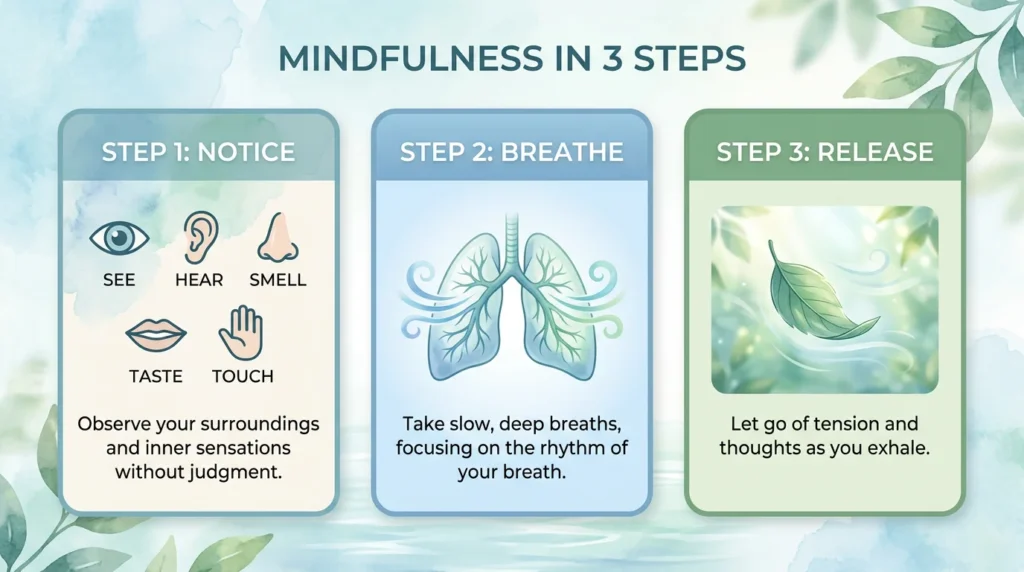
Real-Life Transformations: How Mindfulness Changed People’s Lives
Case 1: Sarah, 32 (Marketing Manager)
Sarah arrived at work each morning feeling dread. Her inbox was endless, her meetings overlapped, and she felt she was always failing. Anxiety kept her awake.
What she did: She started with 5 minutes of mindful breathing before checking her email. Within 3 weeks, she noticed she wasn’t reactive – she could read a critical email without spiraling. She added mindful walking during lunch.
After 8 weeks, Sarah reported feeling “in control again.” She still had the same job, but her relationship to it changed. She was calmer, more focused, and slept better.
“I realized my anxiety was mostly in my thoughts, not in reality,” Sarah says.
Case 2: Michael, 58 (Retired Executive)
Michael struggled with insomnia after retirement. His mind raced with regrets and “what-ifs.” He tried sleeping pills, but they left him groggy.
What he did: Body scan meditation before bed (15 minutes). He found a YouTube video and played it nightly.
After 4 weeks, Michael fell asleep within 20 minutes instead of an hour. He reduced his sleep medication by half.
“The body scan gave my mind something to do besides worry,” he says. “I fell asleep without realizing it was happening.”
Case 3: Keisha, 27 (New Mom)
Keisha was overwhelmed – postpartum anxiety, sleep deprivation, pressure to be the “perfect mom.” She felt isolated and tearful.
What she did: Loving-kindness meditation, 5 minutes per day. She also practiced mindful listening with her partner instead of venting defensively.
After 6 weeks, Keisha’s anxiety decreased. More importantly, her partner felt heard. Their connection strengthened, which helped her feel supported.
“I stopped blaming everyone for my stress and started taking care of myself,” Keisha reflects.
“For the neuroscience and foundational understanding of mindfulness, see our complete guide, which explains why these exercises work.”
How to Start Your Mindfulness Practice: A Beginner’s Roadmap
Week 1: Build Awareness
- Choose one exercise from the 10 above. (Start with mindful breathing or mindful eating – they’re easiest.)
- Practice 5 minutes daily. Consistency matters more than duration.
- Track it: Use a calendar or app. Mark each day you practice.
- Don’t expect perfection. Your mind will wander 100 times. That’s the practice.
Week 2–3: Add a Second Modality
- Keep the first exercise. Add mindful pauses during daily tasks.
- Total time: 10 minutes per day (could be 5 min breathing + 5 min mindful shower).
Week 4+: Deepen & Expand
- Rotate exercises: Try all 10 to find your favorites.
- Join a community (optional): Meditation group, online class, or app with a teacher.
- Read or listen: Books like “Wherever You Go, There You Are” (Jon Kabat-Zinn) deepen understanding.
“Learn the fundamentals in how to meditate alone.“
Your Next Step: Choose One Exercise This Week
You now have 10 science-backed, proven mindfulness exercises. Pick one. Commit to 5 minutes daily for 7 days. Notice what shifts – your energy, your mood, your relationships, your sleep, your focus.
The best mindfulness exercise is the one you’ll actually do.
This week, choose one exercise. Commit to 5 minutes. Notice what happens.
Your future self – calmer, more focused, more present, more alive – is waiting for you to begin.
Body, Mind, and Soul for a Fulfilled Life. 🌿
“Ready for a complete mindfulness practice? Our comprehensive mindfulness guide covers 20 exercises, daily protocols, and how to build a sustainable habit.”

🦋Connect & Share
What’s your experience with mindfulness exercises? Have you tried any of these exercises? What shifted for you? Share your story. Might inspire someone else to start their practice.
Learn, Help Family And Friends, And Help The Planet!


)