The relationship between faith and health is no longer just anecdotal; it’s science.
Research consistently shows that people with strong spiritual beliefs or practices experience:
- Better mental health (lower anxiety & depression)
- Stronger physical health (lower blood pressure, better immune function)
- More resilience during difficult times
- Deeper, more meaningful relationships
But how does this actually work? And is it just about having a community, or is there something deeper happening in your brain and body?
This article deconstructs the pathways: the neurobiological mechanisms, the psychological patterns, and the practical applications for living a healthier, more spiritually integrated life.
Quick Summary: How Faith Influences Health
| Mechanism | Impact | Examples |
|---|---|---|
| Cognitive Appraisal | Reframes stress as meaningful | Finding purpose in adversity |
| Social Support | Reduces loneliness & isolation | Faith communities, shared rituals |
| Behavioral Regulation | Encourages healthy habits | Abstinence, mindfulness, meditation |
| Emotional Resilience | Increases hope & optimism | Prayer, forgiveness, gratitude |
| Neurobiological | Reduces stress response | Meditation lowers amygdala activity |
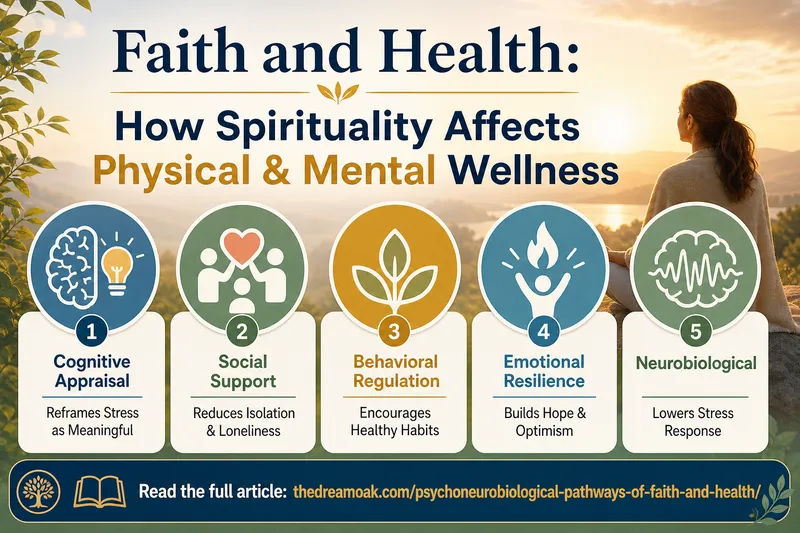
Spirituality isn’t just feel-good – it’s neuroscience.
- ✨ Cognitive Appraisal – Reframe stress as meaningful.
- 🤝 Social Support – Build resilience through community.
- 🌱 Behavioral Regulation – Encourage healthy habits.
- 💫 Emotional Resilience – Cultivate hope & forgiveness.
- 🧠 Neurobiological – Lower your stress response.
Explore the full science behind faith and wellness.
👉 Read on to explore each pathway in depth, including the science and practical implications.
🐦🔥Pathways of Faith and Health
This article aims to move beyond descriptive epidemiology, delving into the nuanced pathways, critical appraisals, and methodological challenges inherent in understanding how belief systems and spiritual practices mechanistically influence human well-being, both adaptively and maladaptively.

The world of learning and personal growth – Centre of Excellence!
Background Context: Bridging the Observational Gap
For those requiring a brief contextualization, the extant research unequivocally demonstrates a statistical association. Studies have shown that individuals reporting higher levels of religious commitment often exhibit lower blood pressure, improved immune function, reduced risk of cardiovascular disease, and greater longevity.
In mental health, spirituality is linked to decreased anxiety, depression, substance abuse, and suicide rates, alongside increased life satisfaction, purpose, and social support. Early theories posited social support, lifestyle choices, and psychological coping as primary mediators.
However, these broad categories often obscure the granular, bidirectional influences at play, necessitating a deeper dive into the specific psychological constructs and neurophysiological processes that underpin these observed effects.
The Neurocognitive Mechanisms of Belief and Well-being
The beneficial impact of faith on health is not a monolithic phenomenon but rather a constellation of interconnected psychological and biological processes. Understanding these requires a multidisciplinary lens.
Cognitive Appraisal and Stress Buffering
One of the most significant pathways involves cognitive appraisal. Religious frameworks often provide individuals with a coherent worldview, a sense of meaning, and a transcendent purpose, which can profoundly alter the appraisal of stressful life events.
According to Lazarus and Folkman’s transactional model of stress and coping, an individual’s perception of a stressor and their perceived ability to cope are paramount. Faith can reframe adversities as opportunities for growth, divine tests, or part of a larger, benevolent plan, thereby reducing primary appraisal of threat and enhancing secondary appraisal of coping resources (e.g., divine assistance, community support).
- Meaning-Making: Religious beliefs offer a comprehensive explanatory framework for suffering, loss, and existential questions, which can mitigate feelings of helplessness and despair. This sense of coherence (Antonovsky’s Salutogenesis) is a potent stress buffer.
- Perceived Control: Prayer or reliance on a higher power can instill a sense of indirect control over uncontrollable situations, reducing anxiety. This external locus of control, when adaptive, can prevent rumination and foster acceptance.
Social Support and Community Cohesion
Religious institutions frequently serve as robust networks for social support, fostering a sense of belonging and community. This social capital is a well-established determinant of both physical and mental health.
- Structural Support: Regular attendance at religious services provides consistent opportunities for social interaction, reducing loneliness and isolation.
- Functional Support: Religious communities often provide instrumental support (e.g., practical help during illness, financial assistance), emotional support (empathy, encouragement), and informational support (advice, guidance).
- Shared Identity: Belonging to a faith group can enhance self-esteem and provide a positive social identity, buffering against discrimination or societal alienation.
Behavioral Regulation and Health Practices
Many religious traditions prescribe specific lifestyle behaviors that are inherently health-promoting, acting as a form of self-regulation enforced by communal norms and transcendent accountability.
- Proscriptive Behaviors: Abstinence from alcohol, tobacco, illicit drugs, or promiscuous sexual activity is common in many faiths, directly reducing exposure to health risks.
- Prescriptive Behaviors: Emphasis on moderation, dietary restrictions (e.g., vegetarianism, fasting), and even practices like meditation or contemplative prayer can lead to healthier physical and mental states.
- Moral Framework: Religious ethics often encourage virtues such as compassion, forgiveness, and altruism, which have been linked to reduced hostility, improved cardiovascular health, and enhanced well-being.
Affective Regulation and Emotional Resilience
Faith provides a rich repertoire of strategies for emotional regulation and fostering resilience, particularly in the face of adversity.
- Hope and Optimism: Belief in an afterlife, divine providence, or ultimate justice can cultivate hope and a future-oriented optimism, crucial for navigating chronic illness or personal setbacks.
- Forgiveness: Religious teachings frequently emphasize forgiveness of self and others, which psychological research shows reduces anger, resentment, and physiological markers of stress.
- Gratitude: Practices of thanksgiving and acknowledging blessings, often central to religious observance, are powerful drivers of positive affect and well-being.
Neurobiological Correlates
Emerging neuroimaging and neurophysiological research is beginning to map the brain’s responses to religious and spiritual experiences, offering a deeper mechanistic understanding.
- Prefrontal Cortex Activity: Contemplative practices (prayer, meditation) associated with faith can modulate activity in the prefrontal cortex, enhancing executive functions, attention, and emotional regulation.
- Amygdala Regulation: Reduced reactivity of the amygdala, the brain’s fear center, has been observed in experienced meditators and during spiritual states, suggesting a mechanism for stress reduction.
- Dopamine Pathways: Experiences of spiritual transcendence or connection can activate reward pathways involving dopamine, contributing to feelings of joy, peace, and motivation.
- Oxytocin Release: Communal religious rituals and strong social bonds within faith communities can stimulate oxytocin release, fostering trust, empathy, and social attachment.
- Neuroplasticity: Sustained spiritual practices may induce neuroplastic changes, strengthening neural circuits associated with positive emotions, self-awareness, and compassion.

Spirituality Courses At New Skills Academy
Embrace a deeper understanding of spirituality with the comprehensive Spirituality Courses offered at New Skills Academy. These courses are designed for anyone looking to explore various spiritual practices and enhance their personal and professional growth.
Nuances, Critiques, and Edge Cases in Faith-Health Dynamics
A comprehensive analysis necessitates moving beyond a purely positive framing to acknowledge the complexities, potential pitfalls, and methodological challenges.
The Dark Side of Faith: Maladaptive Religious Coping
While often beneficial, faith can also be a source of distress, particularly when coping mechanisms become maladaptive.
- Religious Struggle: This encompasses feelings of divine abandonment, conflict with one’s faith community, or questioning one’s beliefs, often leading to increased psychological distress, depression, and anxiety.
- Spiritual Bypass: The use of spiritual practices to avoid confronting psychological issues, emotional pain, or developmental tasks, hindering genuine growth.
- Guilt and Shame: Rigid dogmas, particularly those emphasizing sin and punishment, can induce excessive guilt, scrupulosity (pathological religious doubt), and shame, contributing to obsessive-compulsive symptoms or profound anxiety disorders.
- Authoritarian Religious Structures: Cults or highly controlling religious environments can exert psychological manipulation, isolate individuals from external support, and foster dependency, leading to severe mental health detriments.
Methodological Confounding and Causality
Much of the research linking faith and health is observational, making causal inference challenging. Rigorous methodological critique is essential.
- Self-Selection Bias (Healthy User Effect): Individuals who are already healthier, more emotionally stable, or socioeconomically advantaged may be more likely to engage in religious practices. This confounds the direct impact of faith.
- Confounding Variables: Socioeconomic status, education, personality traits (e.g., conscientiousness), and pre-existing health conditions are often correlated with both religious engagement and health outcomes, making it difficult to isolate the unique contribution of faith.
- Directionality: Does faith lead to better health, or do healthier individuals have the capacity and resources to engage more in faith communities? The relationship is likely bidirectional.
Specificity of Belief vs. General Psychological Factors
A critical question is whether the benefits attributed to ‘faith’ are unique to religious belief or are mediated by more general psychological constructs that can be cultivated secularly.
- Meaning and Purpose: While faith provides meaning, secular philosophies, altruism, or personal projects can also fulfill this human need.
- Social Connection: Non-religious communities, clubs, or volunteer groups can offer similar levels of social support and belonging.
- Coping Strategies: Many coping mechanisms fostered by faith (e.g., cognitive reframing, mindfulness, forgiveness) are also taught in secular therapies. The question becomes whether the transcendental framework adds a unique, irreducible benefit.
Cultural and Contextual Variability
The faith-health nexus is not universally uniform. Its expression and impact vary significantly across cultures, denominations, and individual interpretations.
- Cultural Norms: The social acceptability and integration of religion vary globally, influencing the degree of social support derived.
- Denominational Differences: Strict, fundamentalist traditions might exert different psychological pressures than liberal, inclusive ones.
- Individual Differences: The personal interpretation and internalization of faith (intrinsic vs. extrinsic religiosity) profoundly affect its psychological impact.
Ayurveda Diploma Course: Master Ancient Healing at Your Own Pace
Master holistic healing with the Ayurveda Diploma Course-CPD-certified, self-paced, tutor-supported. Start anytime. £25 (94% off).
Practical Applications and Advanced Strategies for Clinicians and Practitioners
For mental health professionals and healthcare providers, integrating a nuanced understanding of faith and health is critical for holistic patient care.
Spiritual Competence in Clinical Practice
Clinicians must develop spiritual competence, the ability to understand and respectfully engage with a client’s spiritual or religious beliefs without endorsing or imposing their own.
- Spiritual Assessment: Utilize structured tools like the FICA Spiritual History Tool (Faith, Importance, Community, Address in care) or the SPIRITUALS mnemonic (Spiritual belief system, Personal spirituality, Integration with a spiritual community, Ritualized practices and restrictions, Implications for medical care, Terminal events planning, Ultimate concerns, Loss and grief) to elicit relevant information.
- Non-Pathologizing Language: Frame spiritual concerns or struggles as opportunities for growth or existential exploration rather than solely as symptoms of disorder.
Harnessing Positive Religious Coping
When appropriate, facilitate and reinforce adaptive spiritual resources.
- Meaning-Centered Therapy: Help clients identify and leverage their faith-based meaning systems to cope with illness, loss, or trauma.
- Community Engagement: Encourage participation in supportive faith communities, recognizing the social and emotional benefits.
- Contemplative Practices: Guide clients in faith-aligned meditation, prayer, or mindfulness practices that promote emotional regulation and peace.
Addressing Religious Trauma and Maladaptive Coping
Equally important is the ability to identify and therapeutically address the negative impacts of faith.
- Validation and Psychoeducation: Validate experiences of religious struggle or trauma, normalizing these difficult emotions. Educate clients on maladaptive religious coping patterns.
- Cognitive Restructuring: Employ CBT techniques to challenge rigid, guilt-inducing, or fear-based religious cognitions.
- Trauma-Informed Care: For clients from abusive religious backgrounds, apply trauma-informed principles, focusing on safety, trust, and empowerment.
- Boundary Setting: Help clients establish healthy boundaries with religious institutions or family members whose beliefs are detrimental to their well-being.
Integrating Mindfulness and Spiritual Practices
Explore the convergence of secular mindfulness with contemplative spiritual traditions, leveraging shared mechanisms for present-moment awareness and emotional regulation.
- Secular Adaptations: Introduce mindfulness-based interventions (MBSR, MBCT) to clients who may be wary of explicitly religious practices but can benefit from similar cognitive and affective regulation techniques.
- Faith-Consistent Mindfulness: For religious clients, frame mindfulness within their spiritual tradition (e.g., contemplative prayer, centering prayer in Christianity; dhikr in Islam; dhyana in Hinduism/Buddhism).
The world of learning and personal growth – Centre of Excellence!
Future Implications and Emerging Paradigms
The landscape of faith and health is continuously evolving, presenting new avenues for research and clinical integration. The rise of the ‘spiritual but not religious’ (SBNR) demographic challenges traditional definitions, necessitating a more inclusive understanding of spirituality that de-emphasizes institutional affiliation.
Future research will likely leverage advanced neuroimaging techniques to delineate the precise neural circuitry activated during diverse spiritual experiences, potentially leading to neuroscientifically informed spiritual interventions. Furthermore, ethical considerations surrounding the integration of spirituality into healthcare, particularly concerning professional boundaries and avoiding proselytization, will remain paramount.
The burgeoning field of digital therapeutics and AI also presents a fascinating frontier, potentially offering personalized spiritual guidance or community platforms, raising questions about authenticity, efficacy, and ethical governance. Ultimately, a deeper, more granular understanding of ‘faith’ as a multidimensional construct encompassing belief, practice, community, and personal experience will be crucial for unlocking its full therapeutic potential and mitigating its potential harms in an increasingly complex world.
❓Frequently Asked Questions:
How does faith improve health?
Faith can positively influence health by promoting mental well-being, reducing stress, and encouraging healthier lifestyle choices. It may also enhance coping mechanisms during illness and foster a sense of community support.
Is there scientific evidence that faith improves health?
Yes, substantial peer-reviewed research shows that individuals with strong faith or spiritual practices report:
Lower blood pressure and cardiovascular disease risk
Reduced anxiety and depression symptoms
Stronger immune function
Higher life satisfaction and longevity
Studies published in Psychological Science and other journals demonstrate that meditation and prayer activate regions of the brain associated with emotional regulation and stress relief. This is not anecdotal; it’s neuroscience.
Can spirituality alone cure diseases?
No. While spirituality is a powerful complement to health, it should never replace medical treatment. The faith-health connection works best as a complementary approach alongside:
Regular medical care
Evidence-based treatments
Healthy lifestyle choices
Professional mental health support when needed
The science shows faith reduces stress and enhances coping, which supports healing, but it does not substitute for medicine.
How to activate faith for healing?
To activate faith for healing, focus on the following steps:
Set Intentions: Clearly define your healing goals.
Visualize: Picture yourself healthy and whole.
Affirmations: Use positive affirmations related to health.
Meditation: Spend time in meditation to center your thoughts.
Gratitude: Practice gratitude for your current health and future healing.
Surround Yourself with Positivity: Engage with uplifting people and materials.
Take Action: Follow through with healthy lifestyle choices and medical advice.
Pray or Seek Spiritual Guidance: Connect with your spiritual beliefs for support.
Implementing these steps can help enhance your faith in the healing process.
🛠️Resources to Deepen Your Faith-Health Practice
The science of faith and health becomes most powerful when put into practice. Below are carefully selected resources, from books to courses to tools, that transform understanding into lived transformation.
📚 Books: The Foundation
For Understanding the Neuroscience
Altered Traits: Real Neuroscience of Meditation and Mindfulness by Daniel Goleman & Richard J. Davidson
This is THE book if you want rigorous, peer-reviewed evidence on how spiritual practice actually changes the brain. Goleman and Davidson synthesize decades of neuroscience research to show:
- How meditation physically strengthens areas linked to emotional regulation
- Why some spiritual practices create lasting change while others don’t
- The difference between temporary relaxation and permanent neuroplasticity
Why it matters: It bridges the gap between the mechanisms we’ve discussed (amygdala regulation, prefrontal cortex activity) and real, measurable brain change. Essential for skeptics and seekers alike.
The Power of Your Subconscious Mind by Dr. Joseph Murphy
A classic that has influenced millions. Murphy’s work shows how belief, prayer, and inner dialogue reshape your experience of reality and your health outcomes. Practical exercises included.
Why it matters: Demonstrates the cognitive appraisal mechanism in action: how changing your internal narrative changes your neurochemistry and immune response.
For Finding Purpose and Meaning
Warrior of the Light: A Manual by Paulo Coelho
Short, poetic reflections on living a purposeful, spiritually grounded life. Perfect for someone building meaning amid life’s challenges.
Why it matters: Addresses the “sense of purpose” pathway, one of the strongest predictors of health and longevity in the research.
The 5 Types of Wealth by Sahil Bloom
Redefines what a meaningful life looks like beyond money: time, health, relationships, purpose, and community. A natural companion to understanding why faith supports health.
Why it matters: Connects faith-based meaning-making to broader life satisfaction and the protective health effects of purposeful living.
The Element: How Finding Your Passion Changes Everything by Ken Robinson
Explores the intersection of passion, talent, and purpose. For anyone asking, “What is my spiritual calling?” or “How do I align my life with my deepest values?”
Why it matters: Purpose is medicine. This book helps you find it, whether through religious faith or secular meaning-making.
For Emotional Resilience and Stress
The Upside of Stress: Why Stress Is Good for You by Kelly McGonigal
McGonigal challenges the “stress kills you” narrative and shows that reframing stress as meaningful (exactly what faith does) transforms its health impact. Neuroscience-backed mindset shift.
Why it matters: Demonstrates the cognitive appraisal mechanism in the stress-buffering pathway and how faith reframes adversity as growth.
Stress Less, Accomplish More: Meditation for Extraordinary Performance by Emily Fletcher
A practical guide to Ziva Meditation, combining mindfulness, meditation, and manifesting. Designed for modern life, neuroscience-backed.
Why it matters: Shows how meditation (central to many faiths) activates the parasympathetic nervous system, reducing chronic stress.
For Relationships and Compassion
The Science of Happiness: Seven Foundations of Well-Being by Bruce Hood
Explores the relational roots of genuine well-being: empathy, compassion, and connection. The “social support” pathway is made concrete.
Why it matters: Faith communities work partly because they provide belonging. This book shows why belonging is literally health-giving.
Calling in The One (Revised and Expanded) by Katherine Woodward Thomas
A guide to attracting and cultivating loving partnerships rooted in personal transformation and spiritual awareness. Not just romance, it’s about becoming someone who can hold meaningful connections.
Why it matters: Addresses the relational and community pathways of faith-health, showing how spiritual alignment attracts healthier relationships.
The Essential Rumi: 40th Anniversary Edition by Coleman Barks (Translator)
800 years of wisdom on love, loss, longing, and union from the Sufi poet Rumi. Spirituality distilled into poetry that heals.
Why it matters: The emotional and affective regulation pathway, how faith (especially through sacred texts and poetry) cultivates hope, forgiveness, and resilience.
For Spiritual Transformation
Autobiography of a Yogi by Paramahansa Yogananda
One of the most profound spiritual memoirs ever written. A guide to consciousness, discipleship, and the possibility of spiritual awakening.
Why it matters: Shows how faith-based practice (yoga, meditation, spiritual community) transforms consciousness itself, the ultimate health outcome.
The Neville Goddard Deluxe Collection by Neville Goddard
All 14 works by one of the most influential spiritual teachers of the 20th century. Goddard’s teachings on consciousness, imagination, and reality creation remain transformative for anyone undergoing big personal change.
Why it matters: Addresses the neurobiological pathway, how visualization and consciousness reshape reality at the level of the nervous system and behavior.
The Hero With A Thousand Faces by Joseph Campbell
Campbell’s landmark work on the universal spiritual journey across all cultures and mythologies. Understanding it deepens your sense of connection to every other seeker, the community pathway made cosmic.
Why it matters: Belonging to something larger than yourself (faith’s community pathway) connects you to the entire human story.
The Silva Mind Control Method by José Silva
A foundational text in mind-body transformation. Silva’s techniques for entering deeper states of consciousness have been practised by millions. The practical bridge between spirituality and daily performance.
Why it matters: Shows how meditation and mindfulness (spiritual practices) create measurable changes in well-being, immune function, and health outcomes.
Awakening Your Psychic Powers by Henry Reed (Based on Edgar Cayce)
Explores intuitive capacities as part of broader spiritual awakening. A gentle, accessible guide for anyone opening to deeper dimensions of self.
Why it matters: Intuition and spiritual connection are underestimated pathways to health; learning to trust your inner wisdom is protective.
🧘 Courses: Learn by Doing
Spirituality & Mindfulness
Spirituality Courses at New Skills Academy – 65% OFF
Comprehensive courses in Reiki, Tarot, meditation, and spiritual practice. Learn alongside a community of like-minded seekers. Currently heavily discounted.
Best for: Anyone wanting structured, guided learning in spiritual practices.
New Skills Academy Mindfulness Courses – 65% OFF
Evidence-based mindfulness techniques for all levels. Reduce stress, boost focus, enhance overall well-being.
Best for: Those wanting to practice the mindfulness pathway directly (cognitive appraisal reframing, stress reduction, emotional regulation).
Personal Development Courses – academy+ – 65% OFF
Structured programs in confidence, mindset, goal-setting, and life skills. The practical side of spiritual transformation, building the outer life that matches your inner evolution.
Best for: Those ready to integrate spiritual awareness into concrete life changes.
Specialized Health & Wellness
Ayurveda Diploma Course – 94% OFF
Learn the ancient spiritual-medical system of Ayurveda. Integrates faith-based wellness philosophy with practical health practices.
Best for: Those wanting a non-Western, spiritually integrated approach to health.
🎧 Tools: Technology Meets Spirituality
Muse Headband
Real-time brainwave feedback during meditation. See your brain enter calm, focused states. Perfect for those who want to feel (and measure) what neuroplasticity looks like.
Best for: Anyone skeptical about meditation or wanting biometric proof of its effects. Shows the amygdala regulation pathway in real time.
Why it works: Bridges the faith-neuroscience gap. You’re not just meditating on belief; you’re seeing the brain change happening.
Sensate: Stress Relief in 10 Minutes
A sensory device that lowers stress through infrasound resonance. No meditation experience needed. Activates the parasympathetic nervous system (the “rest and digest” system).
Best for: Those with busy lives who want a physical anchor for the stress-reduction pathway. Works even if you don’t “believe” in spirituality; your nervous system does.
📖 Your Starting Point (By Path)
| Your Focus | Start Here | Then Explore |
|---|---|---|
| “Prove it to me” (Need neuroscience) | Altered Traits | Muse Headband |
| “I want to feel better” (Stress & resilience) | Sensate | The Upside of Stress |
| “I’m ready to practice” (Want structured learning) | Spirituality Courses | Autobiography of a Yogi |
| “I need purpose” (Searching for meaning) | Warrior of the Light | The Element |
| “Help my relationships” (Community & connection) | The Science of Happiness | The Essential Rumi |
| “I want deep transformation” (Ready for the journey) | The Silva Mind Control Method | The Neville Goddard Collection |
🌿 Final Word
The research is detailed: faith and spirituality are powerful health tools. But like any tool, they work best when you actually use them.
Start somewhere. Pick one book, one course, one practice. The pathways outlined in this article- cognitive appraisal, social connection, behavioral change, emotional resilience, and neurobiological shifts all activate when you move from knowing to doing.
Your nervous system doesn’t care about your beliefs about spirituality. It responds to practice.
Begin today. Your health is waiting.
📝 Affiliate Disclaimer
This post contains affiliate links. If you make a purchase through them, we may earn a small commission at no extra cost to you. We only recommend products we genuinely believe in and that align with the science presented in this article.
🔗 Explore the Full Mind-Body-Soul Framework
- Holistic Daily Routine for Mind, Body & Soul: 7-Step Wellness Guide (2026)
- Best Position for Meditation – Master the physical foundation
- 7 Benefits of Spirituality – Understand the spiritual dimension
- The Silva Method Explained: Meditation Techniques to Master Your Mind & Achieve Goals
- How to Meditate Alone: 10 Simple Steps for Beginners (That Actually Work)
- The #1 Mistake People Make Every Day (And How to Stop Assuming Right Now)
Together, these articles form a complete guide to holistic wellness.
Learn, Help Family And Friends, And Help The Planet!