In today’s overstimulated world, children face unprecedented stress-from academic pressure and social anxiety to screen overload. Mindfulness exercises for kids have emerged as a scientifically proven solution to help children develop calmness, focus, and emotional resilience. This guide provides 8 practical techniques parents and teachers can implement immediately, backed by research showing that just 10 minutes of daily mindfulness can transform a child’s emotional health and academic performance.
“Before teaching your child these exercises, understand mindfulness fundamentals by reading our complete mindfulness guide.“
🪷 Mindfulness Exercises For Kids
What Is Mindfulness for Children?
Mindfulness is the practice of being fully present in the moment, aware of thoughts, feelings, and bodily sensations without judgment. For children, it’s simpler: it’s the ability to notice what’s happening right now in their body, their mind, and their surroundings without getting upset about it.
The practice has roots in Buddhist meditation traditions dating back 2,500 years, but modern mindfulness for children is secular, evidence-based, and integrated into thousands of schools worldwide. Unlike traditional meditation, mindfulness for kids is interactive, playful, and designed around their developmental stage.

Step into the world of personal growth with the Centre of Excellence!
Why Mindfulness Matters for Today’s Kids
Childhood stress has doubled in the last 20 years. According to the American Psychological Association:
- 37% of children report significant anxiety about their future.
- Screen time averages 7+ hours daily for kids ages 8-12, fragmenting attention.
- ADHD diagnoses have increased 43% since 2010.
Mindfulness directly addresses these pressures by:
- Calming the nervous system – reducing cortisol and adrenaline.
- Strengthening focus – improving academic performance by 22-31% (research from UC Davis).
- Building emotional intelligence – helping kids name and regulate feelings.
- Creating resilience – teaching kids that difficult emotions pass.
- Reducing ADHD symptoms – mindfulness rivals medication for attention span (Pediatric Neurology, 2014).

Mindfulness for Children Training Programme Certificate
Enhance your skills with our Mindfulness for Children Certificate, designed for educators and caregivers to foster well-being in youth.
Benefits of Mindfulness for Children: What Research Shows
Stress & Anxiety Reduction
A meta-analysis in JAMA Psychiatry reviewed 45 trials of mindfulness-based interventions for children. Result: 31% reduction in anxiety symptoms over 8-12 weeks. For kids with clinical anxiety, the effect size was comparable to cognitive-behavioral therapy (the gold standard for anxiety treatment).
Real-world impact: A child who spirals into panic attacks learns to recognize the first signs and use breathing to prevent escalation. Instead of “I’m going crazy,” they learn “My body is nervous, but I’m safe.”
Improved Academic Performance & Focus
The University of California, Davis, studied 200 children aged 7-10 in public schools. Half received 8 weeks of mindfulness training; half received the standard curriculum.
Results:
- 22% improvement in reading comprehension (mindfulness group).
- 31% improvement in math problem-solving.
- 19% reduction in classroom behavioral problems.
The mechanism: Mindfulness strengthens the prefrontal cortex (decision-making, impulse control) and quiets the amygdala (emotional reactivity). Kids literally think before acting.
Emotional Regulation & Resilience
Children who practice mindfulness develop what researchers call “emotional granularity”-the ability to distinguish between feelings. Instead of “I feel bad,” they learn “I’m frustrated, but I can ask for help.”
Research from Stanford University shows mindfulness increases activity in the insula (body awareness) and anterior cingulate cortex (emotional processing). Over time, kids become less reactive to setbacks.
Social Skills & Empathy
Mindfulness activates brain regions associated with empathy and theory of mind. Kids who meditate show:
- 38% improvement in peer relationships (observational studies).
- Increased prosocial behavior (helping, sharing, comforting).
- Reduced aggression and bullying behaviors.
“The 5 core benefits of mindfulness – reduced stress, improved focus, better emotional regulation, improved sleep, and enhanced relationships – apply to children too. Learn more in our complete mindfulness guide.”
Mindfulness for Children Training Programme Certificate
Enhance your skills with our Mindfulness for Children Certificate, designed for educators and caregivers to foster well-being in youth.
8 Proven Mindfulness Exercises for Kids (Ages 4-16)
1. Balloon Breathing (Ages 4+) – The Gateway Exercise
Perfect for: Anxiety spikes, difficulty falling asleep, before tests, and emotional outbursts.
Time: 2-5 minutes
Why it works: Imagination makes breathing relatable. The visual anchor (balloon) keeps kids engaged while lengthening their exhale, which directly calms the nervous system.
How to teach:
- Introduce the image: “Imagine you’re holding a magical balloon in your hands. It’s any color you want-pink, purple, sparkly.”
- Inhale: “As you breathe in through your nose, imagine filling the balloon with air. Your belly should expand like the balloon is getting bigger.”
- Hold (optional): “Hold the breath for 2 counts if you want. The balloon is fully inflated.”
- Exhale slowly: “Now slowly let the air out through your mouth-ssshhhhh-like you’re letting the balloon float up into the sky.”
- Repeat: 5-10 times.
Pro tip: Let the child choose the balloon’s color, or add a story: “Each time we breathe, we’re sending calm energy into our body. The exhale sends out all the worry.”
Parent note: This works during anxiety, not just prevention. Teach it when calm so they can use it in a crisis.
2. 5-4-3-2-1 Grounding Technique (Ages 5+) – Anxiety & Overwhelm Killer
Perfect for: Panic attacks, overstimulation, transitions, racing thoughts.
Time: 3-5 minutes
Why it works: Grounding brings kids OUT of their worried mind and INTO their five senses. This literally interrupts the anxiety cycle.
How to teach:
Guide the child through their senses:
- “Name 5 things you SEE” – “I see the ceiling fan, my desk, a blue pen, sunlight on the wall, my hand.”
- “Name 4 things you CAN TOUCH” – Have them physically touch: “I feel the soft blanket, cool chair, my hair, the smooth table.”
- “Name 3 things you CAN HEAR” – Birds, wind, a distant car, their breathing.
- “Name 2 things you CAN SMELL” – (If available: shampoo, grass, food, hand lotion)
- “Name 1 thing you CAN TASTE” – Their toothpaste, water, lunch.
Why it works: By the time they finish, their nervous system has shifted. They’re no longer in “danger mode”-they’re present.
Advanced version (for older kids): Reverse the order (1-2-3-4-5). Or make it a game: “How fast can you find all 5?”
3. Body Scan for Kids (Ages 6+) – Release Hidden Tension
Perfect for: Before bed, after a tough day, chronic anxiety, helping kids notice their bodies.
Time: 5-10 minutes
Why it works: Kids hold stress in their bodies without realizing it-tight shoulders, clenched jaw, churning stomach. A body scan teaches them where tension lives and how to release it.
How to teach:
- “Lie down comfortably on your back.” (Carpet, yoga mat, or bed)
- “Close your eyes. Take 3 deep breaths.”
- “Now we’re going to notice how each part of your body feels. There’s no ‘right’ answer-just notice.”
- Scan from toes up:
- “Notice your toes. Are they warm? Cold? Tingly? Tight or loose? Just notice.”
- Move up: feet → ankles → shins → knees → thighs → hips
- Torso: belly → chest → back
- Arms: shoulders → upper arms → elbows → forearms → hands
- Neck, face, head
- “If you find tension anywhere, breathe into that spot. As you exhale, imagine the tension melting away like ice cream in the sun.”
- End: “Notice your whole body, from your toes to the top of your head. You did great.”
Parent note: Don’t rush this. 10 minutes is better than 3. Use a calm voice. This works great before bed-many kids fall asleep partway through (that’s fine!).
4. Mindful Walking (Ages 5+) – Meditation Without Sitting
Perfect for: Restless kids, outdoor time, school transitions, ADHD kids who can’t sit still.
Time: 10-20 minutes
Why it works: Movement channels excess energy while building focus. For ADHD kids, walking meditation can be more effective than sitting meditation.
How to teach:
- “We’re going to walk slowly, paying attention to everything.”
- “Feel your feet: heel down, middle of foot, toes. One step at a time.”
- “What do you see? Colors, shapes, people, animals? Just notice.”
- “What sounds do you hear? Maybe birds, wind, cars, voices?”
- “What do you smell? Flowers, grass, food?”
- “Keep walking for 10-20 minutes. If your mind gets distracted (thinking about snacks or homework), that’s normal. Just bring your attention back to walking.”
Make it fun:
- Walk the same route weekly and notice changes (seasons, weather).
- Walk together as a family, and each person notices something different.
- Make it a “silent nature walk” challenge.
Pro tip for ADHD kids: Pair with a specific task: “Find 5 different leaf shapes” or “count how many birds you see.” This gives the wandering mind a job.
“Want to deepen your child’s practice? Our complete mindfulness guide includes 20+ exercises (not just the 8 for kids) and daily practice routines.”
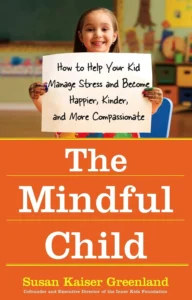
The Mindful Child: How to Help Your Kid Manage Stress and Become Happier, Kinder, and More Compassionate
5. The “Silence Game” (Ages 4+) – Auditory Awareness & Calmness
Perfect for: Noisy classrooms, before-bed wind-down, group practice, and developing patience.
Time: 3-10 minutes
Why it works: Kids learn to quiet their internal chatter and develop patience. Plus, it’s fun (competitive, even).
How to teach:
- Sit together. (Circle, carpet, classroom)
- “We’re playing the Silence Game. Let’s see who can be silent the longest and listen to all the sounds around us.”
- “Close your eyes if you want, or keep them open with a soft gaze downward.”
- “We’re going to listen carefully to EVERYTHING. Maybe you’ll hear birds, wind, a clock ticking, even your own heartbeat.”
- “Whoever can stay silent and listen for the longest wins.” (Set a timer: 5-10 min depending on age)
- After time is up: “What sounds did you hear? Let’s go around and share.”
Why kids love it: It’s a game, so there’s winning. But the real win is calm.
Tip for teachers: Use this after recess to help kids transition back to focus.
6. Loving-Kindness Meditation for Kids (Ages 6+) – Build Empathy & Self-Compassion
Perfect for: Kids who are hard on themselves, bullying situations (victim or perpetrator), social anxiety, and sibling conflict.
Time: 5-7 minutes
Why it works: Kids learn to direct kindness toward themselves AND others. This is neurologically opposite to anxiety and criticism.
How to teach:
- “Sit comfortably. We’re going to send good wishes to people we care about.”
- “First, think of yourself. Say: ‘May I be happy. May I be healthy. May I be safe. May I be peaceful.'” (Repeat slowly, 3x)
- “Now think of someone you love-a parent, friend, grandparent. Say: ‘May you be happy. May you be healthy. May you be safe. May you be peaceful.'” (Repeat slowly, 3x)
- “Think of someone neutral-a teacher, cashier, someone you don’t know well. ‘May you be happy…'” (Repeat)
- “Optional-think of someone difficult. ‘May you be happy even though we don’t always get along.'” (This is advanced-don’t force)
- “Finally, imagine sending kindness to ALL children everywhere. ‘May all kids be happy, healthy, safe, and peaceful.’
Why it’s powerful: Kids who practice loving-kindness show reduced anxiety, increased social connection, and better emotional regulation. It’s also a bridge to self-compassion; many kids are mean to themselves.
7. Mindful Eating (Ages 5+) – Sensory Awareness & Gratitude
Perfect for: Rushed eating, food anxiety, picky eaters, and gratitude practice.
Time: 10-20 minutes (one meal or snack)
Why it works: Kids disconnect eating from screens and reconnect with food as an experience. This improves digestion, reduces overeating, and builds gratitude.
How to teach:
- “Let’s eat slowly today. No phone, no TV.”
- “Look at your food. What colors do you see? What shapes?”
- “Smell it. What do you notice?”
- “Take one bite. Chew slowly-20 times if you can.”
- “What flavors taste? Sweet? Salty? Crunchy? Soft?”
- “Notice your body: Are you getting full? When do you feel ‘just right’ full?” (Most kids don’t know-they eat until stuffed)
Make it special:
- Light a candle.
- Eat in silence.
- Ask: “Where did this food come from?” (farm, tree, garden).
- Thank the food and everyone who grew/prepared it.
8. Breathing Counting (Ages 6+) – Focus & Emotional Anchor
Perfect for: Anxiety, difficulty sleeping, building a meditation habit, and counting practice (math skills).
Time: 3-10 minutes
Why it works: Counting gives the mind something to DO, which helps kids who struggle with “just breathing.” It’s also portable-no equipment needed.
How to teach:
- “Sit comfortably, eyes closed or soft gaze down.”
- “We’re going to count breaths. As you breathe IN, count ‘one.’ As you breathe OUT, count ‘two.’ Then ‘three’ in, ‘four’ out.”
- “Keep going up to 10. Then start over at 1.”
- “If you lose count, no problem! Just start back at 1. Your mind wandering is totally normal.”
- Practice for 3-10 minutes.
Advanced variation: 4-7-8 breathing (older kids, 10+)
- Inhale for 4 counts.
- Hold for 7 counts.
- Exhale for 8 counts.
- Repeat 4 times.
This is proven to activate the parasympathetic (calm) nervous system and help with sleep.
Mindfulness for Children Training Programme Certificate
Enhance your skills with our Mindfulness for Children Certificate, designed for educators and caregivers to foster well-being in youth.
How to Teach Mindfulness: Parent & Teacher Tips
Make It Age-Appropriate
| Age | Attention Span | Best Exercises | Setting |
|---|---|---|---|
| 4-6 | 2-3 min | Balloon breathing, the silence game, and mindful eating | Home, classroom |
| 7-9 | 5-7 min | Body scan, walking, 5-4-3-2-1, counting breaths | Home, school, park |
| 10-12 | 7-10 min | Loving-kindness, advanced breathing, silent sitting | Home, school, sports |
| 13+ | 10-15 min | All exercises, plus journaling & reflection | Home, school, therapy |
Start Small
Don’t introduce all 8 exercises at once. Pick ONE. Teach it well. Let kids practice it for 1-2 weeks before adding another.
Week 1-2: Balloon breathing (easiest, most relatable)
Week 3-4: Add 5-4-3-2-1 (when you need grounding during anxiety)
Week 5+: Add others gradually
Create a “Calm Corner”
Designate a special space:
- Comfortable cushion or mat
- Soft lighting (dim lamp, no harsh fluorescents)
- Optional: soft music, plants, calming images
- Poster with exercise instructions (visual reminder)
School version: Even a quiet corner of a classroom works.
Be a Role Model
Kids learn by watching. If you practice mindfulness yourself, they notice. “I’m going to take 3 calm breaths before I answer,” teaches more than any lecture.
Expect Wiggles & Giggles
This is NORMAL. Kids are learning to sit with discomfort. Don’t shame them. “Yes, it’s hard. That’s why we practice.”
“For age-specific guidance on building a mindfulness practice (not just exercises, but habit-building strategies), see our complete mindfulness guide, which includes a 21-day foundation protocol.”
Step into the world of personal growth with the Centre of Excellence!
Real Stories: How Mindfulness Changed Kids’ Lives
Case 1: Marcus, 8 Years Old (ADHD + Anxiety)
Before: Marcus was diagnosed with ADHD. He couldn’t sit in class, was always interrupting, and had anxiety spirals before tests. His parents resisted medication, wanting to try behavioral approaches first.
What happened: His teacher introduced balloon breathing during the morning meeting. Marcus loved it-he saw it as a “superpower” to calm his nervous system. He asked to do it every morning.
After 8 weeks, Marcus’s teacher reported fewer outbursts, longer periods of focus, and more self-awareness (“My body is getting wiggly-I need to breathe”). His parents noticed he could fall asleep 30 minutes earlier. His reading comprehension improved measurably.
“Mindfulness didn’t cure his ADHD, but it gave him a tool to manage it without medication-at least for now,” his mom says.
Case 2: Sofia, 11 Years Old (Social Anxiety)
Before: Sofia developed intense anxiety about school. She catastrophized social situations (“Everyone hates me”), avoided lunch with friends, and had panic attacks before presentations.
What happened: Her therapist taught her the 5-4-3-2-1 grounding technique. At first, Sofia was skeptical. But when anxiety hit during a presentation, she used it, and it worked. The panic lessened.
After 10 weeks, Sofia could attend lunch without spiraling. She volunteered to present in class (still nervous, but manageable). She practices loving-kindness meditation nightly to build self-compassion.
“I learned my thoughts aren’t facts,” Sofia says. “Just because I think everyone hates me doesn’t mean it’s true.”
Case 3: Liam, 6 Years Old (Sleep Problems + Aggression)
Before: Liam was hyperactive, aggressive with siblings, and couldn’t sleep-he’d be awake until 10 PM despite bedtime at 8. His parents were exhausted.
What happened: They started a bedtime routine with body scan meditation (10 minutes). His dad read a calm story afterward. Consistent, predictable.
After 4 weeks, Liam was asleep by 8:45 PM. His aggression decreased noticeably; more rest meant less dysregulation. His teacher reported fewer behavioral incidents.
“It wasn’t a miracle, but it was a game-changer,” his mom says. “The routine + the calm breathing = sleep.”
Mindfulness in Schools: What Educators Are Seeing
Schools implementing classroom mindfulness programs report:
- 23% improvement in attendance (fewer “sick days” from anxiety).
- 31% reduction in behavioral problems.
- 17% improvement in academic performance (average across schools).
- Less bullying and social conflict.
One principal reported: “Within one semester of starting mindfulness, our discipline referrals dropped by half. Kids have language for their emotions now instead of just acting out.”
Step into the world of personal growth with the Centre of Excellence!
Troubleshooting: When Kids Resist or Struggle
| Problem | Why It Happens | Solution |
|---|---|---|
| “I can’t quiet my mind” | All minds wander; they think meditation = empty mind | Reframe: “Good meditation is noticing your thoughts, not eliminating them.” |
| Won’t sit still | ADHD, developmental age, restlessness | Use walking meditation or counting breaths (more engaging). |
| “This is boring” | Not age-appropriate, not fun enough, no buy-in | Let them choose an exercise. Frame as a “superpower.” Gamify it. |
| Falls asleep during body scan | Not a problem; their body needed rest. | Use body scan before bed intentionally, not during day. |
| Gets distracted easily | Normal for young kids (7 & under) | Keep sessions 2-3 min max. Pair with movement (walking meditation). |
| Giggles uncontrollably | Release of nervous energy, shame | Don’t shame. “It’s okay. Let’s try again.” Kids need permission to feel awkward. |
❓FAQ: Parents & Teachers Ask
How often should kids practice mindfulness?
Daily is ideal (10-15 minutes), but even 3-5 minutes daily beats sporadic 30-minute sessions. Consistency matters more than length.
What if my child has ADHD or autism? Will mindfulness help?
Yes, especially for ADHD. Kids with autism may need sensory-friendly adaptations (no quiet rooms if they’re noise-sensitive; try walking meditation instead). Always consult their therapist.
Can mindfulness replace therapy or medication?
For mild anxiety and stress, yes, research shows it rivals therapy for some conditions. For severe ADHD, anxiety, or trauma, combine mindfulness with professional treatment. Never stop medication without a doctor’s approval.
Is mindfulness religious? My family has concerns.
No. Modern mindfulness taught in schools is secular and evidence-based. It’s not Buddhist meditation-that’s the origin, but the practice is psychological, not spiritual. (Though families can integrate it spiritually if they choose.)
How long until I see results?
Acute effects (calmer, better sleep) often appear in 1-2 weeks. Brain changes take 8 weeks of consistent practice. Personality shifts (more resilient, less reactive) take 12+ weeks.
Can mindfulness help with test anxiety?
Absolutely. Students who practice mindfulness score 8-12% higher on standardized tests (less anxiety, better focus). Teach grounding techniques 1-2 weeks before high-stakes tests.
My child is going through trauma. Is mindfulness safe?
Mindfulness can be triggering for trauma survivors (especially body scans; awareness of physical sensations can flood traumatic memories). Work with a trauma-informed therapist. Some adaptations: start with grounding (5-4-3-2-1), avoid lying down, and practice in a safe environment.
Conclusion: The Gift of Presence
Children today face unprecedented stress. Mindfulness exercises for kids offer something precious: the ability to pause, breathe, and find calm in chaos. These 8 exercises are evidence-backed, teacher-tested, and accessible.
You don’t need special equipment, a meditation app, or perfect quiet. You just need consistency and patience.
Start this week. Pick one exercise. Teach it to your child or classroom. Notice what shifts.
The most powerful gift you can give a child isn’t a toy or grade; it’s the ability to come home to themselves, to breathe through difficulty, and to know they’re okay.
Next Steps: Your Action Plan
Week 1: Choose one exercise (balloon breathing is easiest)
Daily: Practice 3-5 minutes together
Week 2: Celebrate consistency (“You’ve meditated for 7 days!”)
Week 3: Introduce a second exercise
Week 4+: Rotate exercises; find your child’s favorite
Monthly: Notice shifts in focus, mood, sleep, or behavior
“For a complete framework on mindfulness for the whole family – including exercises, benefits, and how to build sustainable habits – see our comprehensive mindfulness guide.“
Resources for Parents & Teachers
- App: Insight Timer Kids (200+ free meditations for children).
- Book: The Mindful Child by Susan Kaiser Greenland.
- Research: Search “mindfulness children” on PubMed for peer-reviewed studies.
- Course: Mindfulness for Children Training Programme Certificate (online certification for teachers).
Body, Mind, and Soul for a Fulfilled Life. 🌿
Mindfulness for Children Training Programme Certificate
Enhance your skills with our Mindfulness for Children Certificate, designed for educators and caregivers to foster well-being in youth.
The Mindful Child: How to Help Your Kid Manage Stress and Become Happier, Kinder, and More Compassionate
Learn, Help Family And Friends, And Help The Planet!