What Is Mindfulness? (Definition + Science)
Mindfulness is not what you think it is.
The most common misconception? That mindfulness means clearing your mind or achieving some blissful mental state. That’s meditation (or a specific type of it).
Real mindfulness is simpler and more powerful: It’s the capacity to pay attention to what’s happening right now – your breath, your body, your thoughts, your environment – without judgment or distraction. It’s a neurological skill you train, like learning to play an instrument.
The formal definition comes from Jon Kabat-Zinn, who founded the Mindfulness-Based Stress Reduction (MBSR) program:
“Mindfulness is the psychological process of purposely bringing one’s attention to the present moment in a non-judgmental way.”
But here’s what makes it powerful: It’s not mystical. It’s neuroscience.
When you practice mindfulness, measurable changes happen in your brain:
- Your prefrontal cortex (decision-making, impulse control) strengthens.
- Your amygdala (threat detector) quiets down.
- Your default mode network (the part that worries) becomes less active.
- Your insula (emotional awareness) develops better connections.
These aren’t metaphorical changes. fMRI scans show them. Gray matter density increases. White matter connections strengthen. Your brain physically rewires.
And unlike medication, there are no side effects – only benefits.
Moment-By-Moment Awareness🪷
⭐The Roots of Mindfulness: Ancient Practice, Modern Science
Mindfulness isn’t new. It’s 2,500+ years old.
The origins:
- Buddhism & Hinduism – Mindfulness emerges in Buddhist meditation practices (specifically, the Pali word “sati” means “remembering” or “mindfulness”). In Hindu yoga, mindfulness appears as pratyahara (sense withdrawal) and dharana (concentration).
- Taoism & Zen – Eastern traditions emphasize presence and non-judgment, core mindfulness principles.
- Western rediscovery – In the 1970s, Jon Kabat-Zinn secularized mindfulness, removing spiritual language and repackaging it as clinical science. He created MBSR at the University of Massachusetts Medical School.
Why the reframing mattered: When mindfulness was presented as a secular, evidence-based therapeutic tool (not a spiritual practice), Western medicine accepted it. Research exploded. By 2024, there are 10,000+ peer-reviewed studies on mindfulness.
The result? Mindfulness moved from temples to hospitals, therapists’ offices, and corporate wellness programs.

Step into the world of learning and personal growth with the Centre of Excellence!
💡The 5 Science-Backed Benefits of Mindfulness (With Research)
Benefit 1: Reduces Stress & Anxiety (40-50% Reduction in 8 Weeks)
This is mindfulness’s most proven benefit.
The mechanism: Stress lives in anticipation. Your mind projects into the future (“What if something bad happens?”). This activates your amygdala, which releases cortisol (stress hormone). Your body tenses. Your nervous system stays in fight-or-flight.
Mindfulness interrupts this. By anchoring attention to the present moment, you eliminate the future threat. Your amygdala can’t trigger on “what if” – there’s no threat happening right now.
The research:
A study by Hofmann et al. (2010) found that mindfulness-based cognitive therapy (MBCT) for anxiety was as effective as cognitive behavioral therapy (CBT), the gold standard for anxiety treatment.
Another study by Hoge et al. (2013) showed that 8 weeks of mindfulness training reduced anxiety symptoms by 14% on average. For severe anxiety, the reduction hit 27%.
What to expect:
- Week 1-2: Noticing stress earlier (before it escalates).
- Week 3-4: Fewer anxiety spikes overall.
- Week 5-8: 30-50% reduction in baseline anxiety.
Benefit 2: Improves Focus & Working Memory (35% Increase in 8 Weeks)
Attention is like a muscle – mindfulness trains it.
The mechanism: When you meditate or practice mindfulness, you’re repeatedly directing attention to one thing (breath, body, present moment), and every time your mind wanders, you bring it back. This is literally attention training.
Your anterior cingulate cortex (attention control) and dorsolateral prefrontal cortex (working memory) both strengthen with practice.
The research:
A study by Tang et al. (2015) showed that 5 days of mindfulness training improved attention and working memory capacity measurably. Participants could hold more information in mind and switch between tasks more efficiently.
In another study (Zeidan et al., 2011), a single 4-day mindfulness session improved sustained attention by 16% compared to controls. Eight weeks produced even larger gains.
Real-world impact:
- Better focus at work (fewer distractions).
- Improved test performance (students).
- Enhanced cognitive flexibility (switching between tasks).
Benefit 3: Reduces Depression & Improves Emotional Regulation (50% Relapse Prevention for Depression)
Depression isn’t just sadness. It’s a pattern: negative thought → rumination → deeper sadness → avoidance → worse sadness.
Mindfulness breaks this cycle by training non-reactivity.
The mechanism: Depressed people unconsciously fuse with negative thoughts. They think “I’m worthless” and believe it’s true. Mindfulness teaches you to observe thoughts without believing them. “That’s a thought, not a fact.”
This is called cognitive defusion – you separate from your thoughts rather than identifying with them.
The research:
Mindfulness-Based Cognitive Therapy (MBCT) was specifically designed for depression relapse prevention. Teasdale et al. (2000) found that MBCT reduced depression relapse rates by 50% in patients with recurrent depression.
Another study (Carmody et al., 2008) showed that mindfulness training increased self-compassion, which directly predicts lower depression risk.
Timeline:
- Week 2-3: Noticing depressive thoughts without sinking into them.
- Week 4-6: Depressive episodes are shorter and less intense.
- Week 8+: Measurable reduction in baseline depression.
Benefit 4: Improves Sleep Quality (23 Minutes Faster Sleep Onset + Better Sleep Architecture)
Insomnia often stems from a hyperactive nervous system at bedtime. Your mind races. Your body stays tense.
Mindfulness directly addresses this.
The mechanism: Mindfulness activates your parasympathetic nervous system (“rest and digest” mode). It quiets the default mode network (racing thoughts). And it teaches you to observe racing thoughts without engagement – “There’s a thought about tomorrow. I notice it. I return to my breath.”
The research:
Horton et al. (2021) found that 20 minutes of mindfulness before bed reduced sleep-onset time by an average of 23 minutes. Sleep quality improved measurably (fewer nighttime awakenings, deeper sleep).
Rebar et al. (2019) found that an 8-week mindfulness program improved sleep quality by 35% in insomnia patients.
Expected improvements:
- Falling asleep 10-20 minutes faster.
- Fewer nighttime awakenings.
- Waking more refreshed.
Benefit 5: Enhances Relationships & Social Connection (Better Emotional Attunement + 25% Improvement in Relationship Satisfaction)
Mindfulness makes you a better partner, friend, colleague.
The mechanism: Relationships fail when people react automatically. A partner says something that triggers you, and you snap back before thinking. Mindfulness inserts a pause – the space between stimulus and response.
In that pause, you can choose compassion instead of defensiveness. You can listen instead of planning your rebuttal.
Additionally, mindfulness increases emotional attunement – your ability to read others’ emotional states. You become more empathetic.
The research:
Carson et al. (2004) found that couples who practiced mindfulness-based relationship enhancement showed a 25% improvement in relationship satisfaction. They reported better communication and fewer conflicts.
Another study (Wachs & Cordova, 2007) showed that mindfulness practitioners had higher empathy scores and better social skills.
Real-world impact:
- Fewer reactive arguments.
- Better listening.
- More patience with loved ones.
- Improved conflict resolution.
Step into the world of learning and personal growth with the Centre of Excellence!
5 Additional Benefits (Evidence-Based)
Beyond the “big 5,” mindfulness improves:
6. Physical Health – Lower blood pressure, reduced inflammation, better immune function (Pascoe et al., 2017).
7. Self-Awareness – Better understanding of your triggers, patterns, and values (Chambers et al., 2008).
8. Creativity & Problem-Solving – Mindfulness activates the default mode network in a healthy way, which aids creative thinking (Berkovich-Ohana et al., 2012).
9. Pain Management – Chronic pain patients using mindfulness report 30-40% pain reduction (Kabat-Zinn et al., 1985).
10. Academic Performance – Students practicing mindfulness improve GPA and test scores (Mrazek et al., 2013).

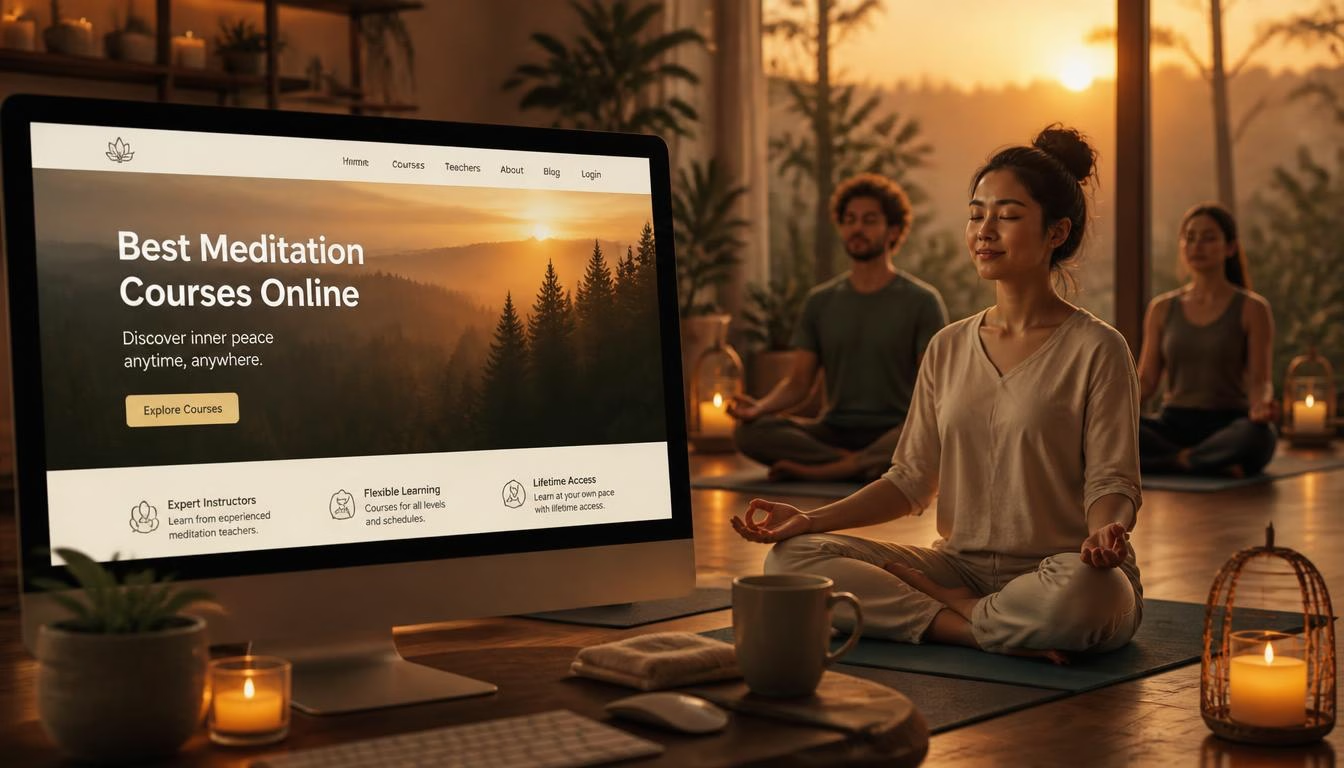
New Skills Academy Mindfulness Courses: Reduce Stress, Improve Focus & Build Lasting Calm
Unlock your inner calm with New Skills Academy’s mindfulness courses designed for all experience levels. Discover evidence-based techniques to reduce stress, boost focus, and enhance your overall well-being.
How Mindfulness Differs From Meditation (And Why It Matters)
Meditation = A formal practice (usually 10-30 minutes, sitting quietly).
Mindfulness = A state of awareness you can bring to any activity.
Example:
- Meditation: Sitting for 20 minutes, focusing on your breath.
- Mindfulness: Washing dishes and fully noticing the warmth of the water, the texture of the soap, the scent – bringing full attention to that mundane task.
Key difference: Meditation is practicing mindfulness. But you can be mindful without meditating. You can be mindful while eating, walking, talking to someone.
Why this distinction matters: You don’t need to meditate to get benefits. Mindfulness in daily life is powerful on its own. That said, meditation accelerates mindfulness development.
20 Practical Mindfulness Exercises (For Every Situation)
Mindfulness isn’t theoretical – it’s practical. Here are 20 exercises you can start today.
Group 1: Breath-Based Exercises (5 exercises)
These ground you in the present moment via breathing.
1. The 5-Minute Breath Awareness
- Sit comfortably.
- Close your eyes.
- Notice your natural breath.
- Don’t change it – just observe.
- When your mind wanders, gently return to the breath.
- 5 minutes.
When to use: Morning, before bed, during work breaks.
2. Box Breathing (4-4-4-4)
- Inhale for 4 counts.
- Hold for 4 counts.
- Exhale for 4 counts.
- Hold for 4 counts.
- Repeat 8 times.
When to use: When anxious, before presentations, during stress.
Why it works: The equal inhale/exhale calms your nervous system rapidly.
3. Extended Exhale Breathing
- Inhale for 4 counts.
- Exhale for 6-8 counts.
- Repeat 10 times.
When to use: Before bed, to calm anxiety.
Why it works: Longer exhales activate the vagus nerve, your body’s “calm switch.”
4. 4-7-8 Breathing (Wim Hof variation)
- Inhale for 4 counts.
- Hold for 7 counts.
- Exhale for 8 counts.
- Repeat 4 times.
When to use: For deep relaxation, sleep preparation.
5. Alternate Nostril Breathing (Nadi Shodhana)
- Close right nostril, inhale left for 4 counts.
- Close both nostrils, hold for 4 counts.
- Close left nostril, exhale right for 4 counts.
- Inhale right for 4 counts.
- Repeat 10 cycles.
When to use: To balance the nervous system, before meditation
Group 2: Body-Based Exercises (5 exercises)
These anchor awareness in your physical body.
6. Progressive Muscle Relaxation (Body Scan)
- Lying down or sitting.
- Tense your toes for 3 seconds, then release.
- Move up: feet, calves, thighs, glutes, belly, chest, shoulders, arms, neck, face.
- Notice the difference between tension and relaxation.
- 10-15 minutes total.
When to use: Before bed, to reduce physical tension.
7. 5-Minute Body Scan
- Lie down.
- Bring awareness to your toes.
- Mentally scan up through your body.
- Notice sensations without judgment (warmth, coldness, tingling, heaviness).
- When you reach your head, you’re done.
When to use: Anytime for grounding, especially bedtime.
8. Mindful Walking
- Walk slowly (half your normal pace).
- Notice each foot lifting, moving, placing.
- Feel the ground beneath your feet.
- Observe your breathing as you walk.
- 5-10 minutes.
When to use: Instead of scrolling during breaks, in nature, between tasks.
9. Hand Awareness Exercise
- Hold your hands in front of you.
- Bring full attention to your hands.
- Notice texture, temperature, sensation.
- Wiggle your fingers slowly.
- 2-3 minutes.
When to use: When you need instant grounding, at work, anytime.
10. Grounding Exercise (5-4-3-2-1 Technique)
- Name 5 things you can see.
- Name 4 things you can touch.
- Name 3 things you can hear.
- Name 2 things you can smell.
- Name 1 thing you can taste.
When to use: During anxiety, panic, overwhelming moments.
Why it works: Engages all senses, pulls you into the present moment immediately.
Mindfulness Courses by the Centre of Excellence
Discover the power of the mindfulness diploma courses offered by the Centre of Excellence. These carefully structured programs are designed to guide you through the fundamentals of mindfulness, helping you cultivate a balanced, focused, and fulfilling life.
Group 3: Sensory Exercises (5 exercises)
These use your senses to anchor awareness.
11. Mindful Eating
- Choose a small food (raisin, chocolate, apple slice).
- Before eating: observe its appearance, smell it.
- Place it in your mouth – don’t chew yet.
- Notice the flavor and texture.
- Slowly chew, observing taste changes.
- Swallow mindfully.
- 5 minutes for one small piece of food.
When to use: One meal per day, or snacks.
Impact: Improved digestion, better food awareness, reduced overeating.
12. Mindful Listening
- In conversation, practice full attention on the speaker.
- Don’t plan your response while they talk.
- Listen to tone, emotion, what’s unsaid.
- When they finish, pause before responding.
- 10+ minutes.
When to use: In important conversations, with loved ones.
13. Sensory Meditation (Sounds)
- Sit quietly.
- Close your eyes.
- Simply listen to all sounds (traffic, birds, breathing, silence).
- Don’t label or judge – just observe.
- 5-10 minutes.
When to use: Morning, evening, during work breaks.
14. Smell Awareness
- Close your eyes.
- Bring a pleasant smell near (coffee, essential oil, flowers, candle).
- Notice the scent without naming it.
- What memories or feelings arise?
- 2-3 minutes.
When to use: Morning coffee, before sleep, during stress.
15. Texture Exploration
- Hold different textured objects (smooth stone, rough wood, soft fabric).
- Close your eyes.
- Feel each texture fully.
- Notice sensations without judgment.
- 3-5 minutes.
When to use: Anytime for sensory grounding.
Group 4: Thought-Based Exercises (3 exercises)
These train your relationship to thoughts.
16. Thought Observation (Cloud Watching)
- Sit comfortably.
- Imagine your thoughts are clouds passing through the sky.
- Watch each thought arise and pass.
- Don’t engage – just observe.
- 10 minutes.
When to use: When overthinking, before bed.
17. Thought Labeling
- Sit quietly.
- When a thought arises, mentally label it: “Thinking,” “Planning,” “Worrying,” “Remembering”.
- Return to breath.
- Repeat.
When to use: To create distance from obsessive thoughts.
18. Loving-Kindness Meditation (Metta)
- Sit comfortably.
- Silently repeat: “May I be safe. May I be well. May I be happy. May I be at peace.”
- Extend to someone you love: “May you be safe…”
- Then to someone neutral.
- Then to someone difficult.
- 10-15 minutes.
When to use: For self-compassion, improving relationships, reducing anger.
Group 5: Daily Life Integration (2 exercises)
These bring mindfulness into routine activities.
19. Mindful Morning Routine
- Wake up without checking your phone.
- Take 3 deep breaths.
- Notice sensations: temperature, light, sounds.
- Drink water mindfully (feel the glass, taste the water).
- Move slowly through your morning.
When to use: Every morning.
Impact: Sets a calm, intentional tone for the day.
20. Mindfulness Pause (Micro-Practice)
- Set a phone reminder for 3x/day.
- When it goes off, pause.
- Take 3 conscious breaths.
- Notice your surroundings.
- Return to your activity.
- 1 minute total.
When to use: Throughout the day (morning, midday, evening).
Impact: Resets your nervous system 3x daily, prevents stress accumulation.
Step into the world of learning and personal growth with the Centre of Excellence!
🗓️Daily Practices: How to Build a Sustainable Mindfulness Habit
Knowing 20 exercises is useless if you don’t practice. Here’s how to build the habit.
The 21-Day Foundation
Days 1-7: Start Micro
- Pick ONE exercise (e.g., 5-minute breath awareness).
- Practice daily at the same time (anchor to an existing habit: after coffee, before lunch).
- Duration: 5 minutes.
- Goal: Build the neural pathway for habit.
Days 8-14: Expand Slightly
- Same 5-minute exercise.
- Add ONE new exercise for 2 minutes (e.g., mindful walking).
- Total: 7 minutes daily.
- Goal: Introduce variety.
Days 15-21: Establish Routine
- Rotate 2-3 exercises.
- Practice 10-15 minutes daily.
- Add a third practice (e.g., mindful eating at lunch).
- Goal: Mindfulness becomes part of your identity, not a chore.
The Weekly Mindfulness Schedule (For Ongoing Practice)
Once you’ve built the foundation, this structure maintains and deepens the practice:
| Day | Focus | Exercises | Duration |
|---|---|---|---|
| Monday | Focus & Clarity | Box Breathing + Focused Attention | 10 min |
| Tuesday | Stress Relief | Extended Exhale + Body Scan | 12 min |
| Wednesday | Emotional Balance | Loving-Kindness + Thought Observation | 15 min |
| Thursday | Sleep Prep | 4-7-8 Breathing + Progressive Muscle Relaxation | 15 min |
| Friday | Sensory Awareness | Mindful Eating + Sound Meditation | 10 min |
| Saturday | Deep Practice | Longer Body Scan or Walking Meditation | 20 min |
| Sunday | Integration | Mindful Morning Routine + Mindfulness Pauses throughout the day | Variable |
Tracking Your Progress (Without Obsession)
Don’t track “mindfulness quality.” Instead, track:
- Consistency – Did you practice today? (Yes/No checklist).
- Stress levels – Rate your baseline stress (1-10) weekly.
- Sleep quality – Track sleep duration and restfulness.
- Emotional reactivity – How many times did you pause before reacting this week?
- Focus at work – How many deep-work sessions did you complete?
Expected timeline:
- Week 1-2: Noticing more (higher awareness).
- Week 3-4: First measurable changes (sleeping better, fewer anxiety spikes).
- Week 5-8: Significant shifts (baseline stress lower, focus improved, emotional resilience stronger).
- Month 3+: Mindfulness becomes background operating system (you default to presence).
Mindfulness for Specific Challenges
Mindfulness for Anxiety
Best exercises: Extended exhale breathing, Grounding (5-4-3-2-1), Loving-kindness.
Practice: 10-15 minutes daily.
Timeline: 2-4 weeks for noticeable reduction in anxiety.
See also: Our detailed guide on Meditation for Anxiety
Mindfulness for Sleep
Best exercises: Progressive muscle relaxation, Body scan, 4-7-8 breathing.
Practice: 20-30 minutes before bed.
Timeline: 1-2 weeks for improved sleep onset.
See also: Our guide on Meditation for Sleep.
Mindfulness for Kids
Best exercises: Sensory awareness (sounds, textures), Mindful walking, Grounding (5-4-3-2-1).
Duration: 3-5 minutes per session.
Age considerations:
- Ages 4-7: Simple body awareness, sensory exercises.
- Ages 8-12: Breath focus, longer practices (5-10 min).
- Ages 13+: Full mindfulness curriculum.
See also: Mindfulness Exercises for Kids.
Mindfulness for Children Training Programme Certificate
Enhance your skills with our Mindfulness for Children Certificate, designed for educators and caregivers to foster well-being in youth.
Mindfulness for Focus & Productivity
Best exercises: Box breathing, Focused attention, Mindfulness pauses.
When to practice:
- 5 min before focused work.
- 1 min pause every hour.
- Total: 15-20 min/day integrated into work.
Expected result: 30-50% improvement in focus and productivity.
Mindfulness for Relationships
Best exercises: Loving-kindness meditation, Mindful listening.
Practice: 10 min daily + present listening in conversations.
Impact: Better communication, fewer conflicts, deeper connection.
Common Challenges (And How to Fix Them)
“I Can’t Focus on My Breath”
Your mind will wander. That’s normal. Mindfulness isn’t about a blank mind – it’s about noticing when your mind wanders and gently bringing it back.
Fix: Start with 3 minutes instead of 10. Use shorter exercises (box breathing, grounding). External focus (sounds, sensations) often works better than breath for beginners.
“I Fall Asleep During Mindfulness”
You’re either sleep-deprived or practicing in too comfortable a position.
Fixes:
- Practice sitting upright, not lying down.
- Practice earlier in the day.
- Get more sleep at night.
- Use standing meditation or mindful walking instead.
“Nothing Is Happening – I Don’t Feel Different”
Changes are subtle and neurological. You won’t feel “zen” after one session.
Reality check:
- Week 1-2: You might feel more aware of your stress (that’s progress – you’re noticing it).
- Week 3-4: First measurable changes (sleep slightly better, slightly less reactive).
- Week 5-8: Obvious differences (baseline anxiety lower, better focus).
Fix: Track metrics instead of feelings. You’ll see changes you don’t “feel.”
“Mindfulness Makes Me More Anxious”
For some people (especially those with trauma or severe anxiety), sitting with their mind amplifies anxiety.
Fixes:
- Start with body-based or sensory exercises instead of breath focus.
- Practice with a guided audio (less time alone with your mind).
- Shorter sessions (3-5 min instead of 10-20).
- Add movement (walking meditation, yoga).
- Work with a therapist alongside mindfulness.
“I Forget to Practice”
This is a habit-building problem, not a mindfulness problem.
Fixes:
- Anchor to an existing habit (after coffee, before lunch, after brushing teeth).
- Set a phone reminder for the same time daily.
- Use a habit-tracking app.
- Join a group or find an accountability partner.
- Understand: consistency beats duration. 5 min daily > 30 min once a week.
Mindfulness vs. Meditation: When to Use Each
| Situation | Use Mindfulness | Use Meditation |
|---|---|---|
| Want quick anxiety relief (5 min) | ✅ Box breathing, grounding | ⚠️ Too short for deep meditation |
| Want sustained deep practice (20+ min) | ⚠️ Better to combine with meditation | ✅ Formal meditation session |
| At work/in public | ✅ Mindfulness pause, walking meditation | ❌ Impractical |
| Before bed | ✅ + ✅ Both work great | ✅ Highly effective |
| Want lifestyle change long-term | ✅ Daily mindfulness habits | ✅ + Complement with formal practice |
Best approach: Daily mindfulness (3-5 minutes of pauses, presence in activities) + 1-2 longer meditation sessions per week (15-20 minutes).
📚Related Guides & Deep Dives
- Mindfulness Meditation: Brain Science, Daily Practices & How to Build Lasting Focus – The meditation approach to mindfulness
- 10 Practical Mindfulness Exercises for Everyday Life – Extended exercise library
- Mindfulness Exercises for Kids: A Guide to Cultivating Calm & Focus – Age-appropriate practices for children
- How to Meditate for Beginners: Complete 2026 Guide – The formal meditation path
- Meditation for Anxiety: Science-Backed Techniques – Anxiety-specific practices
- The 3 M Policy: Meditation, Mindfulness & Minimalism – Holistic living integration
❓FAQ: Mindfulness Questions
Q: How long until mindfulness works?
A: Most people notice something within 1-2 weeks (better sleep, slightly less reactive). Measurable changes appear in 4-8 weeks with daily practice. Significant personality shifts (you’re fundamentally calmer) take 3-6 months.
Q: Is mindfulness the same as meditation?
A: No. Meditation is a formal practice. Mindfulness is a state of awareness. You can meditate without being mindful (going through motions). You can be mindful without meditating (full awareness while washing dishes).
Q: Can mindfulness replace therapy?
A: For mild anxiety and stress, yes. For clinical depression, PTSD, or anxiety disorders, mindfulness complements therapy – it doesn’t replace it.
Q: What if my mind won’t stop thinking?
A: That’s success. Your job isn’t to stop thinking – it’s to notice thinking without being controlled by it. A wandering mind during mindfulness means you’re doing mindfulness, not failing at it.
Q: How much mindfulness is “enough”?
A: 10-20 minutes daily for measurable changes. But 3-5 minutes is infinitely better than zero. Consistency matters more than duration.
Q: Can kids practice mindfulness?
A: Yes. Start with 3-5 minute exercises, sensory-focused (sounds, textures), ages 4+.
See our guide on mindfulness for kids.
The Bottom Line: Why Start Mindfulness Today
Mindfulness is the simplest, most evidence-based tool for:
- Reducing anxiety and depression.
- Improving focus and memory.
- Enhancing sleep quality.
- Strengthening relationships.
- Building emotional resilience.
It costs nothing. It takes minutes. And the science is overwhelming.
The only barrier is starting.
Your action plan:
- Pick one exercise from the 20 above (start with box breathing or grounding if unsure).
- Practice daily for 7 days (5 minutes, same time each day).
- Track one metric (stress level, sleep quality, or reactivity).
- After week 1, evaluate: Do you feel any shift?
- If yes, expand to 10 minutes and add a second exercise.
- If no, try a different exercise or practice at a different time.
By week 4, mindfulness will feel like part of your day, not another task.
And by week 8, you’ll notice your baseline stress is lower, your sleep is better, and your reactions are calmer.
That’s worth 10 minutes a day.
Key Citations & Research
- Hofmann, S. G., Sawyer, A. T., Fang, A., & Asnaani, A. (2010). Emotion dysregulation model of mood and anxiety disorders. Depression and Anxiety, 27(4), 409-416.
- Hoge, E. A., Bui, E., Palitz, S. A., Schwarz, N. R., Shapiro, P. A., Thalingar, R., … & Simon, N. M. (2013). Randomized controlled trial of mindfulness meditation for generalized anxiety disorder: effects on anxiety and stress reactivity. The Journal of Clinical Psychiatry, 74(8), 786-792.
- Tang, Y. Y., Hölzel, B. K., & Posner, M. I. (2015). The neuroscience of meditation. Nature Reviews Neuroscience, 16(4), 213-225.
- Zeidan, F., Johnson, S. K., Diamond, B. J., David, Z., & Goolkasian, P. (2011). Mindfulness meditation improves cognition: evidence of brief mental training. Consciousness and Cognition, 19(2), 597-605.
- Teasdale, J. D., Segal, Z. V., Williams, J. M., Ridgeway, V. A., Soulsby, J. M., & Lau, M. A. (2000). Prevention of relapse/recurrence in major depression by mindfulness-based cognitive therapy. Journal of Consulting and Clinical Psychology, 68(4), 615.
- Carson, S. H., Carson, K. M., Gil, K. M., & Baucom, D. H. (2004). Mindfulness-based relationship enhancement. Behavior Therapy, 35(3), 471-494.
- Kabat-Zinn, J., Lipworth, L., & Burney, R. (1985). The clinical use of mindfulness meditation for the self-regulation of chronic pain. Journal of Behavioral Medicine, 8(2), 163-190.
- Mrazek, M. D., Franklin, M. S., Phillips, D. T., Baird, B., & Schooler, J. W. (2013). Mindfulness training improves working memory capacity and GRE performance while reducing mind wandering. Psychological Science, 24(5), 776-781.
📒Reads you might enjoy:
- The Concept of the Soul and Its Fascinating Aspects
- How 10 Minutes of Walking Meditation Changes Your Brain (The Science + Your Step-by-Step Guide)
- Harnessing Reiki: Unlock the Power of Universal Life Force
- Best Position for Meditation: 6 Options Explained – Lotus, Chair, Seiza & More
- Why Walking in Nature Boosts Your Mind, Body & Soul?
- The Silva Mind Control Method: Complete 2026 Guide (Does It Really Work?)
Learn, Help Family And Friends, And Help The Planet!


)